Friday, October 1, 2010

The American

If Anton Corbijn's The American has any clear directive, it is to mess with its audience. Ostensibly a thriller about a hitman/weapon maker, The American sets up every trope connected to these kinds of stories: the one last job, the killer hiding out after being compromised, a sinner's quest for peace and the battle for his soul. Then, Corbijn lets all of these stories drift away. Instead, the director returns to the existentialist territory of Melville's great Le Samourai, creating a star vehicle that dares Americans to line up for a film they will inevitably despise.

After a tranquil opening that places the protagonist, Jack (George Clooney) in an idyllic Swedish forest with a female companion, the film immediately throws a curveball when mysterious men start shooting. That Jack should encounter someone trying to kill him is of course totally unsurprising, but the measures he takes to conceal his identity are shocking and demonstrate that the James Bond type can be dangerous for lovers not simply because other people might shoot at them.

Having been discovered, Jack retreats to Italy and meets his boss, Pavel, who tells the killer to hide out in a nearby town until further notice. On the way, Jack suspects he might be driving into a trap and heads to another town in the vicinity. There we spend the next hour and a half, roaming the cobblestone streets and surrounding country roads of the gorgeous Castel del Monte. Jack poses as a photographer, a believable cover in such a pastoral village.

Practically nothing happens in The American, which is precisely the point but naturally does not console those going in hoping for some exciting ride with one of America's best A-listers. Jack befriends an old priest who speaks to our protagonist as if he knows what Jack really does for a living. Yet he never puts up a major fight for Jack's soul, and he even reveals parts of his own past that make him sound like an empathetic friend rather than a well-meaning but imperious holy man. When he tells Jack, "You must believe in a hell, because you live in it," he sounds not like a priest urging confession to ensure Jack a place in heaven but someone offering him a shoulder to cry on to make his life on this plane of existence more bearable.

Jack also spends time with a prostitute, Clara (Violante Placido), and even she manages to fall for him in a way that adheres to the endless hooker with a heart of gold stories while digging into the cliché. Clara doesn't beg Jack to take her away, and Jack only once asks her not to go to work. By skirting any open, stilted conversations about love, the two craft one of the only convincing hooker-john relationships I've seen, one that works because it's treated more or less like a normal relationship and not some sort of validation for the prostitute (or the man who initially does nothing more than pay her for sex).

Corbijn keeps everything elliptical. Jack's assignment in hiding is to make a custom rifle for another assassin, and his most technical work involves making a suppressor to dissipate the sound of gunfire, making it impossible for anyone to tell where the shooter is located. Similarly, Rowan Joffe's script and Corbijn's direction scatter the elements of the hitman thriller so you can't trace the clichés back to their sources. The American embodies the genre even as it deconstructs everything it can with a fluid grace.

The American constantly rubs against a typical plot, only to cut back to the moments in-between the action. With its constant shots of winding mountain roads and contemplative car rides, you could almost call the film "Abbas Kiarostami's The Killer." Here is a thriller where the most exciting moments are teases, where the much-delayed payoffs are intentionally stark and cold. After testing his rifle with the assassin (Thekla Reuten), Jack can pause everything to watch an endangered butterfly fly around an untouched park. Even the other killer stops to watch, and the shared moment of regret between them, not sexual tension but an understanding of the game they cannot escape, is surprisingly moving. The protagonist knows that he's being sent into hiding just so his boss knows where to find him, and when the Swedes who sent people after him track Jack down, it's unclear whether they work for some rival or simply Pavel.

People know Corbijn from his Ian Curtis biopic Control, but even that subdued film cannot compare to the beauty of his style here, an atmosphere far removed from the music videos upon which he made his initial reputation. His background as a photographer serves him better here than it did with Control, which the director made partially because he photographed Joy Division in their brief history. Consider the opening credits, the best I've seen all year (even above the frenetic animation of Enter the Void). Jack drives through a tunnel so long that it requires lighting even during the day. The dark yellow of the lights casts Clooney in contemplative silhouette, the end of his other professional-in-hiding movie, Michael Clayton, shot from a different angle. When the camera shifts to the back seat looking forward, the world outside the car is blurred in shallow focus. Jack cannot see the road ahead. At last, he sees the literal light at the end of the tunnel, but it does not seem to draw any closer, remaining seemingly the same distance away even as the dot of light grows. Finally, Jack reaches the end and the screen fades to pure white. Is the symbolism obvious? Sure, but Corbijn does not place serious weight on the moment, letting it scatter as he does everything else, preserving the beauty lest it be endlessly dissected.

The general public reacted to The American as if George Clooney had personally come to each theater and splashed acid in everyone's face. In fact, had he done so, they might have at least been excited that something happened. I, however, was mesmerized. Deconstruction these days is de rigeur, something that every hip writer does to show that he's above something as vulgar as a genre film. Corbijn, however, truly examines: he breaks apart each cliché, studies it, and gently puts it back together in a way that looks different but works the same. In the process, he makes a work of art where so many strive to be "Liked" on Facebook. Clooney has been trying for the last decade to make a serious artist out of himself, and if he hadn't succeeded before (I would argue that he has), his willingness to alienate 95 percent of his American audience surely proves he's gotten his wish. That's the quiet hilarity of the film: the Italian characters routinely mention his nationality, as does the title, yet it could never play in the country its protagonist represents.

Wednesday, September 29, 2010

Enter the Void

Gaspar Noé, the most formally challenging director working today, made his name previously less for the way in which he constructed his films than what those films ultimately depicted. His infamous Irréversible featured graphic rape and violence presented in such a way that audiences either called him a daring moralist or pond scum that made pornographers look presentable. With Enter the Void, he not only makes his previous cinematic experimentation look tame but ensures the focus remains on the film itself.

There are a few ideas in the film. Its characters, all located in Tokyo, are lonely and disconnected, engaging in drug use and promiscuous sex to feel something. The protagonist, an American named Oscar (Nathaniel Brown), lives in Tokyo and deals psychedelics to raise the money to reunite with his lost sister Linda (Paz de la Huerta), whom he has not seen since they were split apart in foster care 20 years ago.

As flashbacks show throughout the film, Freudian tension abounds between the two and even existed between the child Oscar and his mother, who died in a car accident along with the kid's dad. The lustful thoughts Oscar feels for his sister are never kept at bay for long, and there are even moments shown where she teases him sexually.

But these themes seem to exist simply to give the narrative an excuse for existing. What drives the film is pure invention. For the first half-hour, Noé shoots in the most convincing first-person perspective I've ever seen. The camera even "blinks" regularly, speeding up when Oscar is nervous. After his sister leaves to go to her stripping job, Oscar and his friend Alex head out to sell drugs to a kid named Victor. When Oscar arrives, police jump out of nowhere to bust him. Oscar runs into the bathroom and flushes his stuff, but before he can leave, police shoot him through the door and he dies.

Well, not the most supportive anti-drug ad in the world, but that's that then, is it? Not quite. As the breath leaves Oscar's body, so too does his soul, and the camera begins to spiral upward until it can look down on its former vessel. Looking downward is where the camera remains for the rest of the time spent in the present. As it scans over the various club rooms and apartments to track the characters we've already met, colors become more distinct. They buzz even, like neon freed from tubes to swarm around buildings.

In death, everything weighing on Oscar's mind is freed to run riot. Often, he hovers over his sister engaging in sex, and the camera even enters the point of view of the men who screw her, thrusting over Oscar's sister in belated fulfillment. Flashbacks reveal why young Victor set his dealer up, and a constant blur between present and flashback compounds Oscar's sexual compunctions to the nth degree.

This is a masterpiece of editing, art design (under the supervision of director/cartoonist Marc Caro), cinematography and direction. The multitude of crane shots, disguised cuts and digital touch-ups are too numerous to count, and once you slip into the rhythm of the film, you stop wondering when the "substance" will kick in. Quite obviously, the film's animation owes to the Star Gate sequence of 2001: A Space Odyssey, Noé's favorite film, and if Kubrick's magnum opus was the ultimate trip, then Noé's film is a sign of how much drugs have advanced. Now, you don't even have to leave the solar system.

Noé credits the abundant use of overhead tracking shots in Brian De Palma's Snake Eyes as a profound influence on the film, and De Palma's pet theme of perception weighs heavily on Noé's tripped-out vision. In death, Oscar goes back over his life, and pieces of the puzzle fall together even if we never get a good reason to care. The switching between the siblings from their present and younger ages, the splicing Oscar's mom into flashbacks of him seducing older women, and all the other tricks take the facile Freudian evaluation and present it in a novel way. Even the fully animated segments carry a sexual weight, with seemingly random fragments and tendrils coalescing into imagery such as sperm and egg.

Some might consider it a meditation on death by way of the Tibetan Book of the Dead (referenced at several times in the film), but Enter the Void does not ultimately try to be anything other than an acid dream. In the process, it gives us a contentious director's boldest statement yet and spares us the more graphic side of his creative effrontery. Arguments over the film's length are valid, and even I checked my watch more than once, but I wouldn't hesitate to see it again. I might bring some aspirin with me, though.

Tuesday, September 28, 2010

Wall Street: Money Never Sleeps

The most common and enduring misconception about Oliver Stone is that his is a political filmmaker. This is true only insofar as he has made political films. But even when he chooses to focus on a political topic, he rarely rips stories from the headlines: his first two presidential movies were hardly topical, his World Trade Center movie made half a decade after the fact and, if anything, he jumped the gun on his Bush movie.

Instead, Stone is an emotional filmmaker, and if what's nagging at his soul should occasionally match up to the times -- as it did with Natural Born Killers and the first Wall Street -- then all the better. What motivated JFK was a lingering feeling of confusion and anguish, the attempt by a child to find the truth of his dad's murder. World Trade Center tried, unsuccessfully, to recapture that feeling of unity created by the tragedy of 9/11. Nixon was an inevitably Shakespearean look at our vilest president, but it also understood the creepy aura of Nixon enough to make you reach for your back pocket to make sure the oily snake hadn't swiped it. Finally, with W., Stone seemed to say that all you could do with the previous administration was laugh.

What is most surprising about Wall Street 2, saddled with the unfortunate subtitle "Money Never Sleeps," is how well it refrains from anger. With Stone relying more on his notoriety off the set in the past decade than his skill behind a camera, supporters and detractors expected him to be out for blood. The original Wall Street was more comedic than anything, though its warning was clear. No one heeded it, so Stone clearly brought Gordon Gekko out of his cage to say, "I told you so," right?

Instead, the prevalent mood is despair. Stone doesn't approach the meltdown from the outrage that came later. He taps into bewilderment and panic of the moment with more believability than he did the equalizing grief of September 11. None of the characters is even a member of the middle class; they all live in expansive New York lofts that cost more than the lifetime earnings of the average American even in peak economic years, and they all turn their considerable amounts of money into yet more money. Yet even these people, the architects of the Great Recession, do not understand the hole they've dug for themselves and, when the time comes, they seem as lost and overwhelmed as the rest of us did.

Stone opens with a clever visual gag of Gekko being released from prison just after the Sept. 11 attacks as a guard hands him his personal effects, among them a 1987 cell phone that lands on the desk with a dull, deep thud as if the officer had broken out an old family Bible. But the true genius of the scene is the linking of Gekko with his release date. It was in the wake of 9/11 that the government lowered the interest rate to encourage people to start spending again -- I can still remember my mom telling me the morning of Sept. 11 that the stock market had crashed because some loon on the TV was panicking. If Gekko was the symbol of Reagan-era greed, then his release from prison signals the rebirth of the unchecked money worship and deregulatory practices that made Reaganomics look so good on paper until anyone bothered to look into it.

Seven years later, the economy has begun to sag but has given no outward indication of collapse. Jake Moore (Shia LaBeouf), a young proprietary trader who works for the investment firm Keller Zabel. Ambitious even in his pre-teen years, Jake has already risen to a position of prominence within the company, and when his boss and mentor Louis Zabel (Frank Langella) calls the young man into his office, the partner hands him a bonus check for $1.5 million. Yet the old man's mood is troubled, and his unexplained concern finds a possible explanation when one of Jake's friends attempts to talk him out of reinvesting that money in the firm's stock based on rumors of hidden debt. Jake doesn't listen, but the next day, Keller Zabel stock begins to plummet.

If the original Wall Street was rooted in the pandemonium of the stock market floor, only occasionally moving into the backrooms where insider trading tips where issued for those desk jockeys on the floor. But the modern economic system is more complicated and more audacious; now, insider trading might as well be liquor store robbery, something for plebs like Martha Stewart to do. No, the spawn of Gekko found ways to make more and more money with even wilder schemes, and they think their Gordian knot will never been unraveled. What they neglected to consider is that someone or something could come by and simply cut the rope.

That rope then becomes a noose, and the other investment firms quickly fall upon Keller Zabel so that the example made of it will satisfy public outrage in case the rest of the banks need federal help in the future. Louis, ousted from the company he founded and shortchanged by the young, sinister leader of Churchill Schwartz, Bretton James (Josh Brolin), cannot cope with the shame, and he throws himself under a bus. As Gekko says later, he's the only person responsible for the crash to do so.

Lost without his guide, Jake gravitates to Gekko and convinces the man to take him in by telling him the truth: Jake is marrying Gordon's estranged daughter, Winnie (Carey Mulligan). Seemingly eager to reconcile with his child, Gordon starts to advise Jake. Without marking a clear point of departure, Stone sets to work peeling back the layers of false charity of both characters: Gordon carries something of a grudge for being abandoned by his own family, while Jake plies tips for getting revenge against Bretton James for Louis' death.

Allan Loeb and Stephen Schiff's script comes loaded with over-the-top hunks of dialogue -- even LaBeouf has come out embarrassed by the line "Take a look in the mirror. See yourself. It might scare you" -- but Stone deftly mixes the motivations of the characters, never straying from greed as the central motive but demonstrating how multi-layered that sin can be. James bets against debts and wagers his own money behind the scenes to make billions, the gentler Louis still conceals his losses to maintain the illusion, Gordon wants to prove he can remake himself from nothing, Jake checks his idealism for clean energy by musing on how much money he'll make, and his mother (Susan Sarandon) quit her job as a nurse to make a more lucrative living on the housing market. Even Winnie has her ambition, courting investors for her left-wing blog and always searching to break a story that will win her massive page hits and bigger advertising.

In some of these cases, greed is not altogether bad. Jake's desire to find the next big bubble could break the world of oil dependency, while Winnie's quest for page hits stems from a drive to be a serious journalist and to make amends for her father's actions. Yet the bond that links them makes the economic downfall so overwhelming: greed might not necessarily be evil, but it exposes itself fully as destructive in the recession, leaving these people of various morality collectively lost as if a hive mind was suddenly broken.

The bewilderment of these characters in facing this revelation matched my own inability to believe that Oliver Stone could take such an angle. While his more earnest side was visible in the equally surprising Nixon, Stone's -- dare I say -- maturity makes up for the cliché of the script, which falls into one too many romantic drama pitfalls in the Jake/Winnie relationship and routinely changes Gordon around in ways that transcend his duplicitous nature and simply come off as writing to fit a scene instead of a character. Also helping is Stone's direction, which is more measured than his work during his '80s and '90s gold run yet more exciting than anything he's done in years. The opening credits end with a shot that spirals upward across the block of office buildings on Wall Street that makes place seem like a fortress. Later, as Louis walks in the park in a worry, children in the background blow bubbles, and Stone tracks one as it floats briefly, clearly tying this literal bubble to the metaphorical one that just burst back at Keller Zabel. As Stone tracks the bubble, you can practically see the dreams it contains, and you wonder what will happen when it pops.

Best of all, Stone finally gets back to getting consistently great work from his actors. Stories have already leaked about the director's pomposity on the set, but there's no denying that he got great performances across the board even if he should have paid attention to some of the cast's issues with the dialogue. Brolin doesn't match the greatness of his previous work with Stone, but he makes a terrific villain out of James to fill the gap by Gordon becoming an antihero. He isn't slimy like Gekko, just arrogant; to look at him is to see the change in Wall Street, where people now go to even more extreme lengths to make money that they care less for than the Gekkos of the world. Mulligan worked with Stone to make her character more than just the hang-on girlfriend and, even though she's saddled with all the worst aspects of the film's narrative, she succeeds in making something of what is still a fairly thankless role. LaBeouf shines here as Jake, emotional when he should be, intimidatingly conniving beyond his years. He just excels here and makes a fantastic case for being taken seriously as an actor and not the "No no no!" guy.

And yet, of course, the main draw is Michael Douglas. In the 23 years since the first Wall Street, Douglas' body has come to resemble Gekko's soul. His reptilian eyes are now set in a face that looks like that of an iguana or a chameleon, a leathery hide that cannot quite conceal the depths of his hatred for the world that let him rot in prison for what he maintains was a "victimless crime." When he softens at the mention of his daughter, Gordon retains his edge and hints at the ulterior motives driving him. Douglas certainly has no shortage of slimeball roles in the interim between Wall Streets, but he seems to relish being back in the character that cemented his reputation as a world-class asshole (I mean this genuinely in the most positive of ways). Watch the scene that involves a cameo by Bud Fox from the first Wall Street. It's a completely unnecessary scene, frankly, but Douglas' acting makes it into one of the most memorable moments of the film. As Fox gently derides his old boss, Gordon stands there and takes it, but when Bud gives him a mock-friendly pat on the shoulder, a muscle just above Douglas' mouth twitches, a crack in the dike holding back Gordon's murderous rage. That almost imperceptible moment gives the scene a dramatic edge it does not deserve, and it's proof that Douglas is still one of the best actors around and we should all hope and pray that he recovers from his illness.

Wall Street: Money Never Sleeps does not reach the heights of Stone's best work, but it shows the director finally grabbing onto the material with both hands and steering it to intriguing and thought-provoking places. With a terrific cast and a refined take on his exhilarating direction, Stone overcomes the handful of glaring problems that plague the script. Instead of shaking his fist, Stone takes to the enraging issue of the economic crisis and the causes of it with a grace he has not previously displayed. It's anyone's guess whether the director will continue this rejuvenation or if the planets merely aligned one last time, but Wall Street surely ranks as one of the most unexpected pleasures of the year. I never thought I'd be so pleased to see Stone keep his polemical side in the cage.

Sunday, September 26, 2010

Second Thoughts: The Curious Case of Benjamin Button

With the wide release of David Fincher's hotly anticipated The Social Network less than a week away, I decided to go back and watch some of the other films of one of my favorite modern directors. For reasons I cannot fully elucidate, I decided to revisit The Curious Case of Benjamin Button. Now, my original review of the film is enthusiastic but, characteristic of my early reviews (especially the ones written for my school paper), the arguments are ill-formed because of the tight word limit and my own inexperience. Furthermore, soon after writing the review, my opinion on the film cooled considerably. While I still loved the aesthetic of the film, the howls of "Forrest Gump-ian tripe" started to find their mark, and when the experience wore off, so too did the zeal.

Thus, my decision to revisit the film came more as a curiosity than a burning desire to return to Fincher's three-hour opus, yet whatever the motivation, the result was worth it. Even when I embraced the film, I did not realize just how moving The Curious Case of Benjamin Button is, nor did I even grasp the extent of Fincher's visual style. His deep focus photography has always emphasized detail, but here he films events elliptically, deftly turning what is frankly another self-important script from Gump scribe Eric Roth into something poetic, the polar opposite of Zemeckis' travesty.

Button, like Gump, centers the action on a character who exists to be a gimmick more than a human being in his own right. Where Forrest was mentally challenged, Benjamin is born an old man and ages backward. Clearly a cipher, Ben walks through the post-World War I America without understanding the importance of the world around him. The same was true of Forrest, but the key difference is that Forrest Gump made up for the cluelessness of its character by bludgeoning the audience with reminders that everything the Baby Boomers touched turned to gold (except for that whole "everything after 1969" thing).

Fincher does not take that route. Now, Benjamin Button does take itself seriously, but it is not nearly as ponderous as some claim. Rather than focus on World War II, the depression, the birth of the '60s or any moment in the five decades or so that receive serious screentime in the film, The Curious Case of Benjamin Button is as elliptical and ephemeral as its reverse-aging protagonist. That the film should start with a flashback to a story wholly unrelated to the narrative, of a clockmaker who made a town square clock that ran backward in the anguished hope that it might bring back his son killed in the war, offers an immediate hint that Fincher is after something more than the trumpeting and bloviating of Gump. The shot of soldiers in the trenches of France being played backward so fallen boys rise again and those blown apart by mortar fire reconstitute into a fresh-faced, whole teenager is hauntingly poetic.

When the film finally moves to Benjamin's story, no single moment matches the power of this separate opening, but Fincher dissipates the style across the decades of Ben's life. The director stages Ben's birth as if opening an old horror picture, withholding the sight of a newborn baby as the horrified father looks down upon his child and immediately rushes out of the room with it. Before the man can drown the child in the river, a constable wanders by and, in a panic, the man dumps the child on the nearest doorstep and runs to console himself. The owners return and find the baby, at last revealing the horror: it looks like an old man.

Fitzgerald's short story, unconcerned with any remote medical plausibility, posited Benjamin as a man born not only aged like a man but with a wizened brain that retained less as his life continued. Fincher complicates matters: Benjamin is born with cataracts and extreme arthritis, but his brain is that of an infant's, incapable of speech or thought process. Later in life, he's intelligent, but he suffers from Alzheimer's making his brain match his youthful late-age appearance -- as someone dealing with an Alzheimer's grandfather, I can say all too painfully that the childish impudence of the old Ben is not a stretch.

The normal mental growth of Benjamin, when juxtaposed against the reversed aging process, allows for a nuanced form of acting, which Brad Pitt provides with surprising sincerity. Many would claim that Pitt's performance relied chiefly on the work of others who digitally inserted his face onto the bodies of various doubles meant to play Benjamin through his youthful frailty and the physical rejuvenation that comes with his old age, and I suspect even that this line of thinking might be responsible for Pitt's Oscar nomination. Yet one must watch him closely, as the film depends as much on the subtlety with which he plays his part as it does on the majesty of Fincher's visuals.

As Ben's body, withered and miniature, cannot match the youthful curiosity of his mind, Pitt's face displays a constant wonder at everything outside the nursing home where his adoptive mother, Queenie (Taraji P. Henson), works. His inactivity gives him the time to educate himself, but he's still a child, his enthused reaction at the arrival of a young girl, Daisy (Cate Blanchett, in her adult years), communicates just how lonely he felt previously. When his body strengthens enough, Benjamin gets work on a tugboat, and the banality of his occupation does not match the joyous zeal with which Ben takes to his odd jobs of washing bird shit off the deck and other menial tasks. Likewise, a boyish glee breaks through the excellent aging makeup when the tugboat captain takes him to a brothel or gives the man-boy his first taste of alcohol.

Pitt's performance roots the character in the prosaic despite his fantastical biology, and that push-pull between the two moods defines the film, often to its benefit, occasionally to its detriment. With his limitless digital canvas, Fincher creates a film that owes to deeply classical filmmaking, from a subtle use of character makeup à la Citizen Kane to the melodrama of its narrative. But he also creates a work that could not exist in classical filmmaking. With CGI, Fincher can emphasize the insignificance of the tugboat as it drags a behemoth liner, a boat so big that you don't even notice it at first because it cannot fit into the frame even in an extreme long shot. Never has digital been used in so subtle and graceful a manner.

That fluidity informs Fincher's approach to the material. In anyone else's hands, The Curious Case of Benjamin Button might well have been as odious as Forrest Gump. But Fincher shoots elliptically, traversing time in such an understated fashion that he breaks the film from its flawed foundation. This is a film that, for all its Old Hollywood melodrama and modern digital flash, that understands humanity. Those trying to unpack themes can be forgiven, since the film is constructed in such a way that it screams Big Idea, but its focus is more personal. Key to life is the way that nothing makes sense until it slips out of hand. The film's most beautiful shot -- an adult Daisy seducing Ben with a ballet in the fog -- screams with sensual enticement, but only when Benjamin hesitates and loses his chance to be with Daisy for the next decade does he (or the audience) fully appreciate the moment.

Some of the supporting actors understand this sense of ephemera, of the inevitability of loss and regret. The two most lauded performances in the film, those of Blanchett and Henson, are perhaps the least remarkable. Both are trapped in narrowly defined roles, Henson of the good-natured, spiritual black mother, Blanchett of the flighty young woman who loves our hero but looks for an excuse to get out and experience other pleasures before settling down. Jason Flemying portrays Benjamin's biological father, who reconnects with his son as a means of penitence, as a pitiable man who could not handle the strain of losing his wife in childbirth only to face the prospect of raising this genetic anomaly by himself. He withholds any big speeches of sorrow and regret, instead meeting Benjamin during his tugboat days and striking up a friendship before quietly leaving behind all his wealth to his son. Jared Harris has great fun as the tugboat captain, and he manages to temper his endearing vulgarity to prevent himself from turning into Lieutenant Dan. Best of all is Tilda Swinton, who plays the wife of an ambassador. When Benjamin meets her in a hotel, she seems the stereotypically uppercrust British woman, but Swinton immediately fills the character with warmth and sympathy, not waiting to spring it on us after being cold for a half-hour. She is the only character who recognizes how fleeting everything is, and her heartbroken look at the realization that her time with Benjamin will end as quickly as it began is as wrenching as the conclusion of Benjamin's story.

Let us be clear: The Curious Case of Benjamin Button has serious issues, not least of which is the framing device set on the eve of Hurricane Katrina that forces Blanchett to make some awful acting choices and continuously interrupts the narrative for no discernible reason. If Fincher had developed the idea more, he could have tied New Orleans' fate to the the central idea of life's atmosphere of fleeting disquiet, but as it is, the framing device is just a distraction. The script really does retread Forrest Gump in numerous ways, and only the masterful hand of the director steers the story away from the rocks. But it is that hand that makes the film so rewarding, so tantalizing, so perfectly frustrating in the way it captures the frustration of life. Who else would insert the emotional moment of Benjamin helping Captain Mike shuffle off this mortal coil after the tugboat is attacked by a U-boat, and then interrupt it by showing a German consoling his own dying comrade on the broken hull of the sub? If Fincher cannot fully reconcile the grandeur of his visual élan with the simplicity (not simple-mindedness) of his storytelling, he comes closer than others could be expected to and makes art out of a gimmick. For all its issues, it is this film above all others that confirms the emotional motivation of Fincher's oeuvre and has me more convinced than ever that he could make a quasi-thriller about Facebook into a great film.

Saturday, September 25, 2010

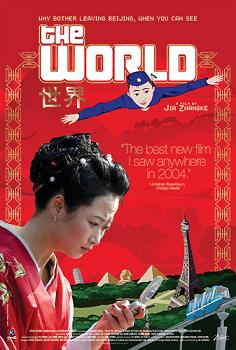
The World

The key directors of China's "Fifth Generation" of filmmakers created some of the great works of the '80s and '90s, but their politically brazen brand of filmmaking cost them dearly. Tian Zhaungzhaung spent nearly a decade in effective exile, while Zhang Yimou and Zhang Junzaho sold out to ensure that their lavish productions could enjoy stable funding from the government. The sixth generation to graduate from the Beijing Film Academy, however, work around a shared aesthetic that costs less money, thus freeing them to get away with more. The World is Jia Zhangke's fourth feature but the first to be approved and funded by the state, yet its critique of China's cultural disconnect is so apparent that no one could mistake the director for compromising.

Like other films of the sixth generation, The World is shot on HD cams and on location, but the documentary effect that crept into Jia's later films does not significantly inform his style. Instead, he shoots in long, serene takes, scanning over Beijing World Park in all its tourist-baiting glitz. His elegant tracking shots could almost pass as an infomercial for the park, which is precisely the director's plan. After the credit titles roll on the screen, Jia identifies the park with a surtitle, along with a link to the place's website. By following the orders of the Communist censors, Jia displays a capitalist advertisement for the national park, and his supposed cooperation helps establish the film's concerns about encroaching capitalism.

Let us get something out of the way now: Jia is not a loyal Communist fearing the end of Mao's legacy. His shots of the uniform, bunker-like buildings outside the park convey his feelings toward the effects of the Cultural Revolution. But he also recognizes that capitalism is not some savior, that it simply shifts the country's social values to the other end of the spectrum without finding a working balance. Of course, China's government refuses to even acknowledge the change even if everyone realizes what's going on, so the citizens are effectively trapped between a failed system and one that doesn't offer much hope for deliverance.

Nowhere is the transparency of China's transition more evident than Beijing World Park, an EPCOT-like construct with miniature versions of landmarks from five continents. "See the world without ever leaving Beijing" boasts one of the slogans, and tourists flock to the place in droves to have their sterilized fun and spend money. The first line of the film, repeated by Tao, one of the park's performers, is "Does anyone have a Band-Aid?" It's possible that this is a choice made by the translators for subtitles, but the use of the brand name over the generic "bandage" shows how capitalism and brand identification have already slipped into the vernacular of China. When a co-worker complains about his girlfriend's cell phone never being on, Tao suggests he buy her the new Motorola "with global tracking." Tao, like the other dancers, dresses in vibrant but plastic costumes like the princesses of Disneyland, and the performances look like music videos: too bright, too colorful and too empty.

Tao's boyfriend, Taisheng, also works in the park, as do most of their friends. Through them, Jia examines how a place designed to feed fantasies of world travel is run like any other business. Workers cart around water, prepare for performances, keep the place clean, etc. Where Tati's Playtime depicted a world of uniform, postmodern architecture obscuring the cultural landmarks that made each place ethnically distinct, The World inverts the relationship. Here, carbon copies of those landmarks cover up the modern, concrete buildings.

The great irony, of course, is that the people who work in the park cannot afford to ever visit one of these places in reality. At night, Tao and Taisheng return to their apartment, a dripping, dimly lit room that would suggest extreme poverty in America but seems disturbingly par for the course here. They view passports and visas with awe as if the original owners of Gutenberg Bibles, holy books all their own. The passport represents freedom, freedom to get out of this dull life and try to make it somewhere else. Instead, they live out tiny fantasies of travel by walking to different sections of the park; "Going to Japan," says one worker casually before hopping on the monorail that circles the "monuments."

With all of them trying so hard to get away, no one in the film pays that much attention to anyone else. Taken with Jia's long takes and removed mise-en-scène, the alienation of these characters within a modernized and modernizing world recalls the work of Michelangelo Antonioni. Yet perhaps the greatest base of comparison between the two is how incomparable they are as artists. The Antonioni link comes up only because Jia is so unlike anyone else that it's natural to latch upon the tenuous connection -- even Jia's blends of docufiction cannot be compared to those of Herzog and Kiarostami for any purpose other than to show where they diverge. Antonioni's concerns primarily affected the bourgeois, who drifted further and further apart until nothing seemed able to forge a meaningful connection. But Jia's film relies on the context of its time as much as Antonioni's '60s films built upon the clashing cultural perspectives of that era. Characters have awkward conversations with each other in person, yet text messages are treasured.

If the park caters to impersonal, broad fantasies, the texts typically segue into animated segments that usually depict some form of flying or freedom. Ironically, the most impersonal form of communication -- brief, misspelled letters that only address one thing at a time -- kickstart deeply personal reveries. Maybe it's the gaps in conversation afforded by messaging: someone gets a text and has time to read it and process it before replying, and in the space he or she projects into the words. The greatest contrast between these giddy flights of fancy and the emptiness of the park's offerings occurs in a mock-up of a commercial airliner. In the cockpit, Tao, dressed as a flight attendant, makes out with Taisheng. Their smooching plays out as a half-fulfillment of the stereotypical fantasy of the Mile High Club, but it's the animation Jia cuts to of Tao flying outside the plane that appears sensual.

That's what makes the simulacra of Beijing World Park so detestable. It's the sort of place you dislike instantly if you've ever been interested in travel. I have, despite the modest resources of my family, the extraordinary fortune to have visited some of the world's most beautiful places. I simply cannot understand the mindset of the hundreds of thousands of people who seem to go to Beijing, London, Paris, Barcelona and all the other great cities of the world just to take photos of landmarks. Those people could save themselves the time and go here, since they see as much of the real cities as they do here. The workers, none of whom can afford to travel, understand that they experience nothing of the landmarks by working near copies of them. If they went somewhere, they wouldn't waste time with endless, meaningless photos of goofy poses in front of attractions. After all, a photograph can't capture the essence of what makes a place memorable. It cannot truly grasp the look a kindly old woman gives you in a shop in Provence when she discovers you're an American, a vaguely sympathetic gaze as if to say it can't be helped. Nor can one adequately convey the horror of an ordinary deli in New York handing you an outrageous bill, crushing any ideas you might have held about the place being some sort of liberal love-in. What of the London pub that has no history other than sheer age, nothing to recommend it to a tourist? A photo would ruin the perfection of the place, assigning importance to a place that is memorable because it has none. It cannot even fully encapsulate the hilarity of a local hanging around a Shanghai boutique conspiratorially whispering to Americans that all the products inside are crap until the proprietor comes shrieking at the lost dollars.

Even these experiences could not be adequate for a movie that wryly calls itself The World, but the sheer, hollow pointlessness of Beijing World Park makes the title almost savage in its sarcasm. At one point, Jia even compounds the postmodernism of it all with a "magic carpet ride," involving couples sitting on a rug as an attendant sways a camera that records to a DVD with world locations imposed in the background. Those who allow themselves to get caught up in the illusion forget that a world exists outside the park's microcosm. Taisheng starts an affair with a shop owner named Qun, who speaks of a husband who left her eight years earlier. She says her ex went to Paris, and Taisheng jokes that he might have hid out in the park, but his chuckles turn to faint confusion when Qun says the man lives in Belleville, which isn't recreated in the park. For a second, Taisheng forgets that just because something isn't in the park doesn't mean it doesn't exist.

Lest you think that the film spends its time simply drifting through bleak tableaux, flashes of optimism and humanity revive the film. Just as the aforementioned use of cell phones show surprising personality in solipsist communication, the friendship between Tao and a Russian dancer named Anna reveals the more positive side of global change. Anna doesn't know a word of Mandarin and Tao likewise cannot speak Russian, yet the two forge perhaps the only genuine and meaningful bond in the film. If the modern world brings alienation, it also opens the possibility for connections between the unlikeliest friends. One night at a karaoke bar, Tao runs into Anna in the bathroom. Though we're never explicitly told, one can intuit that the dancers here are turned into prostitutes, and when Anna laments her passport has been stolen, trapping her in Beijing unable to go to her sister in Mongolia, it follows logically, horrifyingly, that this poor woman has been made to whore herself as well. The moment between Tao and Anna, in which neither says openly what's bothering her even though the other won't understand, is such a powerful exchange of grief that they comprehend each other more than ever. Both cannot get a ticket out, cannot even get the money together to prepare to leave, and they see the hopelessness of it all in each other.

That stunning humanity is echoed when Taisheng's friend, whom he calls "Little Sister," dies in a construction accident. Taisheng is devastated and lashes out at another friend and Little Sister's supervisor, but he understands that Little Sister needed the money. Jia moves to a heartbreaking scene of the dead man's family receiving a meager compensation for the workplace accident in anguished silence. Jia uses this scene, as well as the one of Anna preparing to prostitute herself before leaving in tears, to make his most devastating critique of capitalism: in a society that values money above all else, even flesh can be sold, in one way or another. Yet these are also scenes of emotional purity and haunting rawness, and they do not simply exist as harsh metaphors. The same holds true of the note Little Sister scrawls on his deathbed: not a farewell or even a last will and testament, the note simply lists the various debts the man owes, all insignificant amounts to friends as if adding up all the drunken bets he made over silly nonsense through the years. Fundamentally, his note reflects the capitalist mood of settling all monetary issues, but the wee list somehow packs a more devastating punch than the most poetic of benedictions.

"Poetic" defines Jia's direction, which has all the compositional genius of Antonioni filtered through a more human lens. As much as he clearly does not favor the dripping, unadorned walls of the Communist living quarters, he invests the world underneath and around Beijing World Park with the beauty of his fluid tracking shots. The apartments typically have one light source, usually an uncovered bulb bolted to the wall as if someone rotated the room 90 degrees and turned the ceiling into the left wall, and Jia uses this setup to get some striking shots. Taisheng tries to coerce Tao into sex, and when she throws him off, his shadow looms over her threateningly even as the actual man backs off, hurt and frustrated.

In the park, the director sticks mainly to long, static shots, emphasizing how worthless and alienating a place it is. In the mock airplane where Tao and Taisheng make out, Jia passes over the windows of the fake jet, which pour in a pure, cold light as if each window were a portal to some far away place, somewhere the two might feel at home. It's the only time any of the attractions look tantalizing, and that's because the shot makes us think about where else we might be. It's amazing that the censor board seemed not only to approve The World but to greatly enjoy it, as it so thoroughly attacks the conceit of the park and the government who put it there to give their repressed citizens a half-chance to see the world that it does not even hide behind the mask of satire.

Jia's background as a film student also leads to the referencing of several films. A group of tourists crowds around a mock-up of the Mouth of Truth in the Italian section, and they take turns pretending to have their hands bitten off, recalling the famous scene from Roman Holiday. Jia divides the film into several segments, and he titles the last of them "Tokyo Story," naturally after Ozu Yasujiro's magnum opus. He apes the master's aesthetic in this section, but he turns the themes of Ozu's film on their head: instead of focusing on a dying, unappreciated generation, Jia worries for the youth of the world who seem doomed to a life of not understanding or fully connecting to each other. The only marriage in the film, after all, is between a dancer and her dangerously unstable boyfriend, a man so paranoid and jealous that he calmly sets his jacket on fire (while still wearing it) when his girlfriend threatens to leave him.

The final, most tenuous, reference occurs at the end, when a gas leak appears to claim the lives of the two leads just after their relationship falls apart and starts to mend. As the camera moves over their stiff bodies, we hear the voices of the two over a fade to black. "Are we dead?" asks Taisheng. "No," replies Tao, "this is only the beginning." This ending invokes the finale of Godard's Pierrot le Fou, in which the doomed revolutionaries/outlaws find their escape in death. Just as Godard's film ended with a mix of Romanticism and brutal tragedy, so too does Jia's. The people of China, the world, have found themselves in a time where global communication is instant but we all seem more segmented and separate than ever. I'm not sure what the ending means, but I think Jia is not so nihilistic to say that the only freedom comes with death. however, he does suggest it is the only kind of pure freedom. Then again, maybe death, like life in this time period, is simply a transition, a turbulence between existences that tries us all and, we hope, makes us stronger in the end.

Friday, September 24, 2010

Brian De Palma: The Fury

Though it never reaches the heights of De Palma's previous two features, The Fury combines the best aspects of both. It shares Obsession's convoluted plot and its brazen Romanticism, and it draws from Carrie's supernatural take on puberty. In a way, it resembles All the President's Men, if that movie were somehow turned into an X-Men comic.

Rarely have I seen a narrative more mangled and half-conceived, and never have I seen one that is so happy to point this out to the viewer. When the film opens on a coastal villa with the hilariously non-specific supertitle "Middle East," De Palma gives us fair warning that we'll never get the full details. In no time, the movie spirals into madness. Peter Sanza (Kirk Douglas, grayed but chiseled like a Greek god) lives a relaxed life with his young adult son, Robin (Andrew Stevens), who seems apprehensive about returning to the States after several years away. Vague mentions of some "gift" surface in their conversation, but the arrival of terrorists via dinghies interrupts the chat. In the middle of the firefight, Peter spots one of the supposed terrorists filming the shooting, and he lures attention and gunfire away by leaving Robin with his friend and associate, Childress (John Cassavetes), and grabbing a boat and heading out to sea. His plan takes a bit of a turn when the boat explodes.

This all happens in about seven minutes, mind you. It only gets crazier from here. Peter survives and discovers that Childress orchestrated the attack, sending the father into hiding so that he might reclaim his son and get revenge. Then, De Palma started piling on the craziness. Back in America, a young woman named Gillian Bellaver (Amy Irving) is trying, unsuccessfully, to deal with a talent like Robin's. She's psychic as well as telekinetic, and this causes a surprising amount of mocking and dismissal from the other girls in her school even when she proves herself.

Were any other director behind The Fury, it could not possibly have worked. It's all too silly, and the film finds itself in the nebulous area between conviction and irony, aware that it is absurd but not playing on that knowledge. The greatest running gag of the film involves the normalcy with which it treats some of its craziest elements. Everyone at school knows Gillian is psychic, but they act like she's just trying to get attention. When representatives of the "Paragon Institute" come and test the children for psychic powers, the nurse sent never once lies about why she's there, and everyone accepts this without comment.

Then, there's Douglas' character. Peter is so obstinately unkillable and singularly focused that he becomes an open parody of the individualistic hero of the cinema. He's a master of disguise, an eloquent speaker, an expert driver, a marksman, a lethal close combatant and, finally, sex on legs. Propelled by Douglas' swagger, Peter looks like he could drink James Bond under a table and then screw whatever woman Bond had been seducing previously. At one point, someone asks Peter about Childress and asks if he's afraid of the man. "He's afraid of me," comes Peter's response, and who could blame Childress for his fear?

A comic element always existed in Douglas' rogues gallery of assholes, but he is downright hysterical in the first half of the film. When Childress tracks Peter to a hotel, the man escapes in his underwear, leaping onto raised train tracks and crashing into the apartment of a slovenly couple, complete with harridan mother-in-law. Peter holds them up but is so gentlemanly that the old woman gladly helps him tie up the younger pair and even cooks the beleaguered father breakfast while he creates an old man disguise for himself.

De Palma uses the considerable talents of his leading man to springboard into some of his most audacious and boldly comic filmmaking yet. One of the best sequences in De Palma's early canon comes in the form of a ludicrous car chase between Childress' men and two off-duty cops that Peter threatens. Bob, the cop driving, laments that he only just bought his car that afternoon, but Peter guides them through stop lights, heavy fog and a construction zone, destroying every follower and not getting a scratch on the Cadillac. The sequence is littered with visual gags and ingenious direction, but De Palma reveals it all to be a setup, the punchline of which is Peter ultimately taking the car and driving it off an unfinished bridge in front of poor Bob. Why does he destroy the man's Caddy? I can't say. What else are you supposed to do with a shiny, new vehicle in a comic thriller?

Peter's efforts to find and save his son mirror and invert the murderous rage that the father in Obsession feels for the woman he does not recognize as his daughter. He sleeps with a nurse, Hester (Carrie Snodgress), at the Paragon Institute so he might get information on Robin, who stayed there after Childress abducted the boy. Peter also attempts to take Gillian, who displays a power to rival Robin's, in order to track down his son. His single-minded focus is fearsome, and Douglas' performance is surprisingly powerful even as he, more than anyone else in the cast (save perhaps Cassavetes, made to fake a dead arm the entire time), understands that the film is a lark.

His dedication to the role marks the core of the film's more touching side. Gillian hates her powers and fears the lack of control she has over them. She befriends Hester, who cannot abide by the pressure placed on the children of the Paragon Institute and helps Gillian escape. When the nurse dies in the attempt, however, both Gillian and Peter are crushed. Compared to Bond, who can so casually use women in every way possible until he finally uses them as his own bulletproof vest, Peter looks at his lover's body and understands how his quest for vengeance has gone. After spending more than an hour hunting Gillian to use her, he immediately tries to release the young woman, unwilling to risk her for his suicide mission. It's inevitable that she will still come to the final showdown in the hopes of learning to control her powers through Robin, but the sudden halt in momentum for a man to pause his righteous crusade to spare the innocent reveals a side of De Palma that he won't fully reveal at this time. He's like a flasher walking around a park in naught but an overcoat, stalking up to youths and popping open his coat to reveal a beating heart.

The ending only compounds this romantic side, with Robin, experimented upon to the point of insanity, killing his assigned lover in a mad rage when he senses Gillian coming and fears he's being replaced. He even attacks his father, who endured so much just to see his son again, only for the boy to be so far gone that Peter possibly lets the boy fall to his death, aware that his own love cannot justify keeping such a monster alive. Peter's grief is all-consuming, however, and he leaps to die by his son, reunited at last. After laughing for an hour and a half, I found suddenly that the chuckles caught in the throat.

De Palma does spin the mood right 'round for the finale, which outdoes Scanners a few years before Cronenberg's film even existed, but it's too late. After peeking out from behind the hedges in Obsession, the director's Romanticism enjoys an entire act of open, unabashed visibility, and this revelation raises The Fury above its somewhat plodding middle section. The middle showcases the most of De Palma's tricks, particularly focused around his way of visualizing Gillian's psychic flashbacks, which allow us to essentially watch a second movie within the already-tangled narrative, but he cannot yet find the right balance between his softer side and his more impish impulses. Nevertheless, The Fury boasts one of the finest performances in De Palma's filmography, and after making his reputation on so many wild satires, the sudden emergence of some tangible emotion hints at the humanity that would inform his best films.

Tuesday, September 21, 2010

The Town

After turning his career 180 degrees with his expertly economic take on Dennis Lehane with Gone Baby Gone, Ben Affleck appears to be on a mission to claim the city of Boston as his cinematic turf. Just how Bostonian is his heist movie The Town? Its climax takes place at Fenway Park. Oh my Gahd.

Compared to its haunting predecessor, The Town aims lower. Rather than dig into the psychology of a missing child and the moral quandary presented by her neglectful, addicted mother, The Town contents itself to be a taut, B-movie thriller. And yet it is also denser than Gone Baby Gone, trying not only to work as a heist movie but a coming-of-age tale and a romance. Essentially, it mashes up clichés from three different kinds of movies into something that has no right to work but does, thanks to Affleck's economic direction and his sure-handed ability to get fine performances from his actors.

After using his previous film to promote his brother Casey's considerable talent, Affleck uses his latest to build off the acting comeback of Hollywoodland by playing Doug MacCray, a failed hockey player who returned in disgrace to the Charlestown neighborhood of Boston, where, opening title cards tell us, the highest concentration of bank robbers in the world are born. With a father serving several life sentences for robbery and murder, Doug continues on the "family business," leading a crew of thuggish, arrogant townies whose appearances belie their intelligence and capabilities. When they rush into a bank at the start of the film, they establish a professional precision in no time. They know when the silent alarm goes out, when the safe's time lock opens, where the tracers and dye packs are placed in money, how to make sure no one does anything stupid (including collecting cell phones), and they bring bleach to get rid of any evidence they might leave behind. In a five-minute stretch that includes no prior discussions of planning or obligatory shots of blueprints -- though those do come later -- Affleck conveys just how experienced these four guys are with their work.

The heist goes off without a hitch even though someone trips the silent alarm, but the gang takes the manager, Claire (Rebecca Hall) hostage just in case. Having watched her co-worker beaten by one of the robbers, Claire is rattled, and even when she is released without harm she can barely stop shaking for days. When the gang discovers that the woman lives four blocks away from them, Doug tracks her down and winds up falling in love. It's just stupid and crazy enough to be brilliant, and as much as women in film are constantly set up to help a man grow up, Affleck avoids the trap of the Manic Pixie Dream Girl.

For one thing, Claire is too shaken up to actively bring Doug out of his own stew of self-pity, and we're basically watch a couple repair their relationship after a big shock rather than have them meet and be totally happy until the Big Misunderstanding. Doug helps Claire through the post-traumatic stress disorder that he helped give her, while she inspires him to really try to leave the game he never seems to enjoy, not nearly to the same extent as his best friend Jem (Jeremy Renner, unabashedly channeling Jimmy Cagney).

Jem pressures Doug about the relationship, and his fears are not unwarranted. Bearing down upon the gang is an FBI agent, Adam Frawley (Jon Hamm), a man who's been on the force so long that he has no qualms with overstepping certain ethical boundaries to intimidate cooperation from the tight-knit Charlestown community. I know I just waded waist-deep into clichés, but there's no way to talk about The Town without bogging down in various things you've all heard before.

So let us instead talk about why it remains an enjoyable film. Renner builds off his Hurt Locker buzz brilliantly, even if he continues to play an arrogant, self-absorbed, dangerous man whose rash behavior threatens the cohesion and effectiveness of a group of thieves as much as it does a special Army unit. Jem sees Doug as a brother, and when the weary gang leader speaks of leaving this destructive lifestyle behind, Jim does not disguise his unwillingness to release his friend. Hamm, so memorable on Mad Men, offers a number of fine reasons for continued work on the big screen, from his chiseled look to his ability to maintain some semblance of decorum even as the fury begins to seep out of Frawley's eyes. Paired up in a surprisingly funny double act with Lost's Titus Welliver, Hamm fuses the broad comic talent he shows on his appearances on 30 Rock with the more severe side of his dramatic acting. He's often funny, but not in a way that necessarily makes you laugh.

Even the minor characters are perfectly case. Blake Lively plays Jem's sister and Doug's ex-girlfriend, and her Oxycontin-addled behavior adds a layer of tragedy to the film. Doug wants no part of her anymore, leaving her to raise her 19-month-old baby alone. From the moment you see her, you know she'll be the ones the cops coerce, and when they finally come knocking, all she can say is, "Why is it that I'm the one who's always getting used?" Chris Cooper has one scene as Doug's father but he makes it count; locked away in prison, this gray-haired, bespectacled man still talks of settling disputes with younger inmates and asserting control over the other gangs. Beneath his hardened exterior, however, is a sad, old man who will sit in a cage until he dies, all because of absurd notions of honor among thieves. Pete Postlethwaite, one of my favorite "that guys," also makes an appearance as "The Florist," the man at the top of the robberies who exerts brutal dominion over the various crews and knows just how to hurt them in order to keep them in the game as long as they're useful.

As for Affleck, he never oversells the point as he often did in the past. He has a few meaty chunks of dialogue that force him to put on his "acting face," but he hasn't seemed so natural since his heyday with films like Chasing Amy and Good Will Hunting. Compare the way that he lets his facial language do the talking to the trailer of his next starring feature, The Company Men, which played before The Town. Granted, it's unfair to judge by a trailer, but that film offers glimpses of Affleck at his most ingratiating and "Robin Williams-esque," trying too hard to sell an obvious point. When he starts slipping into Serious Mode here, his style is in-keeping with the B-movie vibe, and he never gets ahead of himself.

His direction, however, is even better. His editing in the opening heist is fast but measured, a healthy blend of the frenetic, modern pacing and a more classical style. The Town boasts one of the better car chases in recent memory, bumping up against the Paul Greengrass style of incomprehensible shots of shrieking, crunching metal without jumping fully into shakycam waters. Some of Affleck's inter-cutting can seem awkward, but when he matches shots of Doug and Claire having sex with Claire being released by Doug and the gang at the beginning, the obtuseness of comparing her orgasm to the euphoria of finding out that she would not be harmed after all becomes somewhat beautiful.

A Michael Mann film this is not, despite the clear influence that director exerts over the picture, yet Affleck still has an eye for detail. One of the most suspenseful moments of the film involves Jem stumbling across Doug and Claire and trying to mask his surprise. Meanwhile, Doug, who knows that Claire might recognize the tattoo on the back on Jem's neck and alert the cops, attempts to keep the tattoo out of sight. Similarly, the blood on Claire's shirt, splattered on her when Jem beat her co-worker, triggers memories in the audience as well as her, and it's a shame that Affleck felt he needed to then insert some shots of the robbery to remind us.

Unfortunately, Affleck wants The Town to be too many B-movies, so it occasionally meanders when it leaves behind the romance and the thrills for a more preposterous coming-of-age/midlife crisis story. When the elements click, however, it's a damn fine film. Most of the dialogue is to-the-point and carries the kind of wit that normally comes from someone older and more familiar with the subject matter: as Welliver and Hamm brief other officers about the gang, they note the limitations placed on them by due process but also of the ways that those laws have been bent. "We'll never get 24-hour surveillance unless one of these idiots converts to Islam," says Dino.

That unforced humor, mixed with the thrilling heist and chase scenes and the fitfully endearing romance, makes The Town uneven but rewarding, a film that embodies countless tropes and modes but manages to funnel them into something enjoyable. It's also a B-movie that doesn't rely on irony, which is a nice change of pace from even the more entertaining movies like Machete. It's earnest and eager, maybe too eager, and if it's a step-down from the triumph of Gone Baby Gone, it's also proof that the previous film wasn't a fluke and that Ben Affleck could well find a way to fuse his mainstream appeal with his desire to make genuine art.