[The following is a contribution to the Nicholas Ray Blog-A-Thon for Tony Dayoub's Cinema Viewfinder.]
Though it begins with the overture and audiovisual bombast expected of a 70mm Biblical epic, King of Kings soon turns into a movie that establishes emotional resonance even as it continues to deliver vast-scale shots of grandeur. Beginning more than 50 years before Christ's birth, Nicholas Ray's film thus dedicates its first images to the sights of Romans sacking Jerusalem, enslaving, pillaging and murdering Jews to establish supremacy. This curbs the sense of wonder, to say the least. Yet this focus on the historical context of the Gospel finds a secular approach to the religious story. The Jews in this film do not pine for a savior because of age-old prophecies; they simply need someone to help them escape this misery.
This situates the film somewhere between Ben-Hur and The Last Temptation of Christ. Though not as humanizing as Martin Scorsese's controversial film, Ray's epic nevertheless breaks ground of its own, breaking from the tradition of showing Jesus in synecdochical ellipses to show Christ in full. The mere process of visualizing him humanizes him, focusing on the man instead of the symbol. Ray understands this, even going so far as to frame most of Jesus' miracles in shadow or other indirect visuals to firmly separate the man from the god. Ray does not visually segment these sides of Jesus for the purposes of commentary or irony, merely to keep our focus on the man even if, like all Ray heroes, becomes an idol before our eyes.
Personal blog of freelance critic Jake Cole, with exclusive content and links to writing around the Web.
Thursday, September 8, 2011
The Savage Innocents (Nicholas Ray, 1960)
[The following is a contribution to the Nicholas Ray Blog-A-Thon for Tony Dayoub's Cinema Viewfinder.]
Shot partially on location in the Arctic, The Savage Innocents switches the familiar expanse of the West for the bleached tundra of the North. Where the heroes of the West stand as moral individualists, carving out their space in the seeming infinity of the range, the protagonist of the Arctic must fight not for his moral authority but mere survival. Its title speaks to the contrast of Inuit life between the innocence of such life and the savagery needed to stay alive. This is embodied in the first shots, of two Inuits throwing real spears into a real polar bear, puncturing the poor beast as blood pours out into the icy water in which it swims. The Eskimos simply need to eat, but the sight of a bear being stabbed to death is gruesome, especially in the age of close animal monitoring and CGI slaughters in the movies.
Yet Ray's film depicts not so much a Manichean contrast as a coexistence of the irreconcilable traits of humanity. By filtering that humanity through the customs of a non-Western race—some of them true, some of them not, all of that beside the point—Ray divorces the audience from its sense of normalcy to show the contradictory nature of culture and its inexplicability to those of another civilization. Granted, the inaccuracies and ignorance that pepper The Savage Innocents (to say nothing of the casting of not one Inuit in a part) hinder the film to a significant degree, but Ray's overriding point is the same one of all his films: the homes we make and who we make them with. Riddled with dated elements, The Savage Innocents nevertheless finds yet another angle from which Ray can attack his central preoccupations. And if his depiction of Inuits occasionally sends the eyes darting down from the screen to look at the embarrassment, that shame should also come from the realization that this thoroughly non-idealized portrait of another culture is more interested in the true behavior of a different race than nearly any Hollywood movie before or since.
Shot partially on location in the Arctic, The Savage Innocents switches the familiar expanse of the West for the bleached tundra of the North. Where the heroes of the West stand as moral individualists, carving out their space in the seeming infinity of the range, the protagonist of the Arctic must fight not for his moral authority but mere survival. Its title speaks to the contrast of Inuit life between the innocence of such life and the savagery needed to stay alive. This is embodied in the first shots, of two Inuits throwing real spears into a real polar bear, puncturing the poor beast as blood pours out into the icy water in which it swims. The Eskimos simply need to eat, but the sight of a bear being stabbed to death is gruesome, especially in the age of close animal monitoring and CGI slaughters in the movies.
Yet Ray's film depicts not so much a Manichean contrast as a coexistence of the irreconcilable traits of humanity. By filtering that humanity through the customs of a non-Western race—some of them true, some of them not, all of that beside the point—Ray divorces the audience from its sense of normalcy to show the contradictory nature of culture and its inexplicability to those of another civilization. Granted, the inaccuracies and ignorance that pepper The Savage Innocents (to say nothing of the casting of not one Inuit in a part) hinder the film to a significant degree, but Ray's overriding point is the same one of all his films: the homes we make and who we make them with. Riddled with dated elements, The Savage Innocents nevertheless finds yet another angle from which Ray can attack his central preoccupations. And if his depiction of Inuits occasionally sends the eyes darting down from the screen to look at the embarrassment, that shame should also come from the realization that this thoroughly non-idealized portrait of another culture is more interested in the true behavior of a different race than nearly any Hollywood movie before or since.
Labels:
Anthony Quinn,
Nicholas Ray,
Peter O'Toole
Wind Across the Everglades (Nicholas Ray & Budd Schulberg, 1958)
[The following is a contribution to the Nicholas Ray Blog-A-Thon for Tony Dayoub's Cinema Viewfinder.]
Wind Across the Everglades marked the beginning of the end for Nicholas Ray. After falling ill during several productions during his career and necessitating shots from other directors, Everglades was the first time Ray's substance abuse problems finally got him fired. As such, it opens up a contentious debate centered on the film's auteurist cred. Budd Schulberg, the film's writer and co-producer, took over for Ray and purportedly discarded a great deal of footage in the editing bay. But if the final product certainly feels to have been put together by another's hand, there are numerous visual and narrative traits common to Ray's oeuvre.
Set in the late 19th century, Wind Across the Everglades charts American expansion into Florida, opening up new territory through swamps to Miami. It also creates a market for the plumage of region-specific birds, sparking a poaching frenzy that flagrantly ignores conservation laws, and few people rise to the challenge of monitoring the glades to enforce these laws. But when a nature studies professor named Walt Murdock (Christopher Plummer) steps off a train and immediately gets arrested for indignantly ripping the feathers off a woman's hat, the Audobon Society realizes they have just the man for the job. Unfortunately for the now option-less Murdock, the poaching gangs won't give up their lucrative trades without a fight, and as he ventures into the glades, Murdock finds himself confronted with a way of life at odds with his own even, in true Ray fashion, as he comes to see his rival as an equal not merely in intelligence and capability but almost spiritual connection to their setting.
Wind Across the Everglades marked the beginning of the end for Nicholas Ray. After falling ill during several productions during his career and necessitating shots from other directors, Everglades was the first time Ray's substance abuse problems finally got him fired. As such, it opens up a contentious debate centered on the film's auteurist cred. Budd Schulberg, the film's writer and co-producer, took over for Ray and purportedly discarded a great deal of footage in the editing bay. But if the final product certainly feels to have been put together by another's hand, there are numerous visual and narrative traits common to Ray's oeuvre.
Set in the late 19th century, Wind Across the Everglades charts American expansion into Florida, opening up new territory through swamps to Miami. It also creates a market for the plumage of region-specific birds, sparking a poaching frenzy that flagrantly ignores conservation laws, and few people rise to the challenge of monitoring the glades to enforce these laws. But when a nature studies professor named Walt Murdock (Christopher Plummer) steps off a train and immediately gets arrested for indignantly ripping the feathers off a woman's hat, the Audobon Society realizes they have just the man for the job. Unfortunately for the now option-less Murdock, the poaching gangs won't give up their lucrative trades without a fight, and as he ventures into the glades, Murdock finds himself confronted with a way of life at odds with his own even, in true Ray fashion, as he comes to see his rival as an equal not merely in intelligence and capability but almost spiritual connection to their setting.
Labels:
Burl Ives,
Christopher Plummer,
Nicholas Ray
Party Girl (Nicholas Ray, 1958)
[The following is a contribution to the Nicholas Ray Blog-A-Thon for Tony Dayoub's Cinema Viewfinder.]
Bursting with clichés and a simplistic script, Party Girl is nevertheless too packed with ideas not to love. An imperfect blend of Ray's mastered genres of film noir and melodrama, Party Girl is a sinister mob movie that also happens to be the most colorful and vibrant film of the director's career of color-soaked, passionate films. Ray's capacity for near-surreal dips into pure cinema have rarely, if ever, been as unabashed as the musical numbers, while others scenes plunge into such chiaroscuro that shots seem to cling to a branch hanging over monochrome.
Not that any of this is visible in the film's opening scenes, which portray the staid, conventional showgirl act that acts as the background noise for the drunken antics of the club owner, mob boss Rico Angelo (Lee J. Cobb, eyes never quite focused even when he turns into an icy monster later). Beneath the stage, the dames bicker viciously, insulting looks and brandishing nails with promises of hair yanking of Biblical proportions. The only supportive woman among this bevy of befeathered and besequined harpies is Vicki Gaye (Cyd Charisse), who tries to comfort her co-worker and roommate, a despairing, crumbling woman named Joy in one of life's cruel ironies. Pregnant with the child of a married man, Joy's childish pouting belies a serious problem, but Ray has a knack for removing foreshadowing from his atmosphere. When he follows through on this brief subplot with a shocking quick shot of gruesome finality, the effect is stunning, and I found myself for the first time truly unsettled by Ray's use of red.
Bursting with clichés and a simplistic script, Party Girl is nevertheless too packed with ideas not to love. An imperfect blend of Ray's mastered genres of film noir and melodrama, Party Girl is a sinister mob movie that also happens to be the most colorful and vibrant film of the director's career of color-soaked, passionate films. Ray's capacity for near-surreal dips into pure cinema have rarely, if ever, been as unabashed as the musical numbers, while others scenes plunge into such chiaroscuro that shots seem to cling to a branch hanging over monochrome.
Not that any of this is visible in the film's opening scenes, which portray the staid, conventional showgirl act that acts as the background noise for the drunken antics of the club owner, mob boss Rico Angelo (Lee J. Cobb, eyes never quite focused even when he turns into an icy monster later). Beneath the stage, the dames bicker viciously, insulting looks and brandishing nails with promises of hair yanking of Biblical proportions. The only supportive woman among this bevy of befeathered and besequined harpies is Vicki Gaye (Cyd Charisse), who tries to comfort her co-worker and roommate, a despairing, crumbling woman named Joy in one of life's cruel ironies. Pregnant with the child of a married man, Joy's childish pouting belies a serious problem, but Ray has a knack for removing foreshadowing from his atmosphere. When he follows through on this brief subplot with a shocking quick shot of gruesome finality, the effect is stunning, and I found myself for the first time truly unsettled by Ray's use of red.
Labels:
Lee J. Cobb,
Nicholas Ray,
Robert Taylor
Wednesday, September 7, 2011
Bitter Victory (Nicholas Ray, 1957)
[The following is a contribution to the Nicholas Ray Blog-A-Thon for Tony Dayoub's Cinema Viewfinder.]
For the Nicholas Ray Blog-A-Thon being held at Cinema Viewfinder from Sept. 5-8, I've written a piece on Ray's elegant but unromantic war movie Bitter Victory at Cinelogue. A work of twisted purity, it uses a war as a backdrop for the more intimate, and thus more humanistically meaningful conflict between two men ostensibly on the same side. For a man who found the Romantic in self-immolation elsewhere, Ray's view of war is one of pure disgust: the death of one man, as they say, is tragic, but the death of millions is a statistic. Where he can find the sad resonance of one person's death reaching for his futile goals, the impersonal slaughter of war holds no glory. This makes for one of Ray's most downbeat and chilly films, but also one of his most passionately argued and affecting. And there's something so compelling about it that Godard's legendary praise of the movie still holds up. One of the master's finest works.
Labels:
Nicholas Ray,
Richard Burton
The True Story of Jesse James (Nicholas Ray, 1957)
[The following is a contribution to the Nicholas Ray Blog-A-Thon for Tony Dayoub's Cinema Viewfinder.]
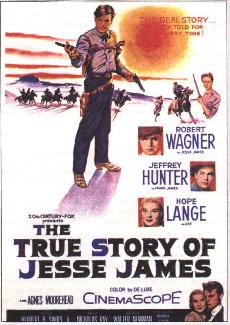
The first of Nicholas Ray's farewells to Hollywood, The True Story of Jesse James served the primary purpose of satisfying his contract with 20th Century Fox. Accordingly, its place within Ray's filmography is relatively obscure, and perhaps not without reason. The film plays like a repository for Ray's themes and tics, but Ray presents most of them early in the film, as if he wanted to make sure he didn't miss his flight to Europe. Mob and gang violence, tormented and iconic youth, and a sense of overriding hopelessness pervade the film, but these elements do not gel the way they do in Ray's finest pictures.
Nevertheless, the film does contain its charms, chiefly in the manner with which it presents the iconography of its protagonist. So many of Ray's heroes feel like timeless figures, but James was the first character Ray put on the screen who knew he was an icon. That foreknowledge allows Ray to have fun with the idea of someone who exists as a legend before a man: often, Jesse can interact with people who have no actual image of the man and thus never once suspect that the person to whom they are chatting is really the Jesse James. Even when some of them later learn the man's true identity, the looks on their faces still register mild disbelief. "How could he be Jesse James?" they seem to say. "He was talking to me!"
The first of Nicholas Ray's farewells to Hollywood, The True Story of Jesse James served the primary purpose of satisfying his contract with 20th Century Fox. Accordingly, its place within Ray's filmography is relatively obscure, and perhaps not without reason. The film plays like a repository for Ray's themes and tics, but Ray presents most of them early in the film, as if he wanted to make sure he didn't miss his flight to Europe. Mob and gang violence, tormented and iconic youth, and a sense of overriding hopelessness pervade the film, but these elements do not gel the way they do in Ray's finest pictures.
Nevertheless, the film does contain its charms, chiefly in the manner with which it presents the iconography of its protagonist. So many of Ray's heroes feel like timeless figures, but James was the first character Ray put on the screen who knew he was an icon. That foreknowledge allows Ray to have fun with the idea of someone who exists as a legend before a man: often, Jesse can interact with people who have no actual image of the man and thus never once suspect that the person to whom they are chatting is really the Jesse James. Even when some of them later learn the man's true identity, the looks on their faces still register mild disbelief. "How could he be Jesse James?" they seem to say. "He was talking to me!"
Labels:
jeffrey Hunter,
Nicholas Ray
Hot Blood (Nicholas Ray, 1956)
[The following is a contribution to the Nicholas Ray Blog-A-Thon for Tony Dayoub's Cinema Viewfinder.]
Nicholas Ray specialized in making films about misfits and outsiders coalescing into the nuclear units of new collectives, more often than not marking such formations with the harsh tragedies of emerging orders. But as Evan Davis rightly noted, Hot Blood is "the first film in which Ray begins from within a fully formed community." This would become a staple of Ray's late career, leading to journeys to Peking, the wild swamps of Florida and the Arctic. What links these movies is an ignorance of their subjects' cultures that cannot be entirely forgiven even with historical perspective in mind. However, like the misguided but not altogether untruthful depiction of Inuits in The Savage Innocents, the gypsies of Hot Blood serve a broader purpose that pushes their cultural traits, both accurate and inaccurate, into universal terms of societal abstraction. The fundamental point is that their system of values is not that of the traditional West's, and by focusing tightly on their isolated world of customs, Ray can not only show that the American way of life is not the only one but that it can even look as ridiculous to others as those people's civilizations look to us.
It should be noted up front, however, that Hot Blood does not approach the level of thematic depth of The Savage Innocents. In fact, it boasts the weakest screenplay of any Ray film since A Woman's Secret. Like that film, Hot Blood squanders a potential mindfield of twists and turns, but where Ray and Mankiewicz clearly put a great deal of stock into their lifeless melo-noir, the director here cares little for the narrative. Instead, Ray devotes his attention to various dance numbers, color-soaked expressions of lust and violence that constantly push the film to the verge of becoming a musical. But it never crosses that line, perhaps because we'd forgive it its excesses if it did so. But Ray seems to delight in the garishness of it all—and of making a quasi-musical without identifiable songs and relying on dances from amateur dancers—and this is the only film so brazen that "gaudy" becomes a compliment.
Nicholas Ray specialized in making films about misfits and outsiders coalescing into the nuclear units of new collectives, more often than not marking such formations with the harsh tragedies of emerging orders. But as Evan Davis rightly noted, Hot Blood is "the first film in which Ray begins from within a fully formed community." This would become a staple of Ray's late career, leading to journeys to Peking, the wild swamps of Florida and the Arctic. What links these movies is an ignorance of their subjects' cultures that cannot be entirely forgiven even with historical perspective in mind. However, like the misguided but not altogether untruthful depiction of Inuits in The Savage Innocents, the gypsies of Hot Blood serve a broader purpose that pushes their cultural traits, both accurate and inaccurate, into universal terms of societal abstraction. The fundamental point is that their system of values is not that of the traditional West's, and by focusing tightly on their isolated world of customs, Ray can not only show that the American way of life is not the only one but that it can even look as ridiculous to others as those people's civilizations look to us.
It should be noted up front, however, that Hot Blood does not approach the level of thematic depth of The Savage Innocents. In fact, it boasts the weakest screenplay of any Ray film since A Woman's Secret. Like that film, Hot Blood squanders a potential mindfield of twists and turns, but where Ray and Mankiewicz clearly put a great deal of stock into their lifeless melo-noir, the director here cares little for the narrative. Instead, Ray devotes his attention to various dance numbers, color-soaked expressions of lust and violence that constantly push the film to the verge of becoming a musical. But it never crosses that line, perhaps because we'd forgive it its excesses if it did so. But Ray seems to delight in the garishness of it all—and of making a quasi-musical without identifiable songs and relying on dances from amateur dancers—and this is the only film so brazen that "gaudy" becomes a compliment.
Labels:
Jane Russell,
Nicholas Ray
Subscribe to:
Posts (Atom)