Showing posts with label James Franco. Show all posts

Thursday, March 28, 2013

Spring Breakers (Harmony Korine, 2013)

On its face, Spring Breakers is such a quantum leap forward for Harmony Korine that it is easy to overlook what a logical progression it is for the director. Its recursive editing, not merely repeating actions but occasionally anticipating them, reflect the patterns used to chart the directionless movements of Korine’s prior characters, a loose, non-narrative structure that gradually reveals milieu over plot. His settings tend to alienate before they assimilate, and that certainly holds true for the slow-motion shots of Floridian bacchanal that open the film to the oppressive strains of Skrillex. Like a lenticular “wish you were here” card, the montage starts with innocuous shots of young adults out on the beach before a turn reveals bikini tops flying and phallically positioned beer cans pouring on women’s faces. The allure of spring break is laid bare, though Korine has barely even scratched the surface of the hell he will conjure in St. Pete.

To a group of undergrads chafing with boredom at their small college, however, those images are utopia, a heaven on Earth compared to the suffocating tedium of their surroundings. When Brit (Ashley Benson) and Candy (Vanessa Hudgens) mime oral sex to each other during an auditorium class, they stick out not for their licentious behavior but for being the only people in the room not staring blankly at personal screens that merely reflect what the giant screen at the head of the class is showing. Faith (Selena Gomez) is a church girl in a phase of awkward transition for Christian youth outreach, featuring such incongruities as a youth minister (neck tattoo, Ed Hardy-esque crucifix shirt and all) standing backlit before stained-glass windows and using the story of Christ’s sacrifice for the sins of mankind to demonstrate just how little awe the word “awesome,” a word originally intended to connote a religious feeling, has lost all of its impact. Even goody two-shoes Faith needs to get away, and spring break seems as freeing to her as it does her more raucous friends.

Tuesday, August 9, 2011

Rise of the Planet of the Apes (Rupert Wyatt, 2011)

Rise of the Planet of the Apes, a fear du jour-updating reboot of the apes-take-over-Earth franchise, has just enough creativity in it that its problematic whole is all the more frustrating. The only actor who genuinely fits into his role comfortably is animated out of the picture, while a good third of the film feels like padding to establish questionable, simplistic motivation for a primate proletariat revolt. Yet when the film clicks, Rise of the Planet of the Apes finds a surprisingly effective tone between the sentimental and vicious.

Swapping out fears of nuclear holocaust for the less definite disease paranoia, Rise of the Planet of the Apes repositions the root of man's fall as the noble but misguided attempt to alter nature. Will Rodman (James Franco) is a scientist for a pharmaceutical firm who engineers a virus to repair the brain, effectively curing Alzheimer's and other brain-degenerative diseases. It's a lofty goal, and one that doesn't particularly need the addition of Will's Alzheimer's-stricken father (John Lithgow, making the most of an almost unwritten part) to sell the importance of such a breakthrough. But when an aggressive test chimp forces the closure of the research, Will secrets away the ape, Caesar, who inherited his mother's altered genes and exhibits intelligence even beyond that of a young human.

Thursday, December 30, 2010

127 Hours

I have previously been open to the occasionally vicious criticism leveled at Danny Boyle. I can sympathize with those who say Sunshine falls apart in the third act though I feel that was the only logical development of the story to that point, or with the Slumdog Millionaire detractors who say it's too glitzy a look at extreme poverty and it appropriates Dickens' optimism and sentimentality without the keen, detailed eye for social commentary that kept his stories serious (though I tend to view those calling Slumdog racist with much more skepticism). At last, I am faced with what must seem de rigeur for the haters: 127 Hours is shameless, garish and so falsely confident that its air of smug self-assurance only makes the experience more intolerable.

The story of Aron Ralston, the man who got trapped while hiking alone and -- SPOILER ALERT! -- ultimately amputated his own crushed arm so he might get to safety, 127 Hours gets off to a particularly offensive and callous start with an inexplicable series of split-screen shots showing people engaged in activity that prominently features hands. Whether it's crowds waving (or doing The Wave) or swimmers cutting through the water with their arms moving in angular precision, these moments seem an odd, cruel jab at Ralston, conveying no sense of foreboding, only a sneering irony. The shots continue as the film's Aron (James Franco) suddenly takes over one of the three strips of film on the screen, rapidly packing a backpack full of snacks and some gear as he prepares to head out to Blue John Canyon in Utah. In the final moment of hyperkinetic foreboding, the camera stays inside a cupboard as Aron's hand blindly fishes around for a Swiss Army knife that stays just out of his reach. Without peering in to have a look, Aron shrugs and moves on, throwing his crap in a beat-down truck and heading out to the wilderness before the sun breaks.

Out at the canyon, Aron tears across the place on a bike for 17 miles before hopping off and going for a run. He meets and entertains two young women (Kate Mara and Amber Tamblyn) before setting off again on his own. He climbs around a bit and tries to ease his way down a moderately deep crevasse when the rock he puts weight on snaps from its perch and sends him plummeting. The rock comes to a stop when the canyon walls narrow, and it just so happens to stop with Aron's right arm pinned between it and the wall. Ten minutes or so in, and the title card flashes on-screen. Set your timers...now.

The initial moments of Aron's attempts to free himself may be the only seconds of the film that work, the hand-held camera shuddering with every shove and grunt he makes attempting to pry his hand out from beneath the stone. It captures a feeling of helplessness, claustrophobia and the dread of morbid realization more acutely than anything else in the 85 or so minutes left in the film's running time. Never again does it so viscerally take hold of emotions, nor even does it find the same encroaching feeling of the walls closing in, though one would normally expect such moods to enhance as time wears on.

Even at 97 minutes, 127 Hours is a bit long for a story that can be essentially summarized as, "Man gets trapped, stays there a few days, cuts off arm, Fin." To keep the audience's attention, he throws every trick he's ever learned into the mix. Water deprivation leads to reveries, then outright hallucinations, on Aron's part. Apropos of the aesthetic curbs from music videos and commercials, Aron's fantasies of liquid refreshment contain such product placement that one wonders why any of these companies let their stuff get shown. What odd marketing strategy is Pepsi devising for Mountain Dew now? (The lack of capitalization on Snickers' "Need a Moment?" campaign was a missed opportunity, though.)

These fantasies are themselves dull and distracting, but their worst contribution is the annihilation of the mood Boyle managed to capture in seconds, that desperate isolation and fear. Having gone along willingly, gleefully, with his previous films, I would easily have fit into the film's cramped groove had it bothered to stay with it for even a moment. But hell no; if it's not a fantasy devised as commercial, it's a mad morning talk show playing out entirely in Aron's head. Perhaps there's a commentary in here on the depth to which pop culture has invaded our thought process, to the point that even an unspooling brain can regurgitate nuggets of entertainment-infused semi-coherence, but the truth is likely no more complex than Boyle wanting to dump out the contents of his own mind onto Ralston.

To be sure, Aron is Boyle's ultimate stand-in, a brash, cocksure young man who is so smart he does not always realize how stupid he can be. (Not even Jake Cole, erstwhile committed fan of Mr. Boyle, would go out of his way to defend The Beach.) Aron loves to film himself, unburdening himself of being accountable with another party present but damned sure to bring back something he can use to brag to others with. His loopy, obnoxious playfulness can be charming when kept on a tether, but at his worst he comes off as a simpering child. Even at his best, Boyle has always flirted with this side of his own personality, and the biggest delight of Sunshine and Slumdog Millionaire, in this writer's opinion, is the manner in which he veers ahead of his flaws to maintain the giddier aspect of his boyishness. But this, this is interminable. I felt guilty for looking upon a man forced to drink his own urine and stare at his putrefying arm as a whiny brat, but not even the endlessly charming James Franco could salvage Boyle's self-portrait of the Dorian Gray variety.

Careening from arduous pacing to attention-deficit, bordering on epileptic frenzy with all the flow of a sputtering faucet, 127 Hours employs so many tricks that it never places faith in its own material, much less the audience to invest emotionally in Aron's plight. Ralston routinely checks his watch as he tracks how long he's been in the crevasse. Sometimes, hours pass in the blink of an eye; in other moments, Aron comes out of his torpor, only to find that mere seconds have elapsed. One sympathizes. By a certain point, I found myself thinking, "Oh, just cut you arm off already. How much more must I suffer?"

Boyle makes the film a grueling ordeal, but never in the manner it should be. The material does not lend itself to cinema, but Boyle trusts Ralston's story less than it deserves. He frames the actual narrative as one of pure inspiration, not a hard-won determination that arises from Ralston's actual story but a lump of incoherent flashbacks and visions that suddenly dump into one of the sleaziest, exploitative "uplifting" endings I've ever seen. A.R. Rahman's score is bombastic, intrusive and nearly as clumsy as Boyle's direction, which is almost an accomplishment. Whenever Franco, the lone bright spot in the film, if an overhyped one, starts to convey a genuine panic and a creeping sense of resignation, Rahman's score forces the point, destroying any subtlety, any humanity, that might have taken root.

At least Boyle captures some aspects of the story that stuck out when I first heard it on a news documentary some years back. The real Ralston discussed the ordeal and mentioned the first time he plunged his dull knife into his crushed hand and heard a terrible hiss of escaping gas. Boyle preserves that, though that horrible sound is frustratingly buried in numerous other sounds. Also, Ralston's mention of cutting through the nerve cluster, frustratingly the one part of his arm that still worked, sent shivers down my spine when he related it. Boyle both honors and bungles that moment as well, using an electronic, crackling feedback to suggest pain where he never did before. But there are simply no stakes in the entire amputation, no build-up to the moment where a man decides to maim himself to live. Boyle's Aron simply wallows around in a hallucinatory stupor, and then he suddenly gets to work hacking off that arm, as if to say, "Oh to hell with it, there's a new CSI on tonight."

Nothing in 127 Hours couldn't be said by a PSA featuring Smokey the Bear or some other equivalent wildlife mascot. "Hey kids, Climby the Mountain Goat says don't go hiking without a buddy and an emergency beacon! Not telling people where you're going is a baaaah-d idea!" It has the temerity to beat up its audience for 90 minutes, then tell them they should feel helpful. A "where are they now?" credit at the end suggested that the recurring vision of a child that appeared before Aron, the vision that motivated him to keep going, came true when he married years later and had a son just this year. I'm sure we're supposed to be touched by this moment, but the clumsiness of saying "Aron's premonition came true" when he eventually had a son (that most likely did not look like the one he envisioned, is indicative of the lazy stabs Boyle makes. If I had a dream about making a sandwich and eventually made one, I wouldn't believe in the power of the subconscious.

For a film receiving so much acclaim, I was surprised, if pleased, to note that the general audience reaction matched my own. As people shuffled out of the theater, they remarked to each other how glad they were it was over. Not that they'd been drained, that they felt Aron Ralston's story. They were just happy to be able to leave. Maybe that is the entire point of 127 Hours, to punish its audience until they want to tear off their own limbs to get away. But the sheer, unrelenting boredom surely could not have been the manner in which he intended to torment us. All his worst ideas, from his scatalogical fetish (a "urine cam" showing stowed waste being sucked down for nourishment is especially heinous) to his ill-advised use of flashbacks, are presented without the goofy, gonzo charm that normally balances them out. I have embraced Boyle's spastic rhythms before, and I imagine I shall again, but 127 Hours is one of the most unpleasant experiences I've had in a long time, not because of its grueling material but because of its abhorrent, exploitative, manipulative and hypocritical nonsense. Perhaps I can take a leaf from Boyle's erratic style and shift suddenly from pleonastic scribbling to more direct terms: Fuck this movie. The end.

Friday, June 5, 2009

Freaks and Geeks


Ever since I sat down with Firefly in late 2006, I've found myself slowly working through the list of "brilliant but canceled" television series that continue to prove that networks promote crap over genius and that it's fundamentally our fault. Maybe if people didn't treat American Idol like a presidential election and give Jay Leno 17 years of fantastic ratings, we could have nice things. Many of them, despite their short lifespans, belong on any serious list of the greatest shows of the last 20 years, if not all time. Arrested Development. Pushing Daisies. Sports Night. But I took my sweet time getting around to perhaps the mother of all brilliant-but-canceled fare, Judd Apatow and Paul Feig's adored Freaks and Geeks. I've been hearing about this series ever since The 40-Year-Old Virgin became a hit, but for whatever reason I never shelled out the dough for it. Perhaps because I was still in high school at the time, I didn't want to see yet another attempt by a bunch of old guys to narrow teens down to clichéd stereotypes -- it didn't help that the show was called Freaks and Geeks. The only meaningful high school movie that addressed all the cliques without making the types the focus was Dazed and Confused.

Freaks and Geeks, to my utter amazement, makes Dazed and Confused look as stubbornly locked into teenage archetypes as The Breakfast Club. Yes, the geeks are geeky and the freaks are freaky, but the way each character differs and matures in the space of its 18-episode run should have guaranteed it multiple seasons, a massive fanbase that included both teenagers and wistful adults, and stardom for its immaculately-chosen cast. By narrowing the scope to only two of the various high school cliques (though by no means excluding the rest), Apatow and Feig give themselves the room to actually delve into these tropes, subverting some stereotypes while playing into others -- but not without exploring why they might actually be true.


Set in the 1980-81 school season, Freaks and Geeks primarily centers on Lindsay (Linda Cardellini) and Sam Weir (John Francis Daley), two well-off preppies who get straight A's and spend their time in A.V. club (Sam) and the Mathletes (Lindsay). But their grandmother's death shakes Lindsay, who suddenly begins to question religion, what's important and her purpose in life. So she dons an old Army jacket and sets about rebelling in just about the gentlest manner possible. Meanwhile, Sam and his friends try to survive and maybe even get lucky despite the dual hurdles of their geek and freshman statuses. It's the simplest setup you could ask for, but in no time these characters grow in fascinating ways, some of which might seem initially contrived but are treated with enough gravitas to never come off as forced.

Lindsay soon stumbles across the titular freaks, and what a grand bunch they are: ever-stoned, romantic Neil Peart-wannabe Nick (Jason Segel); James Dean-esque rebel Daniel (James Franco); viciously sardonic Ken (Seth Rogen); and perpetually enraged Kim (Busy Phillips). They hang out under the bleachers, in empty corners and simply off-campus. They initially regard Lindsay with all the clichéd derision you'd expect, but within no time some of the group accept her -- especially Nick, who is clearly taken by her from the start. The first few episodes show Lindsay slowly ingratiating herself into this gang, winning the friendship of all of them while not simply abandoning the core of her character established in the pilot.

Sam doesn't interact with as many people. Like a proper geek, he doesn't need more than a few buddies; "I've already got 2," he chimes when he's encouraged to meet more people, "how many more does a guy need?" He hangs with Neal (Samm Levine), who fancies himself a comedian, and Bill (Martin Starr), who's allergic to everything but his own body odor. Every now and then, they mingle with portly Gordon Crisp and Harris, who may just be the missing link between overachieving nerd and burned-out freak.

Most of the episodes start with a typical high school situation -- drug use, hosting a party when the parents are away, a car accident -- but all of them play with the conventions through my most favorite of storytelling techniques: "little moments." Freaks and Geeks is, quite simply, the single greatest "little moments" series ever made by someone not named Joss Whedon, and even then it's not an easy choice to make. When Mr. and Mrs. Weir leave for the weekend and soon the entire school is invited to a party, the geeks decide to have a little fun by switching the keg out with non-alcoholic beer, only for everyone to fool themselves into acting drunk via the placebo effect. But the current running under the episode is Nick's despair over John Bonham's death, a depression that delivers nothing but comedy gold when he begins to explain away some questionable decisions as a product of the booze (which isn't really booze, remember) and grief. It's the sort of thing that might warrant maybe one reference just to tie the episode to the time period, but they play it up like a major character died.

At that's just one little moment of the second episode. Everything is gold: Lindsay going to hell and back and blowing money meant for her college fund to secure a fake I.D., only for the club bouncer not to card her. Neal's incessant mentioning of his bar mitzvah that spans the series. Anything and everything that Martin Starr does. Mr. Weir's Korea story that starts seriously and ends in straight-faced absurdity. How Jason Segel never falls into pothead clichés despite having to act high in the majority of the episodes. It's all so natural that you can't tell where the improv ends and the scripting begins -- unlike the explosion of films to come from these collaborators down the road.

But the kids are just the tip of the iceberg. Dave Allen steals nearly all of his scenes as recovering hippie guidance counselor, Jeff Rosso, who means well but can't ever find the right balance between authority figure and someone the kids can trust as a friend. His attempts to condense hippie ideology into keywords and phrases that belong on crap pamphlets highlights the hilarious tragedy of the love generation and how he's really not far removed from all of his friends whom he claims grew up to sell out and run companies. Tom Wilson (you know him as Biff Tannen from the Back to the Future series) plays the gruff, slightly unhinged gym teacher we've seen a thousand times, but he adds a third dimension when he helps Sam deal with all of his confusion and terror concerning sex education and women. Later, he even starts dating Bill's mom, leading to an uproarious trip to a go-kart park to try to curry the geeks' favor.


Lindsay's parents are the best of all: Becky Ann Baker is warm but stern as Jean, and Joe Flaherty, oh man, Joe Flaherty. His Harold is the most overtly sitcom-y aspect of the series: whenever his children express a desire to go to a concert or blow off school, he never fails to have a story on hand about a childhood friend or a celebrity who did the same thing (to a much greater scale of course) and wound up broke, infirm or dead. But he can also pull of the sentimental moments without slipping into that mawkishness that all too often accompanies the abrupt switch from absurdity to profundity. When Nick hides out at the Weir home after his father sells his massive drum kit, Harold teaches the kid a thing or two about real drumming -- and isn't a shame that so few young 'uns don't know about Buddy Rich? -- and gives the boy what may be the first positive encouragement he's ever received, and it feels completely true to the character despite no prior evidence that he could act in such a manner.

Most of the time, we the audience are lucky if each of us can identify with one of the characters, but I saw a part of myself in all of these kids. I knew Sam's inability to hold a conversation with a girl without setting himself as "just a friend,"though at least I never had to field that crushing "you're like my sister" response that poor Sam endured. I had Lindsay's early life crisis, albeit I made it all the way to college before I realized I had no idea what I wanted from life. I spent my freshman year conversing via comedy film quotes like Neal, Lord knows I suffered from Nick's naive, borderline disturbing romanticism, though thankfully I never quite resorted to stalking people.


That relatability with the characters makes it difficult to pick a favorite. Nevertheless, I think I'd have to side with Nick: he has a touch of the romantic in him, but he doesn't know how to show it properly. Clearly he's seen too many movies and read too much poetry, and he tries to apply those exaggerated depictions of love to his high school relationships. He so deludes himself by interpreting Lindsay's friendly gestures as advances that he more or less enters into a relationship with her by acting like they've been dating for months. When Lindsay breaks it off, he spends much of the season trying to win her back, lapsing into unintentional creepiness. It's not that he's some future rapist; he really does think he's being sweet, but he just doesn't realize how unsettling his behavior is. Throw in his troubled home life, his love of drumming and his utter lack of ability for said passion -- he spends more time ensuring that he has dry ice and strobe lights ready than honing his craft -- and you've got the most realistically and endearingly creepy teenager ever depicted on-screen. I found myself uncomfortably identifying with him as the character brought up memories I'd prefer to remain repressed, but Jason Segel's natural charm makes him goofy and harmless as opposed to disturbing.

As hard as it is to pick a favorite character, choosing the best episode is even more of a challenge. There are no plots that don't work, and each episode takes the characters in new places. There's "The Garage Door," in which the geeks slowly uncover Neal's father's affair; the hilarious juxtaposition of Lindsay's first joint and Bill's allergic reaction to a peanut in "Chokin and Tokin"; Daniel becoming a punk rocker to win the heart of a spike-haired pogo-er. They're all hilarious, but the king of them, and in many ways the bedrock for Judd Apatow's eventual box-office success, has to be "The Little Things." In it, Ken, who'd found his sardonic match in Amy, discovers that his new girlfriend was born a hermaphrodite and spends the rest of the time wondering if he's gay. Even if you're suffering from Rogen overexposure, watch the scene where he plays heavy metal, David Bowie and disco to see which type of music -- and therefore, whether or not he's gay -- affects him the most. His facial expressions alone make his subsequent ubiquity well-deserved.

Ken's crisis is juxtaposed with Sam's disastrous relationship with Cindy, for whom he pined the entire series, only to score a date and realize what a terrible, shallow person she was; so many shows make these sort of relationships perfect and the fulfillment of those characters, and it's great to see someone be honest and say that often people don't turn out to be as great as you might think. You know the relationship is doomed when she not only doesn't like The Jerk but is actively derisive when Sam tries to make her happy. Ken and Sam end up having a conversation that reveals how lucky Ken is and how miserable Sam is, in a moment that doesn't insist on itself even as it proves to be one of the most insightful and sweetest scenes in the entire series.

Plenty of shows about teens growing up fancy themselves dramedies -- Gilmore Girls, even Buffy in a way -- but there tends to be a clear line between the laughs and the tears. No such line exists for Freaks and Geeks. Feig and co. have a way of writing moments that pull big laughs out of dark situations. I'm not referring to Office-esque squirm humor; it's something wholly theirs. You get a taste of it in the very first episode when Lindsay tries to stop some boys from teasing the mentally-challenged Eli (played by a young Ben Foster) only to accidentally call him 'retarded,' at which point Eli runs away in frustration only to fall and break his arm. Other so-dark-it's-funny moments include Sam's conversation with Neal's dentist father over whether or not Sam saw the man with his lover while the kid is sitting in the dentist chair, the screaming argument Kim has with her parents while Lindsay watches helplessly, and Harold trying to reaffirm his love for Jean by way of comparing her to pot roast and saying how he thinks of her when he stocks fishing poles. It's the kind of stuff that either shouldn't be funny or can only be mean-spirited, but the tone is never mocking, which makes it all the funnier.

That's not to say that the only humor is severe, however. Some of the greatest moments are just good old-fashioned light comedy. When Jean cooks Cornish hens to change things up, a confused Harold plays with the thing in a manner not unlike Chaplin's dinner roll dance in The Gold Rush. In the midst of the hilarious non-alcoholic party, Nick and Millie's duet of "Jesus is Just Alright With Me" steals the show. Any song that Jason Segel performs, really -- from clunking around on drums while imagining himself as the next Peart to his self-penned tunes like the infamous "Lady L" -- is guaranteed to be a moment of comedic genius. But my personal favorite has to be Sam taking advantage of Styx's "Come Sail Away" to get a romantic slow dance with Cindy, only for the song to speed up in the middle and leave him befuddled. Everyone who doesn't know how to dance has been in that situation: anyone can slow dance, but when you're trapped with any up-tempo number and can't get off the floor, it's terrifying.

Speaking of music: I've seen a lot of T.V. shows and even more movies, and I've never come across anything with such an amazing soundtrack. Never mind the ratings; this show would have needed American Idol numbers just to afford the song rights. The very first scene of the series tells you exactly what you're in for in a moment of audio-visual beauty: it opens with flowery music as a pretty jock professes his undying love for a prettier cheerleader, only to move under the bleachers into Hades with the freaks just as Van Halen strikes up. That moment tells you everything you need to know about the series even though its best aspect is its character growth. Van Halen plays a big part in the show's sound, as does Rush. Elsewhere, Black Flag, Ted Nugent, Billy Joel and Cream find the right note for each scene. There's even an entire episode founded upon a undercurrent of The Who. No wonder it took them four years to release a DVD; fans owe a great deal of gratitude to Shout! Factory for fronting the money for the actual music -- almost all of which is perfectly synched to the characters and their actions -- instead of insisting that they insert cheaper songs as other manufacturers asked.

As pointless as it is to compare the two, and as much as it feeds into my inability not to judge all television by the standard of Joss Whedon, I must admit that Freaks and Geeks has surpassed Firefly in my estimation as the greatest gone-too-soon program ever produced. Where Firefly worked in a area totally its own, forging unique and fully realized characters amidst fantastic plots, Freaks and Geeks does the same in a genre so played out and so hackneyed that it's a downright miracle that it could be so knowing. The numerous commentaries (at least one for each of the 18 episodes, and extra 10 on top of that) reveal how every moment dripped with the personal experiences of the writers and the improvisatory cast, and the presence of a few fan tracks only reinforce how familial the characters are not only with the cast and crew but the viewers as well. Freaks and Geeks plays like the lovechild of Cameron Crowe and Joss Whedon at his most literal, but with a charm and approach that entirely belongs to the writers and the perfect cast. You will never see a better, more timeless depiction of high school life.

Sunday, December 7, 2008

Milk


It’s hard to watch the story of Harvey Milk and not think about recent issues in the country, particularly in California, the state where he left his mark. The recent passing of Proposition 8 is sure to weigh in the minds of all who watch this biopic, and it lends an importance to an already great film. As a matter of fact, a lot of Harvey Milk’s life eerily ties in with today’s events.

We meet Milk as a closeted Republican living in New York City in 1970 patrolling subways for potential partners, one of whom (Scott Smith, played by James Franco), becomes his boyfriend. The two decide to move to San Francisco in the hopes of being able to live out of the closet. However, as they move in and set up a camera shop only to find that even San Francisco is no haven. Slowly, Milk builds ties in the predominately gay neighborhood. Before long, he can rally the denizens of Castro Street for anything, from helping unions to driving anti-gay establishments out of business. You might call him a sort of “community organizer.” Hmmm.

After the police raid Castro Street and beat homosexuals for no reason, Milk is incensed to the point of running for city supervisor and, after a number of failed bids, finally wins it in 1977. Surprisingly, yet perhaps not altogether unexpectedly, this final act of the film, the one in which Harvey Milk made history, doesn’t feel quite as important as his days running the Castro Street like a friendly, nonviolent mobster. As with most idealists, he must deal with the cold, sobering reality of bureaucracy. His biggest political enemy is Dan White, a fellow city supervisor and an ardent conservative.

Dan White is most interesting character in all this tragedy, even moreso than Milk. He is played by Josh Brolin, who has been on a hot streak for the last two years and shos no signs of slowing down. Rumors abound concerning White’s sexuality, and whether his role in the assassinations could be perhaps traced to his own self-hating homosexuality. Van Sant certainly hints at this; White is ever opposed to gay rights, but seems to genuinely want to befriend Harvey. He even seems open to voting with Harvey, provided he backs some of White’s proposals of course. When Milk backs out his end of the bargain, White grows to hate Milk. Was Harvey an exit to Dan? A path out of his lie of a life into being able to live in happiness? I do not know, but at any rate it sends an already unbalanced man over the edge.

While “Milk” must inevitably follow the well-tread, clichéd road of biopics, Gus Van Sant manages to buoy the film above most. Dustin Lance Black’s script is full of tender moments, and the anecdotal research he put into the project gives the film a more personal feeling; I did not feel like I was watching an historic figure, but a man, and that makes me identify with it more than the usual slice of hero worship that defines such films. Van Sant mixes documentary footage with the film, making the voices of those who condemn homosexuals all the more affecting. Anita Bryant, a pop singer who famously championed the removal of gay rights, is wisely never portrayed by an actress; we see her as she actually decries gays as child molesters (despite the evidence even then that most molesters are heterosexual) and we feel the rage that many must have felt watching her at the time.

But the film rests squarely on Sean Penn’s shoulders, and he delivers magnificently. Penn is an actor of little, if any subtlety; he throws himself into a role and infuses it with such melodrama that he either triumphs (“Mystic River,” “21 Grams”) or fails spectacularly (“I am Sam”). Here, he is energetic and warm; you can’t help but love Harvey.

There is a tendency for these kinds of films to praise the messenger for the message and not its merits. For example, while I thoroughly enjoyed the romance of “Brokeback Mountain,” I found the film itself to be a meandering, poorly paced jumble that placed more focus on Ang Lee’s visual prowess than the actual emotions. But “Milk” gets it right, and it becomes perhaps the first great mainstream film to deal with gay rights. I don’t think it will convert any homophobes, but it just might galvanize the gay and gay-friendly crowds, who need something to unite them in the wake of Proposition 8.

Sunday, August 10, 2008

Pineapple Express


This year has already given us one great Apatow Production in Forgetting Sarah Marshall (still the funniest film of the year so far), but the second Seth Rogen-Evan Goldberg written film, Pineapple Express, gives it a decent run for its money. It’s not as well crafted as FSM, but, like that film, doesn’t go more than a few minutes without raising a laugh.

The story follows Dale Denton, a processing server who loves weed, and his amiable drug dealer Saul, who flee a drug supplier (Ted Jones, played by Gary Cole), his hitmen, and corrupt cops after Dale witnesses Ted murdering a member of a rival drug supplier. What follows is a hilarious if slightly uneven mash of action and comedy, and it’s sure to entertain.


Seth isn’t really exploring new ground here. All his characters are slight tweaks on a core model: in 40 Year Old Virgin, he was a gruff but lovable schlub whose was eloquent enough to get laid. In Superbad he was a simple cop who used his position to try to look cool. In Knocked Up, he was just a schlub full stop, initially a prick but eventually lovable. Here, he’s a pathetic schlub thrust into an impossible scenario. Seth’s kind of a chubby Tom Hanks playing Tom Hanks. He’s just different enough in each role to not make me worry for his acting future the way I do for Michael Cera, but he’s still getting a little too one-note for comfort.

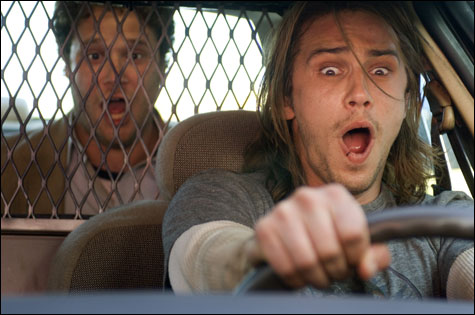
James Franco, however, puts in the performance of his career. In the Spider-Man films, I found him great as the pained kid who just wanted his father’s love, but I found him insufferable, whiny, and completely un-intimidating when he became the New Goblin. Here, he positively inhabits the role of Saul, capturing all the blankness of a habitual pot smoker without going out of his way to highlight his short term memory loss or his empty-headedness as well as making him lovable. It’s a strange year when, in the first 7 months, the two finest acting performances are a clown villain in a comic book film and a stoner in an action-comedy.

After Dale witnesses the murder (and they don’t mess around, you only have to wait about 8-10 minutes before the plot gets underway), the two ineptly dodge Ted’s vengeance: they run to the woods but forget that Ted’s bought cops can track their cell phones. Even when it dawns upon Saul, they don’t take proper steps. They go see Red, Saul’s middleman supplier who buys from Ted and sells to Saul, even though common sense would dictate that Red would be the first person Ted went to. From there it spirals into an explosive, if predictable action-comedy that errs on the side of action.

The focus of the jokes isn’t so much one-liners (though there are plenty of those), but in capturing the absurdity of Dale and Saul’s situation. Conversations are jumbled; everyone frantically talks over one another, making lines hard to filter out. I, however, like this method, because too many comedies let people in an argument speak one at a time so jokes can be heard. Here, it feels like you’re really watching two paranoid stoners who (quite rightly) think they are going to die at any second. The comedy only gets better when Red is introduced. He is at first an asshole and seemingly an antagonist, but, in the film’s third act, manages to steal the show even from James Franco. He’s crazy, simple, and screamingly funny. By the end of the film, he is somehow alive and somehow the best part of the film.

The action scenes are too jump-cutty, but they are where the film stands out. There is a massive fistfight, car chase, and a massive ending gunfight to keep you entertained. The scenes convey a great deal of the film’s humor, yet they are fairly decent action scenes in their own right. It’s not nearly as good a blend of humor and action as Hot Fuzz, but it’s a damn sight funnier than just about anything else out this year.

It’s not all great, though. Seth’s girlfriend serves no purpose other than to make him look pathetic, and her story ends abruptly and unsatisfyingly. My biggest complaint is actually Gary Cole. I love Gary, but he’s at best mediocre as a crazed drug supplier and, at worst, awful. His right hand man is a corrupt cop, played by Rosie Perez, who one can actually understand these days. Both mistake Dale and Saul for professionals sent by their rivals The Asians. Mistaking idiots for pros is uncomfortable familiar to Dumb & Dumber and a host of other films, and this doesn’t really feel unique enough to forgive that. Also, there is a predictable romance between Cole and Perez that is forced and doesn’t even manage to be funny in a “hey look how forced this is” way.


Anyone who goes into this film hoping for a great pot comedy will be crushingly disappointed; pot is merely the MacGuffin here. However, I was relieved; there are few things less funny than pot humor, and I was afraid the film would be a misfire. In fact, not only is the film not pot humor, it shows the flaws of stoners. Don’t get me wrong, the film is purely pro-pot, but Rogen and Goldberg write two stoners who are lovable but pathetic. Dale is in a job that requires little effort just so he can smoke all the time, and he is dating a high school girl. She keeps begging him to meet her parents, but he is scared, which is probably smart since she borders on jailbait. Saul is even sadder: he sits in his apartment watching old 227 reruns surrounded by electronic gadgets so he never has to leave. Pot comedies beat you over the head with how guys who are normally losers are thrust into a magical world of adventure and hot chicks when they smoke pot. Pineapple Express shows two guys who could possibly survive their ordeal if they’d just stop smoking for 2 hours.

As I said, there’s too much action and not enough comedy, but James Franco and Danny McBride make this movie and keep me rolling for the entire film. Gary Cole was weak, but I think the writing has as much to do with that as his portrayal. It’s not the best film I’ve seen, but I must say I laughed more than I do with all but the best of comedies.