Showing posts with label John Ford. Show all posts
Showing posts with label John Ford. Show all posts
Friday, June 27, 2014
Two Rode Together (John Ford, 1961)
Here's my review of John Ford's excellent late-period Two Rode Together and its fine Blu-Ray release from Twilight Time. Read my full review at Slant.


Thursday, March 6, 2014
John Ford's Lasting Importance
I had hoped to devote much of February to a celebration of John Ford, whose 120th birthday was on the first of that month. But restructuring at Film.com and unsuccessful pitches elsewhere stalled those efforts. At least I did get to write this piece, an attempt to counter some notions of the director's supposed stodginess and obsolescence by pointing out how much he still has to offer. It was difficult to limit this piece; at one point I felt I could make a book on the topic, before I remembered that it could not hope to compete with Tag Gallagher's own book celebrating the auteur.
Anyway, check out my piece for Film.com.
Anyway, check out my piece for Film.com.
The Sun Shines Bright (John Ford, 1953)
I wrote about John Ford's The Sun Shines Bright, cited by the man himself as his favorite of his movies, for Spectrum Culture. It's one of my favorite Ford movies as well, a subversive comedy that tackles the legacy of racism and nostalgic martyrdom in the South in a way that is sentimental and weighted toward sympathy for a dying breed even as it hides surprisingly bold critiques of contemporary racial and social division in plain sight. Olive Films put the film out on Blu-Ray out last year, and I can't recommend it enough.
Sunday, March 31, 2013
Steamboat Round the Bend (John Ford, 1935)
One of my favorite John Ford discoveries so far is this lazy river comedy, Ford's final collaboration with Will Rogers and a wonderful example of the director's affectionate but critical view of the post-Reconstruction South. Featuring one of Stepin Fetchit's most brazenly satiric roles and a plot that regularly falls to the wayside for the sake of slice-of-life character richness, Steamboat Round the Bend is a modest but powerful display of Ford's carefully constructed subtleties and humanity.
My full review is up now at Movie Mezzanine.
My full review is up now at Movie Mezzanine.
Wednesday, February 27, 2013
Young Mr. Lincoln (John Ford, 1939)
I was exhilarated by John Ford's Young Mr. Lincoln when I saw it recently, finding all the things I loved about Steven Spielberg's own Lincoln but without some of my nagging reservations about the film. In fairness, the same issues that gave me pause in Spielberg's film (the optimism making the cynicism a bit too well, the way arduous political scheming is presented as heroic) exist in Ford's, but Ford casts everything in a tone of his trademark ambivalence, finding the divine and all too mortal in his protagonist and those around him and not forcing his interpretation on an audience. In many ways, Henry Fonda's fresh-faced, breakthrough performance contains even stronger hints of Machiavellian maneuvering than Daniel Day-Lewis' war-weathered mastermind, and various contrasts of mise-en-scene and tone subvert every image just as soon as it tries to take root. A masterpiece, and truly one of the finest Ford films I've yet seen.
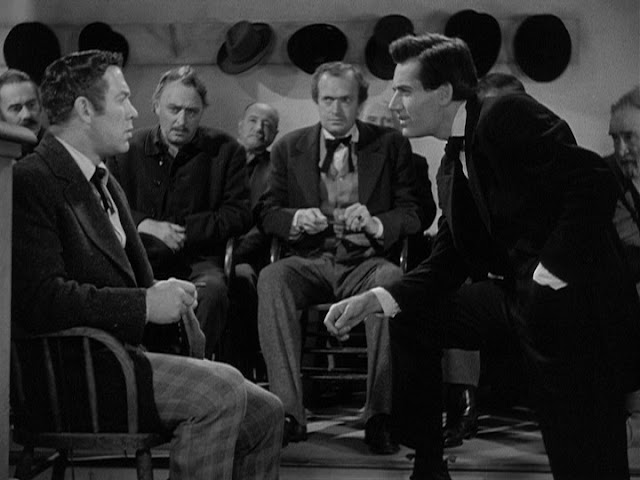
I wrote a longer review of the film over at Spectrum Culture. Check it out.

I wrote a longer review of the film over at Spectrum Culture. Check it out.
Saturday, November 21, 2009
The Grapes of Wrath
 There may have been better America directors before John Ford, and there were certainly better ones after, but no other director so completely epitomized that vague yet long-enduring image of "America." Indeed, no other director of any nationality likely represents that country's image quite like Ford. He was the one to bring majesty to the Old West in cinema, reviving the romanticism of its mythology after talkies sidelined the Westerns for a decade; with Stagecoach, he not only made the genre popular again but brought it for the first time into the level of high art, and subsequent efforts only solidified his indelible mark in the Western and cinema as a whole.
Only a year after Stagecoach, however, Ford made a film set in the wide expanse of the West but wholly antithetical to his typical, romantic vision. The Grapes of Wrath, based of course upon the beloved John Steinbeck novel, trades the open, inviting beauty of Stagecoach's endless landscapes for an engulfing, foreboding perversion of it. Through this vast emptiness blow shrill winds that kick up dust, massive clouds of dust that swallow the characters more than the environment.
Tom Joad enters this terrible new world after his release from a four-year prison sentence. Incarcerated for murder, albeit in self-defense, Joad emerges from prison aiming to see his family for the first time since his trial. He hitchhikes all the way to the old dusty trail that leads home, and we can immediately see that something is wrong. Ford frames Tom in an extreme long shot against dry, infertile farm ground. Once he gets to the Joad family farm, he finds it deserted, save for fellow sharecropper Muley, who tells Tom what happened in a flashback.
Both Ford and producer Darryl F. Zanuck were conservative, which makes their decision to film the most famous left-wing publications of the time baffling. Ford certainly doesn't compromise Steinbeck's original vision with this flashback: the company that holds the deeds to the Okies' land comes around to announce that the farms are losing money because of the dust storms and the company is evicting the residents to hire a handful of tractor drivers to do the same amount of work. These farmers are second, even third-generation descendants of the people who signed the sharecropper agreements. They don't understand that the land they grew up on doesn't belong to them, and one farmer is so outraged that he asks the rep who is doing this. It's not a person, it's a company, the rep replies. No point in killing the company president, though; he just does what the bank tells him. However, the local bank is run by a manager who doesn't remotely have the power to make such decisions. "So who do we shoot?" the farmer seethes. "Brother, I don't know. You find out, you tell me." This scene is The Grapes of Wrath in a nutshell: the rich have created a system that allows them to survive even in a depression, one that works by completely casting aside the working class to starve.
Tom finds his family at his uncle's house, which is next on the chopping block. He is welcomed back with open arms, and he finds the family teeming with excitement over a letter they've received promoting jobs in California, with positions for 800 crop pickers. Oblivious to the full implication of this impersonal message sent en masse throughout all of Oklahoma -- possibly the whole Midwest -- the family speaks of California as if the promised land, and each of the family members sits at the bare table thinking of all the delicious fruits and sweets that await them.
And so, like the hopeful, naïve optimists a century ago, the Joads head west in search of prosperity. At every step, tragedy abounds, at all times revealing Steinbeck's original leftist messages. The grandparents die of old age and malnutrition. A man returning from the empty promise of California bitterly attacks the Joads' bumpkin sunniness with a gruesome description of his family's slow death from starvation. In California, the Joads shuffle through a series of worker camps, where land owners have refined class oppression to an art form: they drive wages down, charge outrageous prices at the only stores in town. Hell, even the cops are in on the shakedown. No matter where the Joads turn, they find only destitution and corruption, all of it brought on by the lingering stench of unrepentant capitalism. Even when the Joads at last stumble onto a clean and just camp, run tellingly by the government as one of Roosevelt's New Deal programs, the corrupt deputies from the other camps come to wreak havoc on those who would find happiness in a community not run on greed.
The epic tragedy of America's collapse is perfectly accentuated by the photography of Gregg Toland, greatest of the cinematographers. Compared to the softer photography of most classic monochrome films, The Grapes of Wrath looks as real as if it were made today. Toland would help revolutionize cinema a year later with his work on Citizen Kane, but here he displays a command of the craft no less impressive, and Wrath contains some of the most strikingly realistic cinematography since Dreyer's 1928 opus The Passion of Joan of Arc. The film is on the cusp of its 70th anniversary, currently available on an old DVD master, yet in some shots you can practically count the pores on Tom Joad's face clogged by grime and dust. Those who believe in hell mistakenly describe it as a place of fire and brimstone, forgetting or simply neglecting that the Bible makes no mention of such a place until Revelation. No, a fundamental definition of hell is simply the absence of God, and the starkly photographed sparsity of the desolate western farmland interspersed with America's children reverted back to the humbled masses who spawned them is as chilling a depiction of the falsity of the American Dream, even of the notion that God blesses America, as anything in the Godfather saga.
For all of Ford and Toland's gorgeous and haunting visuals, however, they place all of the emotional and metaphorical weight on three steadfast and basic symbols. The first is the Joad family vehicle: they ride in a sedan converted into some garish flatbed truck, a revolting blob of warped wood and rusted metal, to house the family and their few remaining possessions. Due to The Beverly Hillbillies, this image is now a parody and a symbol of the stereotypical hick, but here it's as tragic as any of the stories of starvation and destitution. This rickety, decaying eyesore is the sad aftermath of a once-beautiful product of American ingenuity and prosperity, representative of America's shambolic descent in the Depression. Nevertheless, it must be noted that, for all its instability and obsolescence, the car always pulls through in the end.
The second symbol is Jim Casy, whom Tom meets on the way to the abandoned Joad farm. The preacher who baptized Tom, Casy is now an alcoholic disgrace who lost his faith after (consensual) liaisons with some of the young women of his congregation as well as the psychological strain of the Great Depression. In that sense, he recognizes this wasteland as hell and acts accordingly, but this is merely the start of Casy's rebirth, a religious conception, as a secular social reformer. In the camps, he deflects a worker's assault on an officer onto himself, and later he organizes a worker revolt, only to be killed by camp guards. Tom says of his friend's sudden drive to action, "He could have been a preacher, but he seen (sic) things clear," and indeed Casy's human concern for the oppressed workers is the most forceful, as well as ideologically Christian, action in the film.
The third, of course, is Tom Joad, though perhaps that's less apt than simply saying Henry Fonda. If John Ford is the most American of directors, then Fonda must surely be the most American of actors: in his roles he personified some aspect of the American ideal, from a sense of social and racial justice (12 Angry Men) to the admittedly false image of basic morality in the form of Wyatt Earp (My Darling Clementine). He even played Abraham Lincoln, the enduring symbol of American freedom. Here, in the role that made him a star, he is, quite simply, an American. Uneducated but smart, dangerous yet gentle, Tom stands in the middle of various contrasts, and furthermore in the middle of an intense struggle for the future of America's power structure, between the system that failed and now grabs blindly at the shards of its shattered constructs and a government that wishes to help those sucked dry and cast aside by the previous administrators. When I said that this film seems as real as if it came out yesterday, that is not only for its visual acumen but for its glaring parallels to our current situation.
If The Grapes of Wrath falters, it does so at the end, when, for all of Toland's sharp photography and Fonda's naturalistic acting -- seriously, compare Fonda's convincing readings to Carradine's, who literally proclaims his first lines to the heavens his character no longer believes in despite being in a conversation with Tom -- the script suddenly and shamelessly chucks in dialogue that makes everyone instantly aware that it came from a script. Tom's no dummy, but the idea that this farm-raised Okie could speak so poetically severely tests the tensile strength of one's suspension of disbelief. But no matter: The Grapes of Wrath, like its source material, is one of the towering works of the 20th century, and no single chunk of dialogue, however, contrived, could derail it. To better understand the heart of this picture, I would point to an earlier scene, of Ma Joad quietly turning out a box of sentimental possessions, only to discover a pair of earrings that she holds up to a mirror with a look of nostalgia before quietly saving them in her pocket. The scene is pure poetry, an depiction of an implacable sense of dignity that exists no matter how rough it all gets. As an expression of the basic qualities which make us human and give us our humanity, I have seen none better.
Thursday, January 22, 2009
Stagecoach
Written by: Dudley Nichols and Ben Hecht
Directed by: John Ford
 John Ford. His name is synonymous with Westerns. Before he came along, Westerns existed as B-movie schlock, vapid displays of conservative values to pass an evening away. Even Ford himself worked within the conventions of the genre for years. But with Stagecoach in 1939, he changed the game forever, moving the Western out of the realm of the B-picture and into the realm of art.
The titular stagecoach carries passengers from the Arizona Territory to Lourdsbourg, New Mexico. To get there, the drivers must head through hostile Apache territory. The motley crew includes a prostitute, a lady on her way to see her husband, an alcoholic doctor and the whiskey salesmen he brought along. Shortly after departure, the coach picks up fugitive Ringo the Kid (John Wayne). Knowing of the Kid's vendetta against the Apache, Marshal Wilcox (who rides with the driver as protection, ignores Ringo's outlaw status and invites him along, just in case.
With the nine characters riding and driving the stagecoach, Ford and his writer Dudley Nichols explore a myriad of topics, ranging from sexual to racial prejudices to alcoholism to revenge and redemption. While, as with Ford's later masterpiece The Searchers, the director handles the topics in ways much too obvious today, when placed within the context of the day they seem prescient and progressive.
But I find myself wondering if, by focusing on the social messages of Ford's films, we sometimes forget just how much fun they are. I'm not big on Westerns, but I make exceptions for three people: Sergio Leone, Clint Eastwood, and John Ford. All three display an uncanny ability to wring originality from a genre that forever seems trampled in the dust by its horses' hooves. But the plight of these stagecoach riders in the midst of an Apache uprising is genuinely compelling, thrilling even.
One could possibly attribute these thrills to the film's simple but effective structure. Ford divides the movie into 8 distinct episodes, 4 action pieces and 4 character examinations. The six major characters all form their own innovative Western archetype: the alcoholic, the outlaw, the whore, the reputable businessman, the loyal wife, and the Confederate. Pick any Western made since this film and you can likely tick off at least three such characters, some of whom may inhabit more than one of these aspects.
As inventive and groundbreaking as the film remains, perhaps its greatest contribution to the Western was the breakout performance by John Wayne. Wayne, who had appeared in over 70 films at that point (including some of Ford's), still worked chiefly as a hired hand, but all that changed the moment Ford introduced his character. In one of the most famous character introductions ever, the camera spots Ringo and zooms in so quickly the operator could maintain the focus until the camera stopped again. It jolts you out of your seat and makes you want to identify with Wayne before he even utters a line.
Of course, after this film, Wayne was never the same. Suddenly he became the biggest star since Bogey, maybe even bigger. His macho walk and staccato drawl firmly enshrined him in the annals of film history, and it's all because of this film. Yet despite the myriad of roles he took after this film, Wayne put in just about all of his best performance in his subsequent collaborations with Ford, the best and most famous of which being his work in The Searchers.
Just about a perfectly directed film, Stagecoach represents the best of what John Ford has to offer, even if he'd better his own standard with later masterpieces like The Searchers and My Darling Clementine (which boasts one of the best shootouts in the history of film, even though the shootout is never the point). It's the birth of the modern Western, and one of its finest entries. Now hand me my hat, partner.
Subscribe to:
Posts (Atom)