I have capsule reviews for each of the animated and live-action shorts nominated for this year's Oscars at Spectrum Culture. They are mostly a wan bunch, lacking the spark of the best short-form artistry and in some cases feeling like mere fragments where a good short feels as if it contains the world. Even so, a few here and there piqued my curiosity, and some even entertained me.
The post with capsules is up now at Spectrum Culture.
Showing posts with label short fims. Show all posts
Showing posts with label short fims. Show all posts
Tuesday, February 5, 2013


Thursday, October 18, 2012
Cactus River (Apichatpong Weerasethakul, 2012)
Apichatpong Weerasethakul's shorts are the only thing more confounding than his full-length works, and Cactus River is his most obscure in some time. A black-and-white "tribute" to the Mekong River, Cactus River documents one of Joe's actors, Jenjira Pongpas, as she lives out her daily routine with her husband, an American ex-pat she met online and recently married. Sounds innocuous, until Joe plays the film at a lower frame rate, making it jerk around like a silent as the audio track plays only the roar of wind on a poorly covered mic and pops that somehow manage to be louder than the white noise.

Joe tends to attach a brief explanation to his shorts, perhaps anticipating the viewer's bafflement. Not that his statements are entirely helpful: they tend to be as cryptic as the films themselves, though they do sometimes offer a clue to be interpreted. The director's synopsis for this short relates how Jenjira changed her name to Nach, which means "water." Nach lives on the bank of the Mekong, which she worries will dry up soon thanks to Chinese dams. Does that explain the title, then? That this surging body of water may soon become an arid bed of desert plants? And if Jenjira now calls herself water, is she the river's heir? Perhaps this 10-minute abstract posits a Thai Anna Livia Plurabelle.
As ever with Joe's work, Cactus River overflows with indelible, evocative images. The choppy rhythms of the frame rate slow when the camera settles upon the Mekong in the frantic opening montage, put at ease by the river's flow (or, alternately, drying up with a blocked-off source. Nach's husband watches Thai TV on mute, the flicker of Joe's high-contrast film obscuring the image on the TV into what almost looks like a nuclear cataclysm until a cactus can eventually be made out, looming over its surroundings in a low-angle shot. The final, still image cuts to color as Nach beckons out over the river. Rebirth is a key feature of Joe's films, from the bifurcated structure of Tropical Malady to the reincarnation-cum-genre-tour that was Uncle Boonmee. As such, the last shot could be the "In Memoriam" photo for the Mekong, but also the first documented photo of its new avatar.

Joe tends to attach a brief explanation to his shorts, perhaps anticipating the viewer's bafflement. Not that his statements are entirely helpful: they tend to be as cryptic as the films themselves, though they do sometimes offer a clue to be interpreted. The director's synopsis for this short relates how Jenjira changed her name to Nach, which means "water." Nach lives on the bank of the Mekong, which she worries will dry up soon thanks to Chinese dams. Does that explain the title, then? That this surging body of water may soon become an arid bed of desert plants? And if Jenjira now calls herself water, is she the river's heir? Perhaps this 10-minute abstract posits a Thai Anna Livia Plurabelle.
As ever with Joe's work, Cactus River overflows with indelible, evocative images. The choppy rhythms of the frame rate slow when the camera settles upon the Mekong in the frantic opening montage, put at ease by the river's flow (or, alternately, drying up with a blocked-off source. Nach's husband watches Thai TV on mute, the flicker of Joe's high-contrast film obscuring the image on the TV into what almost looks like a nuclear cataclysm until a cactus can eventually be made out, looming over its surroundings in a low-angle shot. The final, still image cuts to color as Nach beckons out over the river. Rebirth is a key feature of Joe's films, from the bifurcated structure of Tropical Malady to the reincarnation-cum-genre-tour that was Uncle Boonmee. As such, the last shot could be the "In Memoriam" photo for the Mekong, but also the first documented photo of its new avatar.
Wednesday, September 19, 2012
Capsule Reviews: Wavelength, Begone Dull Care, Bezhin Meadow
Wavelength (Michael Snow, 1967)

Michael Snow' legendary 45-minute structuralist work feels about three times its length, a slow zoom across a vast, near-empty office to a photo on the opposite wall. Yet the time and space experiment is a fascinating work of cinema, the steady shot using variations in exposure and other in-camera tweaks to subtly transform one space into another, and to turn day into night with a filter change. Further challenging the makeup of cinema (and the audience's patience) is the soundtrack mixing synthetic an oceanic waves into steady wails of unending noise. It is an undeniably infuriating experience, but also one of the most brilliantly conceptual breakdowns of cinema ever made. And as Snow's different filters and exposures warped space and time, I found myself bizarrely moved, the director's intellectual, self-critical use of the camera also something of an exhibition of the "magic" of film. Maybe it's weird to look sentimentally upon a film with a soundtrack gradually building to the hissing shriek of a boiling kettle, but there you go. Grade: A+
Begone Dull Care (Evelyn Lambert & Norman McLaren, 1949)

This 8-minute visualization of jazz music (specifically a three-movement piece by the Oscar Peterson Trio) is a triumph of early experimental filmmaking, using paint, scratches and animation in an abstract ballet of synesthesia. The frantic layering of unclear imagery and sound prefigures so much experimental cinema, yet the sheer giddiness of its dance of light and the complex layering of painted strips and extreme-close-ups on symbols gives Begone Dull Care a vivaciousness that rates it over all but the best of the works to clearly derive inspiration from it. This kind of filmmaking can seem closed off and intellectualized, but from the rolling, danceable bounce of Peterson's licks to the listing of credits in multiple languages, Begone Dull Care is clearly meant to be enjoyed by all. Grade: A
Bezhin Meadow (Sergei Eisenstein, 1937)

Reconstructed from a suppressed work about a boy who prevents his father from destroying the collective's food, Bezhin Meadow is, even as nothing more than a progression of film stills, a work of stunning beauty. The edit of the "film" that I saw opens on lush shots of nature, of branches criss-crossing the frame, before telling the audience that the evil father has beaten his wife to death and now plots against the son for loving the Soviet cause more than him. I normally can't bear to watch reassembled stills presented as a lost film; it's like finding fragments of poetry, or uncollected bars of an unfinished composition. But the stunning composition of Eisenstein's images is so gorgeous and the rhythm of his montage so unexpectedly preserved in the stacking of these static photos that Bezhin Meadow is not only watchable but one of the great director's most stirring works. That's true despite, or maybe because, of its unbearable irony, its propagandic shots in service to some of the most insane public collusions with communism—paranoia over "wrecking" of collective farms, the lionization of the child who reports his parents—apparently insufficient to prevent harsh censorship. This is never more clear than in the scenes in which religious imagery and symbolism is mockingly upended even as the film subtly supplants Christ for Stalin and upholds a new, secular fanaticism that relies upon the stifling religious iconography it seeks to destroy. So many of Eisenstein's film bear the burden of this sad irony in retrospect, but they are never anything less than stunning, even when censoring crackdowns reduce his work to nothing more than a glorified slideshow (and we're lucky to have even that).

Michael Snow' legendary 45-minute structuralist work feels about three times its length, a slow zoom across a vast, near-empty office to a photo on the opposite wall. Yet the time and space experiment is a fascinating work of cinema, the steady shot using variations in exposure and other in-camera tweaks to subtly transform one space into another, and to turn day into night with a filter change. Further challenging the makeup of cinema (and the audience's patience) is the soundtrack mixing synthetic an oceanic waves into steady wails of unending noise. It is an undeniably infuriating experience, but also one of the most brilliantly conceptual breakdowns of cinema ever made. And as Snow's different filters and exposures warped space and time, I found myself bizarrely moved, the director's intellectual, self-critical use of the camera also something of an exhibition of the "magic" of film. Maybe it's weird to look sentimentally upon a film with a soundtrack gradually building to the hissing shriek of a boiling kettle, but there you go. Grade: A+
Begone Dull Care (Evelyn Lambert & Norman McLaren, 1949)
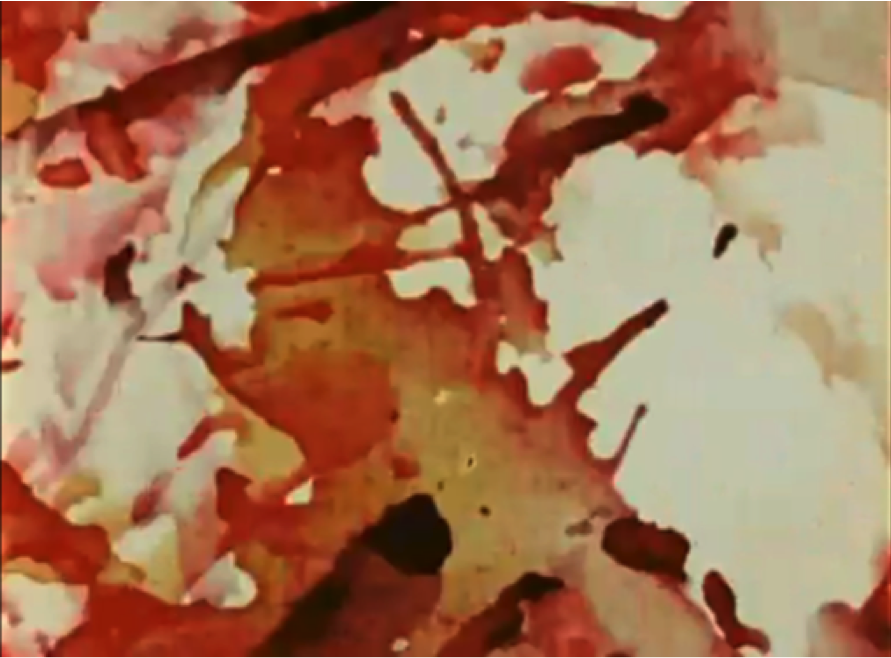
This 8-minute visualization of jazz music (specifically a three-movement piece by the Oscar Peterson Trio) is a triumph of early experimental filmmaking, using paint, scratches and animation in an abstract ballet of synesthesia. The frantic layering of unclear imagery and sound prefigures so much experimental cinema, yet the sheer giddiness of its dance of light and the complex layering of painted strips and extreme-close-ups on symbols gives Begone Dull Care a vivaciousness that rates it over all but the best of the works to clearly derive inspiration from it. This kind of filmmaking can seem closed off and intellectualized, but from the rolling, danceable bounce of Peterson's licks to the listing of credits in multiple languages, Begone Dull Care is clearly meant to be enjoyed by all. Grade: A
Bezhin Meadow (Sergei Eisenstein, 1937)

Reconstructed from a suppressed work about a boy who prevents his father from destroying the collective's food, Bezhin Meadow is, even as nothing more than a progression of film stills, a work of stunning beauty. The edit of the "film" that I saw opens on lush shots of nature, of branches criss-crossing the frame, before telling the audience that the evil father has beaten his wife to death and now plots against the son for loving the Soviet cause more than him. I normally can't bear to watch reassembled stills presented as a lost film; it's like finding fragments of poetry, or uncollected bars of an unfinished composition. But the stunning composition of Eisenstein's images is so gorgeous and the rhythm of his montage so unexpectedly preserved in the stacking of these static photos that Bezhin Meadow is not only watchable but one of the great director's most stirring works. That's true despite, or maybe because, of its unbearable irony, its propagandic shots in service to some of the most insane public collusions with communism—paranoia over "wrecking" of collective farms, the lionization of the child who reports his parents—apparently insufficient to prevent harsh censorship. This is never more clear than in the scenes in which religious imagery and symbolism is mockingly upended even as the film subtly supplants Christ for Stalin and upholds a new, secular fanaticism that relies upon the stifling religious iconography it seeks to destroy. So many of Eisenstein's film bear the burden of this sad irony in retrospect, but they are never anything less than stunning, even when censoring crackdowns reduce his work to nothing more than a glorified slideshow (and we're lucky to have even that).
Monday, April 23, 2012
Day & Night (Teddy Newton, 2010)
[The following is an entry in Pussy Goes Grrr's Short Animation Blogathon, running April 23-27.]
My first experience with short animation was, naturally, old Looney Tunes cartoons played in syndication on morning TV when I was growing up in the '90s. Yet it was through Pixar that I first got the chance to see shorts (either animated or live-action) on a big screen. I still remember the first of Pixar's theatrically attached shorts—Gen's Game, the loopy back-and-forth of an old man ferociously playing himself at chess in a park—better than the feature it accompanied, A Bug's Life. Though I was far, far too young to elucidate how the short's construction hooked me, the way its cuts and "angles" made the old player seem like two distinct people each formulating secret strategies against the other was riotous and thrilling. For the longest time, the lingering, nostalgic giddiness Gen's Game produced made it my favorite of the Pixar shorts.
Until Day & Night. Released 12 years after 1998's Gen's Game, Day & Night was the first Pixar short since that one to be superior to the film it supported. The difference is that the earlier film easily stood out against Pixar's sophomore slump. But Day & Night, that was attached to one of the studio's finest, the unexpectedly poignant, technically superfluous Toy Story 3. At six minutes long, Day & Night proves as much a technical achievement as the feature presentation, and its driving theme as simple and direct yet illuminating and intelligent as the themes of maturation and moving on in Toy Story 3.

True to the time limitations of the form, the short sets itself up quickly. Opening on the usual Pixar 3D animation of an idyllic field, the camera pulls back until it reveals this world as being the tightly contained view of a transparent being existing in 2D space against an infinite black void. Stumbling about in his morning routine, this being happens across someone just like him. Well, almost. Instead of showing an area basked in the morning sun, this other creature offers a window into night. Startled, the two soon engage in a hostile pissing match to demonstrate their superiority, each showing off what goes on at their respective times to impress and cow the other.
The thematic implications are obvious, and only more so as the shortened plot swiftly moves the two from antagonism to mutual admiration and cooperation. Capped off with an old lecture from Wayne Dyer about the importance of embracing the different, Day & Night makes a clear, direct argument for children that warns against xenophobia and just generally hating the unknown. But what makes the film truly masterful is how it's put together. The movement of the two beings in the 2D realm, as well as their moods and expressions, is demonstrated through objects and sounds captured within their portal bodies. For example, when Day wakes up to a rooster crow at the start, thunderclouds communicate the cracking of stiff joints and the sigh of pleasure he emits when he walks into the releasing rush of a waterfall is...well, guess. Even better is the integration of the outer 2D space with the 3D textures within, enhancing the texture of both levels. For a more in-depth account of how this looked in a theater with 3D glasses on, I direct you to Tim Brayton's simply magnificent contemporary review of the short, which he later named the best film of 2010.
Tim's review is so incredible that I'll pretty much stop here, unable to equal his piece, much less add to it. Even his title, "Hegel for Wee Folk," is brilliant, though it also offers perhaps the one area where I can object to him on any grounds. Though the use of 2D and 3D to illustrate the conflict between day and night certainly highlights Hegelian dialectic in several respects, the film's final moments, of the dualities of the two creatures reversing, move beyond Hegel into something more reminiscent of Levinas. When the two stand side by side, the sun setting in one and rising in another (complete with a brief meeting of the two semicircles at the midpoint of both bodies), the self and other invert and become irrelevant, fictitious projections that compel us not into the hatred cautioned against by Dyer but in the fundamental need for empathy as espoused by Levinas. Whether it owes more to Hegel or Levinas, though, Day & Night still broaches at least one of the most challenging philosophers in history, even as it presents a cogent, easily parsed out message for kids. It's one of the best short films I've ever seen.
My first experience with short animation was, naturally, old Looney Tunes cartoons played in syndication on morning TV when I was growing up in the '90s. Yet it was through Pixar that I first got the chance to see shorts (either animated or live-action) on a big screen. I still remember the first of Pixar's theatrically attached shorts—Gen's Game, the loopy back-and-forth of an old man ferociously playing himself at chess in a park—better than the feature it accompanied, A Bug's Life. Though I was far, far too young to elucidate how the short's construction hooked me, the way its cuts and "angles" made the old player seem like two distinct people each formulating secret strategies against the other was riotous and thrilling. For the longest time, the lingering, nostalgic giddiness Gen's Game produced made it my favorite of the Pixar shorts.
Until Day & Night. Released 12 years after 1998's Gen's Game, Day & Night was the first Pixar short since that one to be superior to the film it supported. The difference is that the earlier film easily stood out against Pixar's sophomore slump. But Day & Night, that was attached to one of the studio's finest, the unexpectedly poignant, technically superfluous Toy Story 3. At six minutes long, Day & Night proves as much a technical achievement as the feature presentation, and its driving theme as simple and direct yet illuminating and intelligent as the themes of maturation and moving on in Toy Story 3.

True to the time limitations of the form, the short sets itself up quickly. Opening on the usual Pixar 3D animation of an idyllic field, the camera pulls back until it reveals this world as being the tightly contained view of a transparent being existing in 2D space against an infinite black void. Stumbling about in his morning routine, this being happens across someone just like him. Well, almost. Instead of showing an area basked in the morning sun, this other creature offers a window into night. Startled, the two soon engage in a hostile pissing match to demonstrate their superiority, each showing off what goes on at their respective times to impress and cow the other.
The thematic implications are obvious, and only more so as the shortened plot swiftly moves the two from antagonism to mutual admiration and cooperation. Capped off with an old lecture from Wayne Dyer about the importance of embracing the different, Day & Night makes a clear, direct argument for children that warns against xenophobia and just generally hating the unknown. But what makes the film truly masterful is how it's put together. The movement of the two beings in the 2D realm, as well as their moods and expressions, is demonstrated through objects and sounds captured within their portal bodies. For example, when Day wakes up to a rooster crow at the start, thunderclouds communicate the cracking of stiff joints and the sigh of pleasure he emits when he walks into the releasing rush of a waterfall is...well, guess. Even better is the integration of the outer 2D space with the 3D textures within, enhancing the texture of both levels. For a more in-depth account of how this looked in a theater with 3D glasses on, I direct you to Tim Brayton's simply magnificent contemporary review of the short, which he later named the best film of 2010.
Tim's review is so incredible that I'll pretty much stop here, unable to equal his piece, much less add to it. Even his title, "Hegel for Wee Folk," is brilliant, though it also offers perhaps the one area where I can object to him on any grounds. Though the use of 2D and 3D to illustrate the conflict between day and night certainly highlights Hegelian dialectic in several respects, the film's final moments, of the dualities of the two creatures reversing, move beyond Hegel into something more reminiscent of Levinas. When the two stand side by side, the sun setting in one and rising in another (complete with a brief meeting of the two semicircles at the midpoint of both bodies), the self and other invert and become irrelevant, fictitious projections that compel us not into the hatred cautioned against by Dyer but in the fundamental need for empathy as espoused by Levinas. Whether it owes more to Hegel or Levinas, though, Day & Night still broaches at least one of the most challenging philosophers in history, even as it presents a cogent, easily parsed out message for kids. It's one of the best short films I've ever seen.
Thursday, November 10, 2011
Beneath the Earth Film Festival
OK gang, so recently I was a judge for the Beneath the Earth Film Festival, which showcased short films by up-and-comers looking to prove their stuff. Of the seven films screened, I particularly enjoyed three and felt another three showed real promise (only one completely irritated me, but it shall remain nameless), and I was happy to have participated. Four of the films won for the various categories, but I'd like to briefly highlight the two big winners for Best Film and Audience Award:
Best Film: Photographs
I was extremely pleased to see this film win, though I can't conceive of how it couldn't. A brief, beautifully animated vignette of an old woman discovering a camera that doesn't seem all that much younger than her, Photographs is superb. Its wordless six minutes doesn't waste a second, yet the film takes its time in revealing the significance of the woman's innocent self-portraits. But even without the heartbreaking finale, Photographs is still a moving testament to the childlike properties that art instills in us and nourishes in even the bleakest, most unforgivingly adult situations.
Audience Award: After Ever After
I confess less enthusiasm for the audience award recipient, even if it's still not my least-favorite of the seven films. After Ever After works as a sort of mashup between the works of Michel Gondry and (500) Days of Summer, only it lacks the innovation and cheek of either. I was also ready to pounce on the occupation of its protagonist, the increasingly stale job of the adman, but reading that the director actually has worked for ad agencies mollified me somewhat. At least he's writing from experience; I feel like Hollywood just acknowledges what it really does when it puts its characters in advertising firms. But even if the film doesn't strike me as original or even remarkable, the aesthetic components are all in place: it displays solid editing, cinematography and direction throughout, which are all the things short films are supposed to hone.
Best Film: Photographs
I was extremely pleased to see this film win, though I can't conceive of how it couldn't. A brief, beautifully animated vignette of an old woman discovering a camera that doesn't seem all that much younger than her, Photographs is superb. Its wordless six minutes doesn't waste a second, yet the film takes its time in revealing the significance of the woman's innocent self-portraits. But even without the heartbreaking finale, Photographs is still a moving testament to the childlike properties that art instills in us and nourishes in even the bleakest, most unforgivingly adult situations.
Audience Award: After Ever After
I confess less enthusiasm for the audience award recipient, even if it's still not my least-favorite of the seven films. After Ever After works as a sort of mashup between the works of Michel Gondry and (500) Days of Summer, only it lacks the innovation and cheek of either. I was also ready to pounce on the occupation of its protagonist, the increasingly stale job of the adman, but reading that the director actually has worked for ad agencies mollified me somewhat. At least he's writing from experience; I feel like Hollywood just acknowledges what it really does when it puts its characters in advertising firms. But even if the film doesn't strike me as original or even remarkable, the aesthetic components are all in place: it displays solid editing, cinematography and direction throughout, which are all the things short films are supposed to hone.
Thursday, September 8, 2011
The Janitor (Nicholas Ray, 1974)
[The following is a contribution to the Nicholas Ray Blog-A-Thon for Tony Dayoub's Cinema Viewfinder.]
Nicholas Ray's contribution to the Wet Dreams anthology film, entitled "The Janitor," is a deconstruction of Nicholas Ray the symbol through the symbolic destruction of Nicholas Ray the man. Ray himself plays two of the film's three chief parts, those of a priest speaking to a teenage congregation and a janitor who toils in a movie studio that becomes increasingly connected to the priest's story through broken diegesis and metacinema. And through it all, the film adheres to the softcore theme behind the overall project.
The first striking aspect of the film is Ray's face. With his untamed hair, eye patch, lined face and perilous, craggy chasm of a mouth, Ray looks like Dionysus in decline, a hard-living hero now dessicated by self-abuse. That brand of self-abuse finds its way into the film's main form of self-abuse, and the swirling torrent of religiosity, sexual ecstasy, guilt and self-hatred that springs forth from this collision makes "The Janitor" an unexpected triumph. Unless you were watching this to get off, in which case the film is a horrendous failure.
Nicholas Ray's contribution to the Wet Dreams anthology film, entitled "The Janitor," is a deconstruction of Nicholas Ray the symbol through the symbolic destruction of Nicholas Ray the man. Ray himself plays two of the film's three chief parts, those of a priest speaking to a teenage congregation and a janitor who toils in a movie studio that becomes increasingly connected to the priest's story through broken diegesis and metacinema. And through it all, the film adheres to the softcore theme behind the overall project.
The first striking aspect of the film is Ray's face. With his untamed hair, eye patch, lined face and perilous, craggy chasm of a mouth, Ray looks like Dionysus in decline, a hard-living hero now dessicated by self-abuse. That brand of self-abuse finds its way into the film's main form of self-abuse, and the swirling torrent of religiosity, sexual ecstasy, guilt and self-hatred that springs forth from this collision makes "The Janitor" an unexpected triumph. Unless you were watching this to get off, in which case the film is a horrendous failure.
Thursday, April 14, 2011
When It Rains (Charles Burnett, 1995)

At first glance, Charles Burnett's 13-minute short When It Rains may seem a bit low-key to be worthy of Jonathan Rosenbaum's high praise (his being damn-near the only mention you can find of the once-obscure short). But if the best short films capture something of life in narrow time-frames, Burnett's jazz-blues riff on community life surely stands as a masterful condensation of his unique blend of Ozu's stark but deliberate framing and Rossellini's neorealism.
Set on a bustling New Year's Day, When It Rains depicts a man (Ayuko Babu) attempting to help a friend pay her rent to an impatient landlord threatening to throw her and her child out if she doesn't cough up the money by that evening. The man, a musician and griot (a sort of oral historian/poet), tries to help by calling on favors from people around the community. It's a simple setup, but then Burnett never needed much to make a masterpiece.
Monday, April 19, 2010
Two Short Films by Apichatpong Weerasethakul
What a shame it is, in the modern world, that short films receive absolutely no attention. It's understandable, of course: with so many apathetic to film in general, the chance for bold and innovative short-form work to find an audience has nearly gone from slim to none. Only Pixar, with its admirable commitment to maintaining the tradition of shorts preceding the main feature, has managed to screen brief films in any sort of mainstream context.
Once upon a time, of course, short films could exist comfortably alongside feature films, playing in advance of the main attraction. Well, go back further: once upon a time, short films were cinema, back when one- and two-reelers preceded the advent of the feature film and continued to coexist healthily beside them into the '30s. Now, they exist for burgeoning directors to prove their talent in order to land a feature, after which they never look back. But what of the radical accomplishments of experimental cinema and its numerous short landscape-altering masterpieces? Why is it so crazy to insist that The Big Shave is one of Scorsese's best works, and a fundamental building block in the development of his thematic schemata, its image of a man incapable of ceasing to hurt himself reflected in most of his best features and many of the others?
I myself can claim no decent knowledge in short films, scrambling each year to find Oscar-nominated short films online until the ones I cannot see eventually fade from my mind as other pressing issues enter into it. I have, however, noticed the contributions of two filmmakers, both proven feature craftsmen, in the field of short films. One is Guy Maddin, who balances every feature with a short and whose The Heart of the World nearly captures the copious offerings of silent cinema and its range of genres and styles in only six minutes. Maddin, whose style is heavily indebted to the silent era, clearly understands the power of short films, aware that the same methods of good feature-length filmmaking -- smart writing and attentive direction -- are used to make great works in only a few minutes. The other is, as you may have guessed by now, Apichatpong Weerasethakul. The Thai director, one of the most prominent of the new century, has made dozens of short films, some commissioned, some simply the result of his desire to create. Any number have received attention in their own right, but the focus of this post will be on his two recent shorts, A Letter to Uncle Boonmee and Phantoms of Nabua, each an entry into his "Primitive" series, commissioned by Animate Projects to examine the small but vital village Nabua, situated in the northeast of Thailand on near the Mekong River and the border between Thailand and Laos. Both are noteworthy not simply for their qualities, which are bountiful; they also reveal the director's ongoing preoccupation with pet themes, as well as the way that they relate to each other and to the director's feature canon.

A Letter to Uncle Boonmee serves to prefigure a feature-length film, Uncle Boonmee Who Can Recall His Past Lives, set to premiere at Cannes this year. Like Godard's "making-of" supplements for some of his films -- Scénario du film Passion, for example -- Weerasethakul's short does and doesn't work as a behind-the-scenes companion piece to the longer version. Actors read out his titular letter, impersonating the director as they address the mysterious uncle, who could supposedly remember his previous incarnations upon the Earth.
The letter contains Weerasethakul's musings on traveling to Nabua to make the movie, how what he'd heard and researched, and subsequently scripted, was so very different from the Nabua he saw when he arrived. In the letter's matter-of-fact description of the split between the perceived Nabua and the genuine article, Weerasethakul gently introduces one of his key themes: the difference between cinematic perception and reality. Of course, the use of "gentle" in relation to Uncle Boonmee quickly becomes redundant, as nearly every second of its sublime 18 minutes proceeds in a light, hypnotic fashion.
Strange, too, considering the subject matter. Weerasethakul reveals the actors to be playing the roles of soldiers, who occupy a house in the otherwise empty village. Nabua fell prey to police occupation starting in the '60s and lasting until the '80s, during which time soldiers routinely tortured, raped and murdered under orders to curb Communist insurgency. "Soldiers once occupied this place," says one of the actors. "They killed and tortured the villagers until everyone fled into the jungle." The emptiness of the village thus takes on a wider significance: these soldiers now move into a village that their predecessors pillaged until it became the barren, forgotten hamlet we see under Weerasethakul's gaze.
Yet gentle the film undeniably is, what with its elegant tracking shots through the interiors of the Nabua homes, objects like portraits and mosquito nets frozen in time as the wooden walls that support them slowly rot. Each actor repeats the letter, and the director scans a new house with each reading, curving from left to right to take in the preserved adornments and the decaying structures. The repetition underscores the notion of reincarnation raised by the letter and Boonmee's supposed memories, a motif heightened by the role of the soldiers. The silence of the village, save for the reading of the letter, is broken by two noteworthy sounds. The first is the dull thud of metal farm implements on earth as the soldiers till the land and build a garden. Where their own past incarnations sought to pillage the land, now the soldiers cultivate and regrow. Though Thailand still suffers from oppressive regimes -- Weerasethakul himself has faced numerous artistic challenges from the country's strict censorship board -- these men perhaps represent a calmer future for the tumultuous nation, one in which people seeks to create instead of destroy.
The other dominant sound, and the one facet of the film that obliterates the tranquil of the picture when it crops up, is the nearly deafening roar of wind rippling through the surrounding forest, clanging the open windows against the slotted wooden frames and walls. In these gales, which carry in them the elements that erode the houses of Nabua, are the whispers of the village's ghosts. Though these soldiers now bring a more peaceful attitude to the hamlet, the murdered do not easily forgive and forget. Ergo, the winds roar so loudly -- and A Letter to Uncle Boonmee makes a strong case for the return of broad theatrical exhibition of short films on the basis of its exemplary sound design -- that they terrify, as frightening at their fever pitch as any actual vision of a wrathful ghost. Weerasethakul uses a certain, admittedly unintended, visual device to communicate this idea as well. In his absolutely superb accompanying notes for the film, which I urge you to read in their entirety, the director notes the issue he had with bugs buzzing around the camera, creating little blurs that dart across the screen and break the illusion of the focused photography. Yet Weerasethakul found a use for this nuisance, his poetic description of which I shall quote in its entirety:
Weerasethakul intended the Primitive project to return cinema to the time of Méliès and his landmark early advancement of the medium. It would certainly explain the classic silent film trope used as the director tracks past a window to see an egg-shaped spaceship smoking at the edge of the village, continues to move to the right, pauses, then moves back to the left in surprise to focus on this odd sight. (Amusingly, the camera drifts back in the same halcyon, measured pace as it passed over the object the first time.) Weerasethakul's stated artistic intentions are borne out thematically in the distinction between the Nabua of the past, a besieged, horrifying place, and the calm but eerily empty place we see in the present. Just as the director reworks the spirit of the earliest days of the cinema through his decidedly modern approach, so to does he attempt to consolidate the village's troubled past with its equally threatened presence, introduced here in abstract form to be more thoroughly examined in the next entries of the project.

Phantoms of Nabua literalizes the themes of the previous short in its title, and the dialectical themes that filtered through it, as well as his masterful Syndromes and a Century -- past vs. present, film vs. reality, nature vs. technology -- are conjured once more in the space of only 11 minutes. A Letter to Uncle Boonmee traced the past of Nabua even as it stayed in the present and even moved toward the future, and Phantoms melds those social preoccupations with the director's artistic ones.
The first shot, introduced by the rolling thunder of a gathering storm, shows a fluorescent streetlight humming and flickering in the twilight, surrounded in its medium close-up by trees. In my infinitely rewarding (and woefully incomplete) forays into Southeast Asian cinema, two recurring images have most routinely grabbed me: the sheer beauty of the classical architecture, with its ornate design and vivid coloring, and the cheap, reliable fluorescent bulbs that light the modern continent. The light here has the same effect that it does elsewhere in Asian cinema, to contrast with those classical elements -- in this case nature, not traditional buildings -- of its surroundings, yet also to appear perversely attuned to those clashing elements.
It's a shot that contains rich possibilities of meaning, and it's only the start. Weerasethakul then shows a viewing screen light by back projection. On the screen is a film about Nabua, the source of the thunder as it depicts lightning striking so rapidly and constantly upon the city that it looks as though the electrical discharges replaced rain. A light burns in the middle of this terrifying natural onslaught, linking the Nabua of the past, the one in the film-within-the-film, with that of the present, of the actual film. As the film grain and black lines on the projection screen become more noticeable, Weerasethakul highlights the divergence between the projected film and the "reality" of the present world that he documents. He stresses film's artificial nature, thus calling into question what we can believe of the short he's currently showing to us.
Rounding out Nabua's primary imagery is a pullback to show a group of young men playing near the screen, inadvisedly kicking around a flaming soccer ball. The shift of focus from the projected film to these bystanders allows the director to move away from the past exhibited by the deteriorated film stock depiction of Nabua to the present, as the current village occupants pay no heed to their history, or some simplified version of it, playing next to them. By now, it is entirely dark outside, and the fiery ball becomes the third source of light after the fluorescent bulb and the lit projector. Weerasethakul orders them as a progression: the streetlight is immobile and constant, while the projection bulb does not move but projects light of moving images.
But the ball does move, kicked around with mounting intensity and bringing the light/dark dichotomy of the visual scheme to a head. It flops about the sand like a sentient star, raking across the ground leaving tiny smolders of newborn planets. Where the initially off-putting shot of the streetlight distanced itself from the audience before emitting a more calming effect, the ball first looks cool and shimmering, until its dangers register and the young boys' game becomes increasingly unsettling. Finally, one gets so carried away that he kicks the ball hard enough to send it into the nearby screen, setting it on fire.
Nabua's most striking moment is its end, after the screen has burned down and we see the still-running projector flickering through the smoke. It now projects its images onto us, the heightened artificiality of the projection onto the screen now replaced with a gentle, beautiful reminder that film plays a role in the shaping of our reality as well as our escape from it. Perhaps it's so memorable also because of the sheer fact that it shows us an honest-to-goodness projector in the digital age. There's almost something fetishistic -- and I can speak only for myself here -- about seeing a projector in a time when the art of actually playing a film has been lost, replaced by the a-monkey-could-do-it task of inserting a disc into a machine and hitting the start button. The fussiness over aspect ratios, centering and audio calibration have become sterile and pre-programmed, a shift that has its benefits, of course, but saps some of the magic of the cinema.
As the light of the projector at last flickers out and dies as the reel runs out, Weerasethakul melds the past of his artistic medium with that of this Thai town, undercutting the beauty of the image with a sudden sense of loss, as if we'd just watched the slow decline of cinema's magic gathered in only a few minutes. Yet it also releases Nabua from its past without forsaking it, encouraging its residents, the boys who suddenly take an interest in the screen (and their past) as it burns away, to instill the past literally projected onto them. Just as Uncle Boonmee demonstrated the reincarnation and altered paths of the soldiers who invaded and pillaged the town in the past, Phantoms shows the descendants of the Communist farmers, no longer openly subjugated even though the powers that be still exploit Thailand in a similar fashion to their past rape of Nabua. In this context, the accidental burning of the screen almost seems like the first minor strike of a new revolution, tearing down the wall that stops Nabua's past from fully infusing itself into the next generation and allowing the town's memories to wash over them in the form of light. Ironically, Weerasethakul crafts the short film about the next wave of soldiers (Uncle Boonmee) into a gentle elegy, while making the more visceral and action-packed work about the descendants of the farmers who fled their attackers.
Weerasethakul does not press these ideas, using his striking but spare images to introduce his themes but not to tidily resolve them. Like Uncle Boonmee, he says, Nabua "is a portrait of home. The film portrays a communication of lights, the lights that exude, on the one hand, the comfort of home and, on the other, of destruction." The cold and alien wash of fluorescence somehow connotes familiarity and comfort even to those not from Thailand or other Asian nations, while the burning ball frightens in its magnetic allure. These lights, like the sounds of the recorded thunder, the sputtering of feeding film and the whoosh effect of the flying ball, overlap; Weerasethakul situates the makeshift cinema and the history it represents between these forces of "comfort" and "destruction," ultimately combining them in the screen's inferno and the alternately tragic and reassuring shot of the projector continuing to run. As if freeing the whispering ghosts of Nabua heard in the wind of A Letter to Uncle Boonmee, this act of destruction manages to bring out rebirth as it soaks into the minds of the gathered teens. But to stake a claim to the definitive reading of this moment would be to rob it of its power, and Weerasethakul's restraint allows Phantoms of Nabua to end as it started: one of the most energetic and captivating films of 2009, length be damned.
Once upon a time, of course, short films could exist comfortably alongside feature films, playing in advance of the main attraction. Well, go back further: once upon a time, short films were cinema, back when one- and two-reelers preceded the advent of the feature film and continued to coexist healthily beside them into the '30s. Now, they exist for burgeoning directors to prove their talent in order to land a feature, after which they never look back. But what of the radical accomplishments of experimental cinema and its numerous short landscape-altering masterpieces? Why is it so crazy to insist that The Big Shave is one of Scorsese's best works, and a fundamental building block in the development of his thematic schemata, its image of a man incapable of ceasing to hurt himself reflected in most of his best features and many of the others?
I myself can claim no decent knowledge in short films, scrambling each year to find Oscar-nominated short films online until the ones I cannot see eventually fade from my mind as other pressing issues enter into it. I have, however, noticed the contributions of two filmmakers, both proven feature craftsmen, in the field of short films. One is Guy Maddin, who balances every feature with a short and whose The Heart of the World nearly captures the copious offerings of silent cinema and its range of genres and styles in only six minutes. Maddin, whose style is heavily indebted to the silent era, clearly understands the power of short films, aware that the same methods of good feature-length filmmaking -- smart writing and attentive direction -- are used to make great works in only a few minutes. The other is, as you may have guessed by now, Apichatpong Weerasethakul. The Thai director, one of the most prominent of the new century, has made dozens of short films, some commissioned, some simply the result of his desire to create. Any number have received attention in their own right, but the focus of this post will be on his two recent shorts, A Letter to Uncle Boonmee and Phantoms of Nabua, each an entry into his "Primitive" series, commissioned by Animate Projects to examine the small but vital village Nabua, situated in the northeast of Thailand on near the Mekong River and the border between Thailand and Laos. Both are noteworthy not simply for their qualities, which are bountiful; they also reveal the director's ongoing preoccupation with pet themes, as well as the way that they relate to each other and to the director's feature canon.

A Letter to Uncle Boonmee serves to prefigure a feature-length film, Uncle Boonmee Who Can Recall His Past Lives, set to premiere at Cannes this year. Like Godard's "making-of" supplements for some of his films -- Scénario du film Passion, for example -- Weerasethakul's short does and doesn't work as a behind-the-scenes companion piece to the longer version. Actors read out his titular letter, impersonating the director as they address the mysterious uncle, who could supposedly remember his previous incarnations upon the Earth.
The letter contains Weerasethakul's musings on traveling to Nabua to make the movie, how what he'd heard and researched, and subsequently scripted, was so very different from the Nabua he saw when he arrived. In the letter's matter-of-fact description of the split between the perceived Nabua and the genuine article, Weerasethakul gently introduces one of his key themes: the difference between cinematic perception and reality. Of course, the use of "gentle" in relation to Uncle Boonmee quickly becomes redundant, as nearly every second of its sublime 18 minutes proceeds in a light, hypnotic fashion.
Strange, too, considering the subject matter. Weerasethakul reveals the actors to be playing the roles of soldiers, who occupy a house in the otherwise empty village. Nabua fell prey to police occupation starting in the '60s and lasting until the '80s, during which time soldiers routinely tortured, raped and murdered under orders to curb Communist insurgency. "Soldiers once occupied this place," says one of the actors. "They killed and tortured the villagers until everyone fled into the jungle." The emptiness of the village thus takes on a wider significance: these soldiers now move into a village that their predecessors pillaged until it became the barren, forgotten hamlet we see under Weerasethakul's gaze.
Yet gentle the film undeniably is, what with its elegant tracking shots through the interiors of the Nabua homes, objects like portraits and mosquito nets frozen in time as the wooden walls that support them slowly rot. Each actor repeats the letter, and the director scans a new house with each reading, curving from left to right to take in the preserved adornments and the decaying structures. The repetition underscores the notion of reincarnation raised by the letter and Boonmee's supposed memories, a motif heightened by the role of the soldiers. The silence of the village, save for the reading of the letter, is broken by two noteworthy sounds. The first is the dull thud of metal farm implements on earth as the soldiers till the land and build a garden. Where their own past incarnations sought to pillage the land, now the soldiers cultivate and regrow. Though Thailand still suffers from oppressive regimes -- Weerasethakul himself has faced numerous artistic challenges from the country's strict censorship board -- these men perhaps represent a calmer future for the tumultuous nation, one in which people seeks to create instead of destroy.
The other dominant sound, and the one facet of the film that obliterates the tranquil of the picture when it crops up, is the nearly deafening roar of wind rippling through the surrounding forest, clanging the open windows against the slotted wooden frames and walls. In these gales, which carry in them the elements that erode the houses of Nabua, are the whispers of the village's ghosts. Though these soldiers now bring a more peaceful attitude to the hamlet, the murdered do not easily forgive and forget. Ergo, the winds roar so loudly -- and A Letter to Uncle Boonmee makes a strong case for the return of broad theatrical exhibition of short films on the basis of its exemplary sound design -- that they terrify, as frightening at their fever pitch as any actual vision of a wrathful ghost. Weerasethakul uses a certain, admittedly unintended, visual device to communicate this idea as well. In his absolutely superb accompanying notes for the film, which I urge you to read in their entirety, the director notes the issue he had with bugs buzzing around the camera, creating little blurs that dart across the screen and break the illusion of the focused photography. Yet Weerasethakul found a use for this nuisance, his poetic description of which I shall quote in its entirety:
On the other hand, I think they are very beautiful, like ghosts darting across the frame. They create a moment of wonder that makes the audience become conscious of the filmic focal plane, and of filmmaking. I would like to invite them to be part of this short film. These bugs are free to invade some of our ‘clean’ frames. Perhaps these mysterious bugs are flying across most of the villages in Thailand and happen to stop by in this village. Or they simply emerge from the ground where the soldiers are digging. Perhaps Nabua, with its tragic history, cannot host a pristine, bug-free picture of itself.Just as the letter's notation of Weerasethakul's idea of Nabua vs. the real village, the occasional micro-blurs highlight the split between verisimilitude in film and the actual truth. But it also gives visual form to the antagonized ghosts who attempt to wear away their physical remains through the winds, barely perceptible blips on the radar that subconsciously unsettle us in a way we cannot immediately identify and do not consider until later.
Weerasethakul intended the Primitive project to return cinema to the time of Méliès and his landmark early advancement of the medium. It would certainly explain the classic silent film trope used as the director tracks past a window to see an egg-shaped spaceship smoking at the edge of the village, continues to move to the right, pauses, then moves back to the left in surprise to focus on this odd sight. (Amusingly, the camera drifts back in the same halcyon, measured pace as it passed over the object the first time.) Weerasethakul's stated artistic intentions are borne out thematically in the distinction between the Nabua of the past, a besieged, horrifying place, and the calm but eerily empty place we see in the present. Just as the director reworks the spirit of the earliest days of the cinema through his decidedly modern approach, so to does he attempt to consolidate the village's troubled past with its equally threatened presence, introduced here in abstract form to be more thoroughly examined in the next entries of the project.

Phantoms of Nabua literalizes the themes of the previous short in its title, and the dialectical themes that filtered through it, as well as his masterful Syndromes and a Century -- past vs. present, film vs. reality, nature vs. technology -- are conjured once more in the space of only 11 minutes. A Letter to Uncle Boonmee traced the past of Nabua even as it stayed in the present and even moved toward the future, and Phantoms melds those social preoccupations with the director's artistic ones.
The first shot, introduced by the rolling thunder of a gathering storm, shows a fluorescent streetlight humming and flickering in the twilight, surrounded in its medium close-up by trees. In my infinitely rewarding (and woefully incomplete) forays into Southeast Asian cinema, two recurring images have most routinely grabbed me: the sheer beauty of the classical architecture, with its ornate design and vivid coloring, and the cheap, reliable fluorescent bulbs that light the modern continent. The light here has the same effect that it does elsewhere in Asian cinema, to contrast with those classical elements -- in this case nature, not traditional buildings -- of its surroundings, yet also to appear perversely attuned to those clashing elements.
It's a shot that contains rich possibilities of meaning, and it's only the start. Weerasethakul then shows a viewing screen light by back projection. On the screen is a film about Nabua, the source of the thunder as it depicts lightning striking so rapidly and constantly upon the city that it looks as though the electrical discharges replaced rain. A light burns in the middle of this terrifying natural onslaught, linking the Nabua of the past, the one in the film-within-the-film, with that of the present, of the actual film. As the film grain and black lines on the projection screen become more noticeable, Weerasethakul highlights the divergence between the projected film and the "reality" of the present world that he documents. He stresses film's artificial nature, thus calling into question what we can believe of the short he's currently showing to us.
Rounding out Nabua's primary imagery is a pullback to show a group of young men playing near the screen, inadvisedly kicking around a flaming soccer ball. The shift of focus from the projected film to these bystanders allows the director to move away from the past exhibited by the deteriorated film stock depiction of Nabua to the present, as the current village occupants pay no heed to their history, or some simplified version of it, playing next to them. By now, it is entirely dark outside, and the fiery ball becomes the third source of light after the fluorescent bulb and the lit projector. Weerasethakul orders them as a progression: the streetlight is immobile and constant, while the projection bulb does not move but projects light of moving images.
But the ball does move, kicked around with mounting intensity and bringing the light/dark dichotomy of the visual scheme to a head. It flops about the sand like a sentient star, raking across the ground leaving tiny smolders of newborn planets. Where the initially off-putting shot of the streetlight distanced itself from the audience before emitting a more calming effect, the ball first looks cool and shimmering, until its dangers register and the young boys' game becomes increasingly unsettling. Finally, one gets so carried away that he kicks the ball hard enough to send it into the nearby screen, setting it on fire.
Nabua's most striking moment is its end, after the screen has burned down and we see the still-running projector flickering through the smoke. It now projects its images onto us, the heightened artificiality of the projection onto the screen now replaced with a gentle, beautiful reminder that film plays a role in the shaping of our reality as well as our escape from it. Perhaps it's so memorable also because of the sheer fact that it shows us an honest-to-goodness projector in the digital age. There's almost something fetishistic -- and I can speak only for myself here -- about seeing a projector in a time when the art of actually playing a film has been lost, replaced by the a-monkey-could-do-it task of inserting a disc into a machine and hitting the start button. The fussiness over aspect ratios, centering and audio calibration have become sterile and pre-programmed, a shift that has its benefits, of course, but saps some of the magic of the cinema.
As the light of the projector at last flickers out and dies as the reel runs out, Weerasethakul melds the past of his artistic medium with that of this Thai town, undercutting the beauty of the image with a sudden sense of loss, as if we'd just watched the slow decline of cinema's magic gathered in only a few minutes. Yet it also releases Nabua from its past without forsaking it, encouraging its residents, the boys who suddenly take an interest in the screen (and their past) as it burns away, to instill the past literally projected onto them. Just as Uncle Boonmee demonstrated the reincarnation and altered paths of the soldiers who invaded and pillaged the town in the past, Phantoms shows the descendants of the Communist farmers, no longer openly subjugated even though the powers that be still exploit Thailand in a similar fashion to their past rape of Nabua. In this context, the accidental burning of the screen almost seems like the first minor strike of a new revolution, tearing down the wall that stops Nabua's past from fully infusing itself into the next generation and allowing the town's memories to wash over them in the form of light. Ironically, Weerasethakul crafts the short film about the next wave of soldiers (Uncle Boonmee) into a gentle elegy, while making the more visceral and action-packed work about the descendants of the farmers who fled their attackers.
Weerasethakul does not press these ideas, using his striking but spare images to introduce his themes but not to tidily resolve them. Like Uncle Boonmee, he says, Nabua "is a portrait of home. The film portrays a communication of lights, the lights that exude, on the one hand, the comfort of home and, on the other, of destruction." The cold and alien wash of fluorescence somehow connotes familiarity and comfort even to those not from Thailand or other Asian nations, while the burning ball frightens in its magnetic allure. These lights, like the sounds of the recorded thunder, the sputtering of feeding film and the whoosh effect of the flying ball, overlap; Weerasethakul situates the makeshift cinema and the history it represents between these forces of "comfort" and "destruction," ultimately combining them in the screen's inferno and the alternately tragic and reassuring shot of the projector continuing to run. As if freeing the whispering ghosts of Nabua heard in the wind of A Letter to Uncle Boonmee, this act of destruction manages to bring out rebirth as it soaks into the minds of the gathered teens. But to stake a claim to the definitive reading of this moment would be to rob it of its power, and Weerasethakul's restraint allows Phantoms of Nabua to end as it started: one of the most energetic and captivating films of 2009, length be damned.
Subscribe to:
Posts (Atom)