I hear a lot of valid objections to ranking a director's filmography, most of which I share, but the format at least allows me to argue for some of the more idiosyncratic and neglected entries in a director's oeuvre, which is what I tried to do with the work of Brian De Palma. The nice thing about De Palma is that even hardcore fans can disagree wildly on what constitutes his best work, and I hope some of my more unorthodox loves convince a few people to give movies like Mission to Mars and The Black Dahlia another shot.
My full piece is at Film.com.
Showing posts with label Brian De Palma. Show all posts
Showing posts with label Brian De Palma. Show all posts
Wednesday, September 18, 2013



Friday, May 24, 2013
Redacted (Brian De Palma, 2007)
Spectrum Culture closes out its De Palma retrospective with my piece on Redacted, a film I continue to find fascinating in theory but sloppy and self-aggrandizing in practice. Even so, seeing this in the wake of Zero Dark Thirty has reminded me of ways De Palma beat Bigelow to the punch, both in a climactic sequence shot through night vision lenses and an ending of an ostensibly good person's emotional breakdown. In communicating anti-war sentiments, De Palma's versions of these sequences top Bigelow's, willing to indict those on the ground where Bigelow and Boal demur in favor of a broader, more ambiguous critique. Elsewhere, though, this is half-baked agitprop that fails to capitalize on the freeform approach to digital that De Palma takes, and it results in one of the director's worst films.
My full piece is up over at Spectrum Culture.
My full piece is up over at Spectrum Culture.
Saturday, May 18, 2013
Revisited: The Black Dahlia (Brian De Palma, 2006)
I've loved Brian De Palma's maudit The Black Dahlia since I first watched it over a year ago, and each viewing proves more rewarding. It's the ideal blend of the director's uncompromising independent streak and the visual sumptuousness of his glossiest studio work, a fake-out work of genre prestige that is slowly consumed by the inconsistencies and hypocrisies it allows to creep out from around the edges. With racial tensions filtered through that sun-bleached bone of an actor Josh Hartnett and its critique of misogyny played out in gazes, The Black Dahlia is often guilty of what it attacks, but that also permits De Palma to trace his themes to their fullest extent. Roundly dismissed as a sloppy mess, The Black Dahlia may be one of the great American films of the previous decade, and certainly one of its maker's finest moments.
My full article is up at Spectrum Culture.
My full article is up at Spectrum Culture.
Friday, November 16, 2012
Dionysus in '69 (Brian De Palma, 1970)
I never got around to this in my De Palma retrospective, so when Spectrum Culture decided to do one of its own, I knew I had to cover it. The results are...middling, like so many early De Palma efforts, though as a concentrated experiment in sustained split-screen usage it remains an intriguing work. De Palma's highly cinematic techniques ironically enhance the theatricality of the filmed performance, though soon he would be employing the methods for even more lavishly stylized effect. Nothing more than a curio, perhaps, but De Palma has made far worse.
My full review is up now at Spectrum Culture.
My full review is up now at Spectrum Culture.
Tuesday, February 28, 2012
Brian De Palma: Redacted

Then there's Redacted. In 1989, De Palma made Casualties of War, one of his most sincere films and perhaps the only one to lack any postmodern flourishes. Redacted seeks to rectify this: it swaps Vietnam for Iraq and swaps the classical filmmaking of Casualties for a collage of styles and media. De Palma constructs his film as a hodgepodge of footage sources. The intent is clear: by stylistically and narratively repurposing Casulaties' true story of a rape and massacre being arduously brought to light, Redacted uses its own dramatization of real events to demonstrate that, in a war that can now be documented by anyone with a cell phone, truth has never been further from the public's grasp. If Casualties of War found worth, even moral victory in doing the right thing, Redacted nihilistically sees no point in even trying.
Saturday, February 25, 2012
Brian De Palma: The Black Dahlia

Narrated in terse, strained voiceover by Dwight "Bucky" Bleichert (Josh Hartnett), The Black Dahlia feels like a noir from the start, even as it introduces its detectives via their alternate gig, boxers for the force. If Femme Fatale delved into the characteristic female type of noir, The Black Dahlia breaks down the male cop archetypes. We meet Dwight "Bucky" Bleichert (Josh Hartnett) as Mr. Ice and Lee Blanchard (Aaron Eckhart) as "Mr. Fire," their accomplishments as police officers nothing more than mere fodder for hyping this exhibition match for the precinct. It casts the two as leading men not merely of the film but of its diegetic world, headliners revered for their crowd-pleasing qualities. This presentation fundamentally weakens the two men as serious police officers, but De Palma will spend the rest of the movie undermining them even more, digging into the grim, unheroic truths beneath their aesthetically captivating shells.
Thursday, February 2, 2012
Brian De Palma: Femme Fatale

Femme Fatale follows Laure Ash (Rebecca Romijn), who embodies the titular concept to such a pure degree that the first we see of her is a reflection of her face in a television as she watches one of the quintessential femme fatale movies, Double Indemnity. By the end of the extended and wild opening, she's already seduced a woman and double-crossed her gang of dangerous criminals, and she'll only prove more manipulative from there. But even as De Palma brings out the distilled essence of that character type's destructive properties, he also contextualizes it with equally outsized depictions of the misogyny that surrounds such a character. The head of the criminals she works with at the start (Eriq Ebouaney) slaps her before their mission even begins, and I don't think he ever once so much as refers to Laure throughout the film without using the term "bitch." De Palma, who fielded accusations of misogyny throughout the '80s, makes Black Tie's vulgar harassments so unpleasant that he makes clear his disdain for the masculine brutality that drives so many of his characters. De Palma the offense-baiting provocateur this is not.
Wednesday, October 12, 2011
Brian De Palma: Mission to Mars

But I see a remarkable film, one that puts all of De Palma's generic immersion and aesthetic strength to use at the opposite end of the emotional spectrum. Here is a film so unabashedly optimistic that De Palma can open on a barbecue with red, white, and blue colors used without a drop of irony, no mean feat for man who loves his American flags huge and imperialistic. And even if one wants to play the usual simplistic game of "Who is De Palma ripping off today?" the closest you'll get is Star Wars by way of 2001. Considering that those two films stand at polar ends to each other, suggesting De Palma is just playing the plagiarist holds even less water than it always has.
Tuesday, September 27, 2011
Brian De Palma: Snake Eyes
 Snake Eyes is, in a bizarre way, the logical continuation of Brian De Palma's previous film, Mission Impossible. Mixing political thriller with questionable plays for De Palma's capacity to capture Romantic grief, Snake Eyes likewise feels like a safe bet for the director, but one he that allows him to push his luck. If it's one of the emptiest films of De Palma's corpus—a collection of work that houses more than a few technical exercises—at least the director gives us a story so ridiculous you almost don't mind when it collapses in the third act.
In a long career of intricate, arresting openings, the start of De Palma's Snake Eyes may be his finest. A 13-minute tracking shot that moves through the grimy politics behind a heavyweight championship fight, the opening moves from camera monitors through police corruption and finally ends with an assassination. I would couch that in a spoiler warning, but I want to avoid repetition and thus see no need to mention that this is a Brian De Palma movie a second time. It's the start of a shallow but merry and hysterically over-intricate journey into late-Clinton America, a time of economic success and almost-grating peace, of a country so well off it's now darkly quaint to think how badly everyone wanted something interesting to happen.
Tuesday, August 23, 2011
Brian De Palma: Mission: Impossible

Sent to intercept a diplomat selling U.S. secrets, the Impossible Missions Force team led by Jim Phelps (Jon Voight), stakes out an embassy with precision planning. But just as everything seems to be going perfectly, tiny cracks begin to form, and in short order sabotage leaves the entire team dead save for Ethan Hunt (Tom Cruise), who looks mighty suspicious when superiors inform him that they are hunting a mole in the organization. Betrayed by the true traitor and now suspected of treason by his bosses, Ethan has no choice but to flee and clear his name. These betrayals, real and imagined, are but the first in a film where the dead return and mirrored shots always reveal different perspectives.
Tuesday, July 12, 2011
Brian De Palma: Carlito's Way

This mix of the daring with the quotidian might explain why so many mistook the film for a mildly original take on a tired subject. But to see how the film subverts and analyzes clichés, one need look no farther than the opening, a monochromatic framing device that spoils all pretense at suspense by showing the titular hero murdered by way of introduction. De Palma uses the sequence not only to set in motion his aesthetic approach—using his Steadicam shots as POV representations of Carlito's view, up to and including the slow pivot upside down and pull back as Carlito's soul leaves his body—but to make sure that we spend the film not wondering what happens to Carlito but why this doomed scenario occurs.
Wednesday, July 6, 2011
Brian De Palma: Raising Cain
 One of the more depressing critical threads that wove its way through the positive reviews of the recent Transformers film was that, for the film's glaring flaws, somehow its garish orgy of grease and gears constituted "pure cinema," as if the form's zenith is achieved solely by throwing money at the screen. By the same token, I would actually somewhat agree with the idea that the most cinematic moments in film tend to be the ones least connected to reality and tethered in some fashion to camp, even trash. The florid visual melodrama of Powell/Pressburger, Nicholas Ray or Martin Scorsese capture, for me, the essence of the artform, usually in the gaudiest, most brazen of moments. But if trash is one aspect of "pure cinema," skill obviously constitutes the X factor that finds the art and beauty within cinema's capacity for otherworldiness.
Going through Brian De Palma's canon has convinced me that, in the modern age, no one is better able to make pure cinema from the unlikeliest and most repellent of sources than De Palma, not even the wonderfully garish Tony Scott. Thus far, my favorites of his films—Hi, Mom!, Phantom of the Paradise, Body Double, etc.—have been the trashiest, transgressing all boundaries of moral and aesthetic taste while still displaying a keen satiric and visual prowess. His late-'80s strain of pure Hollywood features, even the intelligent and affecting Casualties of War, lack the madness De Palma pushes to the brink of abandon, and I found myself wishing for a return to the more gauche side of his filmmaking.
Wednesday, June 29, 2011
Brian De Palma: The Bonfire of the Vanities
 Brian De Palma may be perennially mistreated by a Hollywood that doesn't fully understand where he's coming from, yet I don't know of many directors who have been given so many chances to lose his backers' money. By this stage in his own career, John Carpenter had been all but finished by an industry tiring of his diminishing returns, but De Palma was on just on the cusp of being a validated mainstream filmmaker despite his box office receipts: he'd been given a glamorous gangster picture and a moralizing war film, both of which he infused with his own film-school geekdom even as he demonstrated an ability to play by Hollywood's rules. Having established himself as the '70s film-school leftover best-suited to the decade he'd already mocked with Scarface and Body Double, he finally had his chance to climb to the top.
The Bonfire of the Vanities is the apex of the director's late-'80s rise to prominence within the industry, and damn near the nadir of his career. To be clear, it is not as awful as legend would have you believe, or at least, it isn't to me as I've yet to read Tom Wolfe's source novel. I have actually come across some people who not only defend this film but say they prefer it to the book. If that is true, Wolfe's novel must be a real piece of shit. For even without the knowledge of the book's full contents, De Palma's fiasco feels so incomplete and haphazard it's a wonder the director only realized the problems in retrospect.
Saturday, June 25, 2011
Brian De Palma: Casualties of War
 On a first viewing, I found Casualties of War to be a fitfully intriguing, if overly quotidian Vietnam film that offered up a unique story but a predictable payoff. Furthermore, the tonal upheaval that occurs in the final act turned what had been one of Brian De Palma's most solid films into a well-meaning but sappy liberal morality play. Looking at it now, however, I see one of De Palma's better films, and a slyly literal take on the illegality of war that proposes such a simple, self-evident solution that it never seems to come to mind: what if someone actually took the horror and wrongness of war to court?
Unlike a court-martial film, Casualties of War is neither about a kangaroo court to make an example of the enlisted or a demonstration of the rotten chain of command. In fact, it isn't about the trial itself but the courage to bring one's fellow soldiers to that trial, overcoming self-doubt over incriminating one's fellow servicemen and intense pressure from everyone else to let the whole thing go. Coming off the upswing of strong (and strongly critical) Vietnam films like Platoon and Full Metal Jacket, De Palma's film sticks firmly with the men on the ground. Less forgiving than Stone's semi-autobiographical film and less heady than Kubrick's movie, De Palma's feature shows the same breakdown of sanity and humanity not as the result of an officious, out-of-touch command but of the absence of any clear structure in an environment so confusing the trees themselves seem to be hostile.
Sunday, May 29, 2011
Brian De Palma: The Untouchables
 No one in The Untouchables, either cop or criminal, seems to have anything in the way of a moral code. Their lives are far more existential: the criminal steals because he is a thief, and the cop upholds the law because it is his job to do so. When a reporter asks Bureau of Prohibition agent Eliot Ness (Kevin Costner), dedicated defender of Prohibition, what he would do if the government repealed the 18th Amendment, he replies without hesitation" I think I'll have a drink." Until that day, however, "It is the law of the land."
As for everyone caught in-between, life under a system of legislated morality has seemingly divorced individuals from a sense of right and wrong. Ness' efforts to conduct raids on bootleggers fail because of corrupt cops tipping off Al Capone's men in order to get a few drops of the material they're helping to hide. The title refers to the team of uncorrupted policemen Ness and Irish beat cop Jim Malone (Sean Connery) recruit straight out of police academy to ensure their unblemished records, but it just as well describes Al Capone and his empire, which has such control over the desires of the common American that the boss can openly chat with reporters about bootlegging.
Monday, May 23, 2011
Brian De Palma: Wise Guys
 After the veiled satire of Scarface and the open assault of Body Double, Brian De Palma finally caved to pressure and made the sort of film he'd spent the last few years tearing apart. It is unclear whether Wise Guys is the more devastating indictment of '80s mainstream cinema. No, that's mean: there isn't enough to Wise Guys to pick on one way or another. Everything about its concept and execution (not to mention the presence of Joe Piscopo during his brief flare-out in Hollywood) suggests it was one of the first films to deserve the critical shorthand "would have worked better as a Saturday Night Live sketch than as a full movie).
The premise is, admittedly, amusing: in the insular, self-contained underworld of the mafia, self-sufficiency must be such a priority than even worthless errands cannot simply be done by someone else without ties to the Family. Then again, enforcers and soldiers aren't going to waste time fetching the don's laundry or getting him groceries, so the poor schmucks assigned with these tasks must be so low on the totem pole they must be the part buried in the ground.
Wednesday, May 11, 2011
Brian De Palma: Body Double
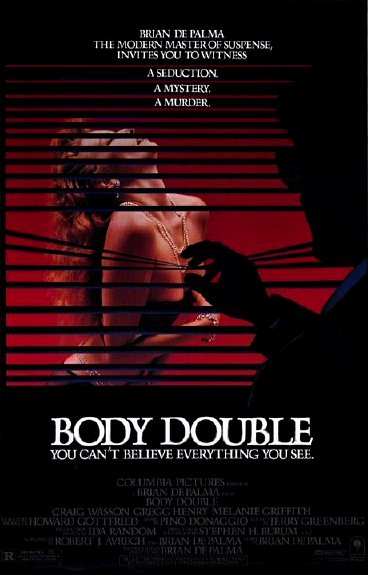 In some respects, Body Double may be the quintessential Brian De Palma film. This is not to say that it is his best, and it may not even mean that I even like the damn thing (there are too many clashing perceptions to sort out a coherent view on the first go). Instead, it summarizes the director's strengths and flaws to such an extreme that the film does not veer between brilliance and garbage so much as jump between the two without transition as if using wormholes for transportation. Only one film removed from Blow Out, Body Double develops the ideas of that film to their apex, mixing De Palma's anarchic form of brutalized Godardian experimentation with his corkscrewing thrillers.
If Scarface represented a sort of warning shot across the studios' brow, Body Double is outright war. De Palma views his opening shots as a means of putting the audience on-guard, never easing them into a movie via what he views as the boring, wasteful helicopter shots of city skylines or montages of neighborhood life.* Here, he opens in such transparently schlocky terms that for once no one can seriously believe what we're watching is not a put-on. With dripping blood titles and midnight-feature mise-en-scène, De Palma goes for broke, establishing a film-within-a-film so unbelievably campy that it's all he can do not to walk out like Alfred Hitchcock at the start of The Wrong Man and warn the audience what they're in for.
Tuesday, May 10, 2011
Brian De Palma: Scarface
 That Scarface enjoys a position in the pop culture lexicon that only strengthens with each passing year serves as a validation of its deliberate excesses and its transparently critical view of upper-class decadence in the '80s and the yuppie love for this outrageous lifestyle. Scarface updates Howard Hawks' 1932 original in a way few remakes do: it truly guts the original and places the update firmly within its own time period not only in its references but its aesthetics. In the process, it continues the mounting sociopolitical dissatisfaction creeping its way back into Brian De Palma's work, peeling back the veneer glossed over the whole decade and marking the start of the director's open hostility to the changing social landscape of the 1980s.
What De Palma does best with Scarface is demonstrate that those old gangster films (which his protagonist openly acknowledges as an influence on his young mind) were as much glamorizations of violence and decadence as anything being shunned by contemporaneous critics. Those pre-Code pictures came out during the Great Depression, times of hardship and desolation; yet the films showed well-dressed criminals living the high, fast life. When the film came out in 1983, America was just starting to recover from its worst economy since the depression, and De Palma films inside ritzy clubs and absurdly lavish mansions. And like the mainstream culture looking to flashy pop culture touchstones like Miami Vice for comfort, so too did the masses in the '30s enjoy those gangsters up on the screen (hell, they liked real-life gangsters like Dillinger). Scarface was De Palma's way of showing the public face of the '80s, and it's no wonder so many viewers hated being shown their cultural "values" in such harsh terms.
Tuesday, May 3, 2011
Brian De Palma: Blow Out
 Blow Out represents a breakthrough for Brian De Palma. After farcically and satirically pulling apart the bonds of cinema for nearly two decades, the self-reflexive director at last found a way to incorporate cinema into a narrative without breaking up the movie. There are still jokes in Blow Out, but they tend to be of the cosmic variety; the closest anyone comes to an outright punchline is one character's innocent assertion "I don't watch the news. It's too depressing." Instead, De Palma structures his gags as dark, wordless payoffs, all of them carrying a bitter, emotional irony that feel like punches to the gut, something only rarely felt in De Palma's canon up to this point.
As with Dressed to Kill, De Palma does open his film with an extended gag, in this case a POV shot of a mouth-breathing killer stalking a sorority hall, his magnified breathing and racing heartbeat raising tension as scantily clad coeds fail to notice him. At last, he moves into a Psycho pose in the shower, pulls back the curtain, raises the knife, and the woman lets out the most hysterically fake scream you ever did hear. The camera shifts to tripod-mounted third-person in an editing studio for exploitation features as soundman Jack Terry (John Travolta) chuckles at how bad it is to his teed-off boss. What was I saying about this not being a funny movie?
Saturday, January 22, 2011
Brian De Palma: Dressed to Kill
 After using his student collaboration Home Movies to grab for that early sense of anarchic satire, Brian De Palma was all set to adapt Cruising, a thriller about a homophobic killer preying on gay bars in New York City. But that project fell through, eventually going to William Friedkin, who captured the gaudiness De Palma would no doubt have brought to the film but lacked any of the warped, witty dimensionality of Hitchcock's disciple. Undaunted, De Palma decided to make his own look at the effects of questioned sexual identity on the psyche. The result combined the disparate aspects of the director's early period into their first cohesive whole, mixing comedy, suspense, and the director's unique ability to at once flagrantly plagiarize and make even the most blatant ripoff something wholly his own.
If Obsession could be directly traced back to Hitchcock's Vertigo, Dressed to Kill clearly owes its nightmarish, violent sexual reverie to Psycho. Yet where De Palma's dreamlike tone in his first full Hitchcock homage matched the oneiric, rending tone of Vertigo in ways that reflected but also stretched and contorted the master, Dressed to Kill completely opposes the realist, spare vibe of Psycho. De Palma's film actually opens and closes with two separate dream sequences, both of which mix recollections of Hitchcock (both feature showers) with De Palma's own films, specifically Carrie.
Psycho showed Hitchcock using ripped-from-the-headlines realism against itself in one of his most brilliant subversions (albeit one slightly undermined by an adherence to psychological summary that Hitch does not ironically undermine and complicated in the way he often did). Meanwhile, Dressed to Kill plays out like the twisted fantasy inside Norman Bates' mind while he commits his crimes, a sleazy yet perversely conservative and quaint presentation that demonstrates De Palma's gift for splitting reality along the illusory. Though shot on location around New York City, Dressed to Kill has the look and feel of classic Hollywood -- even the subways are unreal and attain the same balance between glitz and gaudiness that defines the film's aesthetic.
Immediately establishing that real/fake dichotomy, De Palma opens his film with the same graceful, slow-motion tracking shot into a shower that began Carrie, only De Palma makes use of the then-new Steadicam to add three dimensional movement, no longer forced to move in a rigid line but gently curving through a bedroom into the bathroom beyond. Inside is a man shaving at the mirror and his wife in the shower, and De Palma naturally moves right on past the guy and moves right in with Angie Dickinson. Where the protagonist of Carrie undercut her own semi-erotic soaping with a discovery that revealed her sexual ignorance and fear, Dickinson's Kate, a bored housewife, washes herself with movements suggesting she isn't just trying to get clean. Her scrubbing morphs into masturbation, but suddenly a male figure appears behind her, choking her screams of fear as steam billows and obscures her from her husband's view. Suddenly, De Palma cuts to Dickinson in bed with her husband, revealing it had been not a dream but a fantasy, the severity of her lust an outgrowth from the clumsy thrusting of her inept husband. Kate then goes to see her therapist, but one doesn't need a degree to know that she must be unfulfilled if she's having lustful daydreams about rape.
Her sexual hunger is such that she even hits on the psychiatrist, Dr. Elliott (Michael Caine), who calmly turns down her advances. Dejected, Kate heads to the Metropolitan Museum of Art, where De Palma crafts perhaps the greatest sequence of his career to this point, or at least the best one since "Be Black, Baby." The scene starts simply, Kate sitting on a bench, spying on the men in the place, all of whom are either with a lady or hitting on one. De Palma then reverses the voyeurism when a black-clad man walks up and begins ogling Kate in turn. Completely wordless, the sequence highlights the always moving camera when the graceful movement becomes more complicated and labyrinthine as Kate and the mystery man enter in a cat-and-mouse chase, in which the roles of cat and mouse swap so often it is impossible to tell who is pursuing whom. (In pure De Palma fashion, the director ensures to stop for a moment just so he can frame Kate by paintings of nude women, particularly a giant vagina he frame in the center -- sometimes, the Rule of Thirds just does not apply.) At last, Kate stumbles her way out of the museum, only for the man to throw down her set of gloves that he nicked, luring her into his cab like a trail of bait leading to one of those old boxes propped up by a stick. He drags her inside and begins kissing her and feeling her up, and naturally the cabbie tilts his mirror to get a peek instead of worrying about a woman being pulled forcefully into the car and set upon. But Kate clearly enjoys the situation, all the more so for its element of danger, and she heads back to the man's apartment for a romp to make real her daydreams.
De Palma only gives the audience a brief amount of time to rest before taking the jumbled, ever-reversing structure of the setpiece before obliterating the whole thing by revealing the predatory feeling of the man to be a red herring, undercutting the suspense of his demeanor (and the note Kate finds in his desk saying he has an STD). Kate gets on the building's elevator to leave, only to remember she left her wedding ring in the man's apartment, a cheekily suggestive oversight. Before she can however, the doors open to reveal a tall, blond woman brandishing a razor. Grimly suspecting the man's sinister nature, we are instead treated to the proper villain from out of left field. It's a bait-and-switch worthy of Psycho, and De Palma not only introduces the true antagonist but also the proper narrative a full half-hour into the movie. A prostitute, Liz (Nancy Allen), spots the killer fleeing, but the murderer gets away before anyone else does, resulting in witnesses seeing only Liz standing over Kate's mutilated body holding the discarded razor. At least the characters are bewildered too; it's the least they could do to relate with the audience.

Dressed to Kill takes the purely Hitchcockian moment and uses it to start unifying the sometimes conflicting ideas that have run through his films to this point, ironically through one of his most egregiously strung-together narratives. The film unfolds in self-contained vignettes that add up to a unified whole, but it helps that each of these individual segments is so brilliant, and that they fit together thematically and stylistically if not putting forward a solidly coherent plot.
One of the familiar aspects of De Palma's cinema the director further develops here is his outlandish take on sexuality. Dressed to Kill set off a solid decade of intense antagonism from various feminist groups over the portrayal of sex and violence in the director's films, and even a neophyte like myself can understand where they were coming from with this film alone. I wracked my brain over the cruel moralism of Kate's death, her desire for sexual liberation and fulfillment not simply cut short with an animalistic butchering but preceded with the secondary punishment of venereal disease. Ultimately, however, the entire film exists as mired sexual fantasy, and De Palma is honest in showing that not all fantasies are wholesome (now that would have been regresive). Though I still cannot reconcile certain troubling aspects of the sexual violence against Kate, I would argue that, if her death is meant to be a cautionary tale, it is about the true dangers of the rape fantasies she gets off on, a harsh reminder that it is not a pleasant experience to be abducted and violated, and that sexual assault and literal assault often go hand in hand, even if De Palma does not depict both through the same character.
At the other end of the movie is Liz, who serves as Kate's opposite. Kate, an upper-middle-class housewife whose material comforts cannot overcome her sexual desires, dies at the feet of Liz, a prostitute who uses sex to raise money to play the stock market. Apart from being a hysterical and slightly prescient take on the coming impact of Reaganomics, Liz's relationship with sex and money is the complete inverse of Kate. Liz, comfortable with sex, uses it to aid her financial insecurity, though the hooking itself provides more job security than playing the market, which was a scant two years away from a major downturn. Kate's intelligent, innovative son Peter (Keith Gordon), mired in his quest for revenge, ends up saving Liz from an attack by her stalker, but Liz is so kind and friendly that it never appears to occur to Peter to view her fawning gratitude as a route to a relationship. It's as if Liz is not exactly a hooker with a heart of gold so much as a smart hooker taken to be one with a heart of gold by the male figure. Only when Peter helps Liz use her seductive powers on Dr. Elliott to try to find the identity of the killer does he finally realize her sexual presence.
Then, there's the matter of Bobbi, the transsexual who murdered Kate in sexual frustration and stalks Liz to tie up loose ends. Just as the disturbing nature of some of the sex in the film drew criticism from feminists, De Palma's depiction of a transsexual killer lashing out in violent manifestation of confusion and self-hatred won him a number of complaints from LBGT groups. Yet consider the true identity of Bobbi: in the clearest effort to step outside his piety to Psycho, De Palma does not make the sweet, mother-obsessed Peter the true culprit but Dr. Elliott, the psychiatrist. We hear "Bobbi's" voice on Elliott's answering machine (in the clipped, sleazily slurred tones of William Finley, who may be the first actor to sound like a chronic and intemperate masturbator) hissing furious taunts at the doctor for refusing to sign off on his sex-change operation. When another psychiatrist launches into the expected monologue of Elliott/Bobbi's motives, he confirms that Bobbi really did hate Elliott, the feminine half of Elliott's mind refused its liberation by Elliott, who despite the human empathy of his learned profession cannot extend that same understanding to himself. Elliott's violence arises from his sexual confusion, which in turn is the product of repressive old codes of order that torture him. De Palma slyly uses a real news clip of a transsexual on Donahue that presents the male-to-female guest as someone initially reticent to speak about her life until she says with a smile that she has "always been a committed heterosexual." Elliott/Bobbi does not have that centered self-awareness, so when Elliott's masculine side gets attracted to Kate (and, later, Liz), Bobbi takes over and uses the phallic image of the straight, hard razor to cut apart that which made him erect. If you'll forgive me, that's some ballsy filmmaking.
The Elliott/Bobbi split brings up De Palma's interest with body doubles, previously shown with Sisters -- and an obsession De Palma would continue to investigate, even past the film openly titled Body Double. Elliot's double, Bobbi, is just the man in a wig and women's clothing, but his psyche and sexual lust splits, creating two separate people from one body. This is further complicated by the female police officer assigned to watch Liz (whether to absolve her or prove her guilt is not entirely clear): hilariously, she looks exactly like Bobbi, leading to several misdirections that add suspense and humor. During the aforementioned scene with the Phil Donahue clip, De Palma not only lays hints of Elliott's true identity but uses a split screen to contrast Elliott watching with an inscrutable look on his face trapped between scholarly curiosity and resistance to his dawning new self with Liz viewing the same program as she dresses for "work." Liz, Elliott's target not simply because she witnessed his crime but because she arouses Bobbi's masculine side, distractedly watches as she preens in front of the vanity mirror (which duplicates and divides the image further), highlighting all her feminine elements in preparation for the night's johns. Elliott, meanwhile, surrenders entirely to his masculine side, and the ominous tinge of revulsion in Caine's face could well be Bobby's if he could only look to the other side of the frame and spot Liz.

There are even literal instances of doubles in the film. The close-ups of Dickinson's lathered body as she touches herself at the beginning are actually those of Victoria Lynn, a Penthouse model, effectively teasing the audience with bawdy imagery of a sex icon that really isn't her. Even the Metropolitan is doubled: though the outside is the proper building, the interior shots were recorded in the Philadelphia Museum of Art. These structural, not diegetic, doubles complicate the movie in the sort of half-serious put-on De Palma excels at, raising ouroboric questions of what can be trusted.
That, in turn, feeds into the grandest theme of De Palma's canon: the line between illusion and reality. If, as I argued, Kate's death is less a critique of her "loose" morals than of her dangerous fantasies, the weight of her death is lessened not only by the structure of plot moving beyond her immediately but also by the oneiric aesthetic of the entire film. Never has New York City looked so artificial, not even now in its plastic Disneyfication: slightly saturated colors make the image pop, seductive in its vivid beauty but also repellent in its blatant artificial sheen over on-location shots. And the spatial relationship of the mise-en-scène is always shifting, particularly in a playful but sinister sequence on the subway. A gang of thugs surround Liz on the platform and give chase when she runs, vanishing into thin air when she leaps into a train car with a police officer, who chastises her for making up stories. As the train moves to its next stop, Liz finds herself alone again, only for the gang to show up again and slowly move in for her as she moves from car to car. Just as they close in on her, the blond stalker strikes, proving the thugs meaningless but using them to tantalize and manipulate solely to their own end.
These elements have never fit together so well in De Palma's early, anarchic style, here smoothed out by the lilting but ironic grace of the Steadicam. A dollop of De Palma's humor, so offbeat it may only ever appeal to him, spackles the cracks -- I will cast my vote in favor of any film that can melt an orgasmic squeal into a car horn, or lets Dennis Franz gnaw on scenery as the most stereotypical New Yawk detective who has ever lived. De Palma even turns the psychobabble of the other therapist's summary into a joke when he has Liz repeat it to Peter in a restaurant as a prim and proper old woman glances over from behind Peter in horrified offense. The last sequence, of course, is just another outgrowth of this dark wit, a final scary/hilarious reveries à la Carrie that gives one last jolt before releasing the audience to contemplate its various twists and turns. One of the director's more contentious films, Dressed to Kill delighted me as much as the best of his work to this point. If the fiery debates that greeted his subsequent '80s features had as much merit to warrant a discussion as this, my apprehension over this most-vilified period will abate quickly.
Subscribe to:
Posts (Atom)