 The rhyming book-end shots that open and close Ugetsu—the first shot an out-to-in establishment of a village that hones in on its main characters, the final one a move outward from those who remain to that same village horrifically altered—tidily summarize the intricate formal arrangement of Kenji Mizoguchi’s masterpiece, their inverse compositions and movements indicative of the thorough visual mapping of the entire film. The early shots are almost literally straightforward, with camera setups that view its laterally arranged characters from perpendicular positions. These compositions match the bluntness of the narrative setup: Genjuro (Masayuki Mori), a local potter, sets out with his friend Tobei (Eitaro Ozawa) to sell his wares in neighboring areas as a civil war heats up between rival daimyo. Genjuro’s wife, Miyagi (Kinuyo Tanaka), frets about him going to cities filled with soldiers, but otherwise their lives are tranquil.
Showing posts with label Kenji Mizoguchi. Show all posts
Showing posts with label Kenji Mizoguchi. Show all posts
Friday, January 24, 2014
Ugetsu (Kenji Mizoguchi, 1953)
[The following is a belated entry in last year's Blind Spots series.]
The rhyming book-end shots that open and close Ugetsu—the first shot an out-to-in establishment of a village that hones in on its main characters, the final one a move outward from those who remain to that same village horrifically altered—tidily summarize the intricate formal arrangement of Kenji Mizoguchi’s masterpiece, their inverse compositions and movements indicative of the thorough visual mapping of the entire film. The early shots are almost literally straightforward, with camera setups that view its laterally arranged characters from perpendicular positions. These compositions match the bluntness of the narrative setup: Genjuro (Masayuki Mori), a local potter, sets out with his friend Tobei (Eitaro Ozawa) to sell his wares in neighboring areas as a civil war heats up between rival daimyo. Genjuro’s wife, Miyagi (Kinuyo Tanaka), frets about him going to cities filled with soldiers, but otherwise their lives are tranquil.
The rhyming book-end shots that open and close Ugetsu—the first shot an out-to-in establishment of a village that hones in on its main characters, the final one a move outward from those who remain to that same village horrifically altered—tidily summarize the intricate formal arrangement of Kenji Mizoguchi’s masterpiece, their inverse compositions and movements indicative of the thorough visual mapping of the entire film. The early shots are almost literally straightforward, with camera setups that view its laterally arranged characters from perpendicular positions. These compositions match the bluntness of the narrative setup: Genjuro (Masayuki Mori), a local potter, sets out with his friend Tobei (Eitaro Ozawa) to sell his wares in neighboring areas as a civil war heats up between rival daimyo. Genjuro’s wife, Miyagi (Kinuyo Tanaka), frets about him going to cities filled with soldiers, but otherwise their lives are tranquil.


Friday, August 12, 2011
The Story of the Last Chrysanthemums (Kenji Mizoguchi, 1939)
With some 60 films to his name a mere 16 years after starting in the film industry, Kenji Mizoguchi certainly had enough on-the-job training to get his act down. Nevertheless, 1939's The Story of the Last Chrysanthemums represents such a stylistic leap it almost seems less an evolution than a complete rebirth. It is not the master's first great work — in fact, I might even continue to argue for the powerful (and more defiantly upbeat) The Straits of Love and Hate, released two years earlier — but it is the true emergence of Mizoguchi the master, ironing out the style of immaculate compositions and increasingly sophisticated historical detail (courtesy of designer Hiroshi Mizutani, who had started working with Mizguchi on Straits) that would become his forte.
Admirers routinely (and correctly) note the nobility of Mizoguchi's female characters, but that implies placement on a pedestal that, despite their recurring Madonna/whore dynamics and martyrdom, these fully human characters do not reside upon. Not all of the women in The Story of the Last Chrysanthemums is a saint; many, in fact, are gossipy and territorial, geishas tugging at men as if quarreling over a kimono. But even these sweet-talking gaggles do not feel like mere props in Mizoguchi's world, instead perpetuating a clear but unforced social commentary on the insular nature of the occupational caste system that defines each person in his period pictures. The men of the film, Kabuki actors in late-1800s Japan, are also isolated by the social restrictions of their professions, forced to adhere to strict codes of conduct even when far nobler actions prove to be outside that set of manners.
Admirers routinely (and correctly) note the nobility of Mizoguchi's female characters, but that implies placement on a pedestal that, despite their recurring Madonna/whore dynamics and martyrdom, these fully human characters do not reside upon. Not all of the women in The Story of the Last Chrysanthemums is a saint; many, in fact, are gossipy and territorial, geishas tugging at men as if quarreling over a kimono. But even these sweet-talking gaggles do not feel like mere props in Mizoguchi's world, instead perpetuating a clear but unforced social commentary on the insular nature of the occupational caste system that defines each person in his period pictures. The men of the film, Kabuki actors in late-1800s Japan, are also isolated by the social restrictions of their professions, forced to adhere to strict codes of conduct even when far nobler actions prove to be outside that set of manners.
Thursday, April 15, 2010
Sisters of the Gion
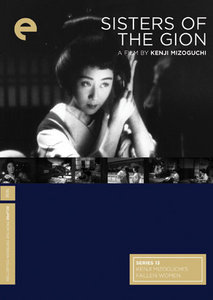 Released in the same year as Osaka Elegy, Sisters of the Gion presents itself as a companion piece to Kenji Mizoguchi's breakthrough through simple proximity. But the parallels run far deeper: Sisters consolidates the inconsistencies in its predecessor's style, retaining its Art Deco reflective lighting as the director perfects his camera placement and movement. As precise as the narrative and imagery were in Osaka, they become even sharper in the Gion district of Kyoto.
The story itself practically builds off the end of Osaka Elegy. That film closed with a shot of its protagonist, played by Isuzu Yamada, walking toward the camera with steely resolve. In Gion Yamada plays Omocha, a geisha who might easily be Ayako a few years past her ostracism in Osaka. Where Ayako fought against the oppression in the family unit that hobbled her, Omocha has moved far beyond those confines, only to find herself in the larger cage of Japan's hegemonic society.
Gion opens, as its predecessor did, not on Omocha or her older sister, fellow geisha Umekichi, but on a man. Well, not quite; technically, the film begins in a storeroom filled with antiques being sold off as the camera tracks and pans into the next room where the auction to buy the items in the first room is underway. Mizoguchi continues to track and turn until fading into the next shot via composites to finally settle upon the bankrupt businessman, Furusawa, and his male assistant. Just as the beginning of Osaka Elegy conveyed the film's theme and style, so too does Gion's first shot(s) lay the foundation of what's to come: Mizoguchi tracks through separate rooms, but he moves outside the doorways, not through them. Thus, the unbroken movement of his camera (until the dissolve) is contrasted with the constant fracturing of the mise-en-scène as he passes over each partition. As the camera settles upon Furusawa, bemoaning his poor financial decisions, Mizoguchi immediately reestablishes the split in power between genders as he frames Furusawa and the assistant alone before panning to show Furusawa's wife in the next room, pacing nervously as she deals with her husband's failure but cannot do so directly. At last she snaps and throws the lout from the home -- wives in Mizoguchi's world seem to have just enough power to shame their spouses once, though the effect is only temporary -- and Furusawa stumbles to the geisha where we meet our heroines.
The doubled leads allow Mizoguchi to frame Sisters of the Gion as a dialectic. Umekichci, raised from childhood to be a geisha, adheres to the traditions of the role: always dressed in proper kimonos, she entertains only one patron at a time and submits to their requests without hesitation. Omocha, on the other hand, sees through the elaborate staging of the geisha, seeing only a trumped-up prostitute. She knows that no real connection between client and geisha forms, that the man uses the woman and practically discards her along with the contraceptive. “Men come here and pay money to make playthings out of us," she states defiantly. "If you keep living this way, you’ll always feel as if you’re being strangled to death.” Dressed regularly in Western clothing, Omocha uses her seductive skills to manipulate multiple clients, extracting from them as further compensation for taking from her. Where Ayako attempted to break the bonds that she only just realized held her, Omocha knows the bars that bind her and bends them as she can to test their tensile strength.
Naturally, the sisters represent the cultural schism in prewar Japan -- it would of course be suppressed in the nationalist furor of the war -- between traditionalism and Westernization. Umekichi believes in the old ways and treats her patrons almost like husbands, while the public-schooled Omocha carries downright radical ideas of self-worth and independence. It is odd and wonderful to see Omocha's outrage played as progressive instead of shrill and bitter, more so that her role as the seductress feels empowering instead of stereotypical. Interestingly, for all the bile she spews on her Umekichi regressive views, Omocha primarily uses her wiles in an attempt to benefit her sister. When she challenges Umekichi's decision to let Furusawa stay with them by asking, "Why should we be comforting him? We can barely take care of ourselves," the rage in her voice belies her concern for the siblings' own financial straits; with Furusawa leeching off the already strapped pair, Umekichi will send them into bankruptcy along with her client. Later, Omocha charms the clerk of a kimono shop into giving her a dress made of expensive material for her sister.
The power these geisha can exert over men is simply comical. Umekichi meets one of Furusawa's friends, Jurakudo, and the rigid formalization of Mizoguchi's direction highlights the way that Umekichi, even as the submissive one, calls attention to herself: she enters the crowded room, instantly drawing the eye to her as she walks while everyone else sits, yet Mizoguchi maintains the focus of the shot entirely upon her after she kneels through lighting and the blocking of the other actors, all looking to a side or away from the camera so that Umekichi is the only person looking toward the audience. Her move from the top left in a down-right direction suggests ominous things to come, yet by stopping in the middle of the frame, she demonstrates that she still holds a certain power, whether she exercises it or not.

Omocha of course holds even more sway, as she understands her abilities and uses them. She seduces older, wealthier men by playing into their socially ingrained sense of superiority, assuring them that she prefers the experience and wisdom of elders to the rash ignorance of youth. "Young men are no good," the client agrees. "They haven't suffered." The irony of this man, who has likely never known anything in the league of true suffering, making such a statement in the presence of a woman, is so staggering that one almost commends Mizoguchi for not leaping out from behind his camera and throttling the fool, if it's all make-believe. When Jurakudo collects a payment from a client who owes him money, Omocha stands to the side, tacitly encouraging the merchant to get more money from the debtor which he can then lavish upon her. Hilariously, Mizoguchi uses some of his few close-ups in this single scene, cutting to Omocha's encouraging face as the frame tightens in a slight haze around the edges -- it's too pronounced to be a matter of focus, yet too crystalline to be print damage -- as if the geisha was exerting some form of hypnotic control on the man, a Dr. Mabuse in silk and clogs.
Elsewhere, Mizoguchi's direction is just as stellar. The partitions in the opening shot predict the ubiquitous uses of frames, walls and doors to separate characters physically, a reflection of their emotional isolation. Often, one character sits in the foreground while another figures into the background (seen in deep focus, of course), and Mizoguchi simultaneously highlights the distance between them as he shrinks that space by segmenting the foreground from the background via a door frame. The space no longer seems so large, but it's compartmentalized and segregated, even more remote that it would have been if simply one big room. Subtly canted angles heighten this disconnect, though the director also wrings some comedy out of them when he uses a more exaggerated angle as Umekichi leads the drunken Jurakudo back to her place to see Furusawa, emphasizing the man's tipsiness. Set against terrifying moments like the tense, claustrophobic shot/reverse shot exchange inside a car between Omocha and the kimono clerk she inadvertently got fired -- the man who seemed most innocent and lovestruck ultimately revealed to be the most sadistic -- the wry humor is even more incisive and the lighter moments welcome moments to catch one's breath.
The incident in the car puts Omocha in the hospital with severe injuries, and Umekichi, freshly dumped by Furusawa after he secured another job and reconciled with his wife, returns to her sister to care for her (thus repaying the favors she never consciously noted). Umekichi accepts Omocha's fate as proof that the more progressive sister should have been more reserved after all, but Omocha's resolve only hardens. "Something like this won't make me give in to men." The characters move behind a slotted wall, vaguely visible as the camera stays behind but still obscured, and Omocha's rants become even more powerful and thunderous in their disembodiment. But then, her resolve crumbles. "If we do our jobs well," she cries, "they call us immoral. So what can we do?" We saw Yamada link two characters into one evolution, from submissive, giri-influenced daughter to liberated streetwalker to feminist geisha, but now Omocha sees that the bars she bent will never break. It doesn't matter whether, like Umekichi, a woman submits or, like Omocha, a woman rebels: there is simply no escape. It's a horrifying prospect that reduces Omocha's defiance to tear-streaked despair, wracking her body and mind until this once-proud woman can only sob a damning rhetorical question aimed squarely at its contemporary Japanese audience: "Why do there even have to be such things as geisha?"
Tuesday, April 13, 2010
Osaka Elegy
 Kenji Mizoguchi believed that Osaka Elegy, his 56th film,* marked his first serious work. "I was able finally to learn to show life as I see it," he said. With so little of the director's previous work available to compare it to, perhaps he is right, but the likelihood that he produced dozens of previous works before suddenly hitting artistic pay dirt engenders a certain amount of skepticism. It's hard to argue the results, however, as Osaka Elegy is so aesthetically sound and emotionally draining that, whether it marks the director's arrival or not, certainly stands as the work of a master.
Opening with a flourish of big band music that will sound all to bitterly ironic in the moments to come, Osaka Elegy initially catches the audience off-guard before moving in for the kill. Its first shot depicts blazing neon signs on Japanese buildings, a vision of modernity as Japan moves further into the contemporary era. But Mizoguchi holds the shot as the sun rises, switching off those burning lights and leaving an ugly, uninteresting shell. In its first moments, it suggests that Japan is moving in the right direction, yet the sunrise yields an image points toward Mizoguchi's concerns with the rest of the film. In the full daylight, the skyline becomes nondescript, even a bit old-fashioned.
From that moment, the director dives into Japanese life to find that, despite the nation's modernization, its citizens still conform to outdated, practically feudal social stratification. Chief among its second-class citizens are women, a group of whom bustle in the mansion of a rich man, Mr. Asai, who speaks the first lines of the film. Those lines are an insult to one of his female servants, chastising her for giving him a towel that wasn't completely dry. He spends the rest of his morning berating the young woman as she prepares his meal and puts on his vest and coat, even going so far as to suggest she'll never nab a husband through her incompetence and simplicity. The woman is not the film's protagonist, and Asai will only play a small (but highly significant) role in the narrative, yet Mizoguchi starts here to show how ingrained attitudes against women are in society: all the woman can do is apologize for the flaws the man incessantly points out to her.
This opening aside reveals the entrenched norms of Japanese society so that when Mizoguchi introduces the protagonist, telephone operator Ayako (Isuzu Yamada in a fiery yet heartbreaking performance), her modern profession immediately establishes itself an inadequate defense against the traditions that will eventually crush her. She works at Mr. Asai's pharmaceutical company, and the boss openly makes a pass at her behind the obscure glass door of his office. The image of that closed door is a recurring shot in the film's first segment, demarcating the "proper" social behavior in the rest of the building and the lewd soliciting found within. Asai Pharmaceuticals thus becomes a symbol for the rest of the film, and the contradictions in the Japanese sense of propriety and honor.
Ayako does not respond to her boss' advances, but she finds herself going home with Asai when her father reveals that he's plunged the family in debt and embezzled ¥300 from his own employer. With her self-absorbed student brother unable (or unwilling) to cover for his dad, Ayako agrees to sleep with Asai to settle her father's debt.
Mizoguchi's eye is merciless as it captures Ayako's increasingly hopeless existence. She receives the money from Asai, and accompanies him to the theater, where Asai's wife catches the two. Considering that her modernity drove Asai to look for more submissive companionship, it's not surprising that Asai's wife refuses to simply let the incident slide to avoid making a scene, but Asai's colleagues gather to cover for their friend. One of the co-workers, Mr. Fujino, mediates the situation by assuring the wife that Ayako was his date, not Asai's, and the men fall in line immediately, embarrassing the woman for being so flighty as to assume the worst of her noble husband. Later, Fujino takes the young woman as his own mistress, to which Ayako acquiesces in order to pay her brother's tuition fees.
It is at this point that it simply becomes impossible to discuss Osaka Elegy without comparing it to the director's own life. Mizoguchi's father sent his family plunging into debt with some bad investments, and times turned so desperate that the family sold Mizoguchi's sister as a geisha. She helped keep the family afloat, and it was only through her marriage to a wealthy patron that the director could attend art college. Ayako's actions, and Mizoguchi's sister's, reflect the Japanese tradition of giri, of social obligation and duty. A major aspect of giri concerns filial piety, devotion of children to their parents and the need for the children to tend to their elders when needed. The fate of the director's sister would not seem so unorthodox even in the early 20th century, and Ayako's descent into prostitution becomes an inevitability as she struggles to pay back a socially conceived debt to her parents that she, like every child, can never fully repay. Mizoguchi doesn't buy it, however, just as he never forgot how much he owed to his sister and how much he hated his father for abusing her and his mother. He takes giri to its most disturbing extreme, in the process highlighting the hypocrisy of the demand for honor men place upon the women and the salacious lusts they want to sate.
This social attack is communicated as much through aesthetic as it is the narrative. Mizoguchi's deep focus photography is excellent, yet he uses the device less often than the other major deep focus directors of the time, Renoir and Welles. Mizoguchi uses long takes and deep focus in the style André Bazin preferred, that which left the audience to decide what was worth its attention instead of forcing them to focus on the images the director felt were important via montage. However, he also moves between deep and shallow focus in his shots to let us know whether anything in the background is worth seeing. If something important is happening, Mizoguchi uses the deep focus and allows the audience to peer past the foreground; if there isn't, then he doesn't try to lure the audience away from what matters. Married to immaculate staging, the stellar photography captures images that suggest themes without a word. The women in the frame often kneel before the men, showing how women must still literally place themselves below the males in society. Yet Mizoguchi subverts the image, lighting the women as he usually casts the men in shadow, stressing their sinister control even as he suggests with darkness that the men are just weaklings. When Ayako's would-be suitor, Nishimura, visits her home, he casts a long shadow on the sliding paper door; unlike the looming presence this normally affords a character, however, this shadow makes the man look small, insignificant, piercing the heart of the man long before his true nature is revealed.
Even the city's architecture plays into Mizoguchi's critique: he captures the more reflective objects in the film -- metal, glasses -- in flares that give the movie an Art Deco leaning, a contemporary aesthetic that clashes with the traditional format of Japanese architecture. In doing so, the director reveals how antiquated those designs have become, and ties that back into the men, who sit inside their houses made of paper and flimsy wood as kings of their own domain. To Mizoguchi, they look scarcely more than petulant boys building a homemade fort with a "no girls" sign on it. It's all an illusion, he's saying, and one that requires so little effort to puncture though no one ever does.
Ayako, whether she fully realizes it or not, attempts to shatter this illusion, buying makeup and hats and smoking cigarettes without a care for how she's viewed. Earlier, at the theater, we saw the female character in the play performed by a male-controlled puppet, and Ayako attempts to step outside this even as she turns to an occupation that relies entirely and openly on male dominance over women. Ironically, the punishment she receives for leaving traditional society is ostracism when a vengeful Fujino reports her to the authorities; faced with a tarted-up Ayako who represents the glaring contradiction between the ideals of propriety her father, brother and boyfriend place upon her and the effects of their lascivious tastes, the men abandon her. Thrown out on the streets where she was already making her new living.
Osaka Elegy has its flaws: it's a bit on-the-nose, it could stand to spend more time than its spare 71 minutes further exploring its bountiful ideas and, gorgeous and meticulous as the aesthetic is, it wobbles uncertainly at times between the objectivity of its long takes and deep focus and a more sympathetic visual style (both perfectly valid, but sharply contrasting). Holding these quibbles against the film, however, seems a waste of time -- besides, criticizing it for not going far enough with its themes ignores the fact that Mizoguchi would re-examine them constantly for most of his career. In the end, all that's left is a reflection of those early neon signs, a sign that, through banishment, Ayako may more easily move into the modern Japan. She does so with such gusto that, as she walks toward the camera with conviction in the final shot, Mizoguchi pulls back, as if afraid. Hell hath no fury indeed.
*At least I think it's his 56th. Even Mizoguchi didn't recall all of the films he made, and the vast majority of his silents and his early talkies were lost. I went by this list here.
Subscribe to:
Posts (Atom)