Unfairly, if inevitably, compared to a number of science fiction films which gutted Edgar Rice Burroughs’ source material, John Carter admittedly doesn’t feel like anything new. Its narrative of an embittered veteran transported to another world where he becomes a just warrior fighting for natives naturally calls to mind Avatar, and some setpieces look almost uncomfortably close to similar sequences from Star Wars movies. The very nature of the story places the film in the past, its pulpy, gung-ho dialogue wholly at odds with contemporary cynicism.
Yet if Andrew Stanton doesn’t reinvent the genre with his first foray into live-action filmmaking, he does at least offer up one of the few truly thrilling, giddy adventure epics of the last decade, maybe even since the third Indiana Jones installment. Though clearly meant to launch a franchise—and thus weighed down by all the overcooked mythology and origins that define the first entry in a planned series—John Carter features enough coherent action and empathetic characterization to make one of the few overstuffed blockbusters I’d love to watch more than once.
Personal blog of freelance critic Jake Cole, with exclusive content and links to writing around the Web.
Showing posts with label Mark Strong. Show all posts
Monday, April 2, 2012
Sunday, December 4, 2011
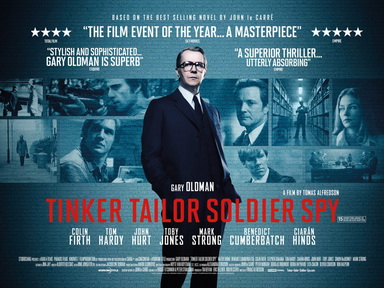
Tinker Tailor Soldier Spy (Tomas Alfredson, 2011)
Expanding upon the style that brought him international fame with 2008's Let the Right One In, Tomas Alfredson makes a chilly, claustrophobic character drama out of John Le Carré's classic spy thriller Tinker Tailor Soldier Spy. This is even more impressive considering that the film primarily takes place in vast sets colored in warm, oaken browns (albeit the kind Joyce used to signify death and ossification). Alfredson's vampire film similarly used its expansive white space to actually constrict the frame, and here he goes one step further, swapping out intense but myopic angst for loyalty fears with global consequences. Where youth merely think the whole world is against them, it truly could be if one of these spies slips up, hence why the members of the organization seem to spend more time monitoring each other than anything going on in Russia.
Sunday, June 19, 2011
Green Lantern (Martin Campbell, 2011)
Watching Green Lantern in 3D is like watching a glowstick through sunglasses, the already unimpressive neon goop dimmed to a murky hum of sickly light. Its dulled visual scheme matches the narrative, a story about a man chosen for the highest honor in the universe that has all the excitement of finding out one has been selected to be a Nielsen family. In fairness, this movie is not as bad as the increasingly increasingly garish X-Men: First Class, which is aging in my short-term memory like milk left out in a hot sun. Green Lantern at least lacks the pomposity and waste of recent blockbusters, but it makes up for this "shortcoming" with a stupefying lack of creativity, in a film about a hero whose power is his imagination.The first sign of the dearth of ideas is the hero himself. The Hal Jordan of the comics, a conservative, stoic pilot without fear, is replaced with a smarmy jackass played with much-practiced knowing by Ryan Reynolds. Jordan here is nothing more than Tom Cruise's character from Top Gun, to the point that, after he becomes the titular hero and inevitably saves the day, I expected Hal to buzz the giant lantern core on the planet Oa, making the gruff drill sergeant Kilowog (voiced by Michael Clarke Duncan, because of course he is) spill his galactic coffee all over himself in surprise and rage. But, if wishes were horses...
Saturday, April 17, 2010
Kick-Ass
It is of no particular use to discuss Kick-Ass, far ahead of the pack of what will eventually be the most debated films of the year, with anything approaching the false objectivity of holistic criticism. You know the sort, the reviewing style in which, one hopes, the critic does write about his or her own response to the film among the more objective and studious observations, albeit without the use of the dreaded 'I' as if writing from the darkest nightmare of Ayn Rand. Kick-Ass, based on Mark Millar's gonzo (is he ever anything else but?) comic series about teenage vigilantism, announces itself as a love-it-or-hate-it picture from the start, generating such a forceful schism between vitriolic rejection and open adoration that it appears to be the geek version of Antichrist.At least Lars von Trier's helter-skelter mind- and soul-fuck had something to say, though I'll be damned if I quite know what it is yet. The appeal (and point of contention) of Kick-Ass is that it does not seem to have anything to say at all, though its most vocal defenders insist that the naysayers simply didn't "get" it. But is there anything to get? Mark Millar's comic, written along with the movie script, follows an altogether unremarkable young man, gifted with neither powers, intellect, sophisticated gadgetry nor even a solid physique who decides to become a superhero just to give his life some purpose.
Vaughn and Jane Goldman's adaptation, however, takes a left turn in quick order that throws this premise completely out the window. On his first night out in a wetsuit costume, ho-hum loser Dave Lizewski (Aaron Johnson) attempts to stop a carjacking and gets a knife to the stomach for his troubles. It's a moment that distills the difference between fantasy and reality, a rude awakening for the kid who thought his antics might get him some popularity. Then, everything changes. Doctors place so many metal pieces in Dave's body to strengthen his bones that even the kid remarks his similarity to Wolverine, and the attack fried his nerve endings, allowing him to absorb large amounts of abuse without feeling pain. Granted, it's not flight or laser vision, but that shift changes the entire dynamic of the film: it's no longer a story about an average kid trying to be a hero but an empowered teen who's simply untrained and rough around the edges.
So, Dave now experiences some success as Kick-Ass, not foiling the beating of a man on the street so much as transferring that beating onto himself and withstanding long enough that the attackers simply leave and bystanders with cell-phone cameras turn the hapless, baton-whirling teen into a sensation. And then...what? Dave, purposefully made as banal as possible to strip him of any attribute that might serve him in his night job, does not resonate for the exact same reason. He has a crush on the popular girl, Katie (Lyndsy Fonesca), hangs out with his two wittier friends (Clark Duke and Evan Peters, adhering to the rule that all adolescents travel in trios) and fantasizes about his buxom teacher. That's about as far as we go with his character, even when rumors arise in school that Dave's constant bruises and cuts are the result of him being a gay prostitute, a rumor that, of course, brings him closer to the in-mandated-need-for-a-gay-best-friend Katie.
The only characters of any true interest are Big Daddy (Nicolas Cage, spouting a hilarious Adam West impersonation) and Hit-Girl (Chloë Moretz). Big Daddy and Hit-Girl are, as Dave notes, "the real deal," taking vigilantism to shocking heights with madcap killing sprees executed with precision. The two have an actual story and motivation, unlike Dave, who routinely steals attention away from the gonzo pair for his insipid journeys through the motions of comic book tropes, never conveyed through action but spoken aloud and immediately undercut by another bit of dialogue, empty boasts of self-awareness. Dave's relationship with Katie, with its usage of tired situations that read like Three's Company leftovers that climax in a Big Misunderstanding scene which manages to fly in the face of what meager characterization exists between the two. When Dave first sees Hit-Girl and Big Daddy in action, he realizes how out of his depth he was to pretend to be a hero when this finely conditioned vigilantes roamed the same streets. If only Vaughn agreed with the protagonist; Millar purportedly intended the two to be the main focus of the story, but altered his approach as an unremarkable teenager made for easier identification than such extreme characters. Yet the audience can identify with Big Daddy and Hit-Girl more readily as they have some sort of personality.
Kick-Ass even lives up to its promise of giddy mayhem when Vaughn cedes the floor to the destructive tag-team. Moretz completely steals the show as the profane and hyperviolent Hit-Girl, with her hot pink wig and arsenal of blades and pistols. Capable of portraying both the unstoppable assassin and the adorable, if ludicrously maladjusted, 11-year-old girl inside the costume, Moretz gives one of the most memorable performances by a child in recent years; no wonder, then, that she's been tapped to play the vampire in the (wholly unnecessary) American remake of Let the Right One In, a role that gave audiences the other great young female performance of recent cinema.
But even her terrific presence is undone by the extremity of her actions. Unlike most of the film's critics, I find nothing particularly offensive about most of the film's ultraviolence. That's actually the problem: Vaughn so stylizes the bloodshed, with the typical slow-motion and fast editing that directors continue to mine from The Matrix, that it has no meaning. Death has no sense of finality in Kick-Ass, save the times when, perversely, it is at its most absurd. The hordes of thugs Hit-Girl cut down do not register a second thought, but a man shoved into a giant microwave(?) offers at least a moment of reflection for the audience, before Vaughn then plays that moment for laughs. Sin City had the same cartoonish violence, but it also had an emotional core that Kick-Ass lacks and so desperately needs. In one scene, the only truly serious one of the film, Vaughn veers so close to genuine meditation on the price of vigilantism, the blind quest for revenge and how the evil that exists in the real world is no better than the exaggerated archvillains of the comics that he runs in the opposite direction as if afraid of his own intelligence. Kick-Ass' final act replaces the wheel-spinning repetition of the first half with the utter insanity that it only hinted at previously. But the payoff fails to live up to the hype, moving even farther away from any sense of relatability until one cannot even compare the violence to that of a video game; video games have progressed too much to insult them so.
I feel like I'm spinning my own wheels now, but the inexplicably (yet inevitably) positive reaction carries with it the sort of mind-boggling defense that makes the film impenetrable. This film has no point, not in the sense of anything so high-minded as "theme" or "subtext" but in the sheer absence of any reason to watch it. "But it doesn't need a reason," shout its defenders, "It's fun!" Setting aside personal reactions to the film's supposedly enjoyable elements, this argument holds no water for two important reasons: 1) these same people are calling Kick-Ass a satire, or at least subversive -- an understandable mistake, as the brain searches for meaning when none is immediately apparent, as it is certainly not here; Un Chien Andalou is so timeless precisely because Buñuel and Dali intentionally robbed the short's incomprehensible images of even symbolic value. 2) Since when is it artistically bold to make a stupid movie? I am so sick of this asinine illogic, the notion that it takes courage to aim low, as if the cinematic landscape is not already littered with pointless, plot-less behemoths that snake their tendrils into your wallets. It's that line of reasoning that keeps hundreds of intelligent films out of the vast majority of American theaters, and God only knows how many scripts from being developed. And don't tell anyone who doesn't like a film that they just don't "get" it.
Christ, even the filmmakers have insisted that they've made something smart and unique. Matthew Vaughn said that Kick-Ass "has broken every rule." What rule did it break? A child uses the c-word. Goodness gracious. She also kills, and anyone who thinks that a schoolgirl wreaking havoc on men is fresh must think that Japan's only cultural export is a large number of America's best baseball players. Vaughn didn't stop there, going so far as to cite each aspect of production as unique, touching upon "the way it was made, the way it was written, the way it was financed, the way it was directed. We didn’t do anything by the book. Maybe that’s why it feels so fresh.” Let's break this down: Kick-Ass was written as its source material was being written. Stanley Kubrick and Arthur C. Clarke did the same with 2001: A Space Odyssey and made two fascinating but vastly different takes on Clarke's vision, each with their own merits. Vaughn just simplified Millar's wryer and more decadently cynical take on the premise into something more fit for mass consumption. Too many films have been self-financed to pause for a second on his second point, and Kick-Ass isn't even the first self-financed, hyperviolent blockbuster meant for the instant gratification of a wide audience; I am of course speaking of Mel Gibson's The Passion of the Christ. As for direction, Kick-Ass steals so many cues from The Matrix and from Vaughn's old collaborator Guy Ritchie (including Ritchie alumni Mark Strong, Jason Flemyng and Dexter Fletcher, playing Italian wise guys because why the hell not) that the only artistically bold choice of the film was claiming originality. Perhaps Vaughn meant that last point literally, that the manner in which he shot the film was different. Maybe he suspended himself from the ceiling upside-down while he was looking through the viewfinder.
His assertion of Kick-Ass' "freshness" underlines the film's failure. It's trying to have its cake and eat it too, politically incorrect just to drum up some controversy and interest even as it insists that its madness has some method. I spent so many drafts and rewrites addressing points I disliked and then re-addressing them to deal with the perceived catcalls of "that was the point!" to come that I nearly gave myself a migraine, so let me instead save you the trouble of reading an even longer, even more circular diatribe by saying this: I don't care whether Kick-Ass was supposed to be stupid. It has nothing to give its audience; it can only take two hours away from them. Shocked laughs give way to the realization that so little was actually funny, and the protagonist quickly becomes an unfortunate obstacle between the audience and the father-daughter duo that offers the only consistent entertainment. Kick-Ass is supposed to be about an aimless teen and his aimless plan to be a hero, yet even the plot abandons him when Big Daddy and Hit-Girl come along with a possible narrative to latch onto. Their story, by the way, is the exact sort of hero origin tale that Dave Lizewski adamantly states he does not have, and it's one more reason this faux-subversive comic book flick fails to break the rules it thinks it can shatter with its carnage. Kick-Ass wants to be dumb in a smart way, and it makes itself into an idiot in the process.
Saturday, January 2, 2010
Sherlock Holmes

Guy Ritchie's Sherlock Holmes has and likely will continue to receive attention -- positive, negative, thoughtful and juvenile -- concerning the transparency of its "hinted" homosexual bond between Sherlock Holmes and his trusty friend Dr. Watson. Indeed, they're so inseparable that one might be forgiven for assuming that Guy Ritchie had adapted the work of Sir Arthur Conan Bro-yle. Christ, is this really how I've decided to usher in the new year of this blog? With asinine puns that would make a five-year-old groan? I deeply apologize ladies and gentlemen; if I have offended one or all of my five regular readers I can only assure you that it shan't happen again.Where were we? Ah yes, Guy Ritchie's action-flick re-imagining of Sherlock Holmes. Well, perhaps it's not as extreme a makeover as some believe: in Doyle's stories, Holmes knew the street fighting techniques Robert Downey Jr. uses every few minutes to knock what few teeth haven't already rotted off out of the mouths of cockney thugs. Downey is, even to this admitted fanboy, astounding in the role of Holmes: one could be forgiven for cynically viewing Downey's casting as proof that producers will seemingly never fund a big-budget British action feature without an American star for insurance, but that ignores both Downey's tenuous, recently founded position as a bankable star and his incandescent performance as the English Charlie Chaplin. Downey captures the full range of the character, Holmes' wit, infinitely broad range of knowledge and powers of deduction.
Furthermore, the world Ritchie builds around Downey and his fantastic performance is an exemplary depiction of Victorian England, flawless in its deep, grimy flaws. The skies maintain a constant gray formed from that terrible mention of London's rainy climate and the pollution of the Industrial Revolution; stagnant rainwater forms into puddles everywhere, but this London is so dull that the water can barely reflect it. A moderate steampunk influence permeates this world, with spring-loaded Derringers and an electric contraption that proves central to a climactic setpiece.
Downey and the background are the two best aspects of the film, but both are outrageously, inexplicably truncated, set aside in a movie that belongs to them in favor of...what, exactly? Certainly not the intricacies of the plot, involving the cultish occupations of one Lord Blackwood (Mark Strong, who is now apparently contractually obligated to be a villain in any movie that calls for a British antagonist), a Member of Parliament caught sacrificing young virgins (oy) by Holmes and hanged by the courts. He's pronounced dead -- by none other than Dr. Watson (Jude Law, hopefully staging a comeback after slipping from guaranteed bankability to critical and commercial indifference in the last few years) -- but returns from the grave and continues to kill.
The problem with this setup is that it clearly defines the villain in a "whodunit" movie, which might not have been a detriment had Ritchie streamlined the picture. Yet Sherlock Holmes drones on for two hours with barely enough material to fill a 70-minute film: Law has nothing to do but pout as Watson and occasionally lend a hand in a fight, a streetwise version of Law's performance as Lord Alfred Douglas in Wilde. Various interesting characteristics dash fleetingly across the screen -- a gambling problem, the question of his medical acumen in pronouncing a man dead who "returned" from the grave, the tension he suffers from his fiancée and Holmes' rivalry -- but they vanish as soon as they appear, titillating the audience with the promise of three-dimensionality before firmly rooting Watson as nothing more than the straight man (so to speak) for Holmes. Holmes himself has few opportunities to prove his intelligence, never letting us in on a single aspect of his thought process during the main investigation and demonstrating his deductive reasoning in one or two tacked-on scenes inserted to assure the audience that he's a genius; had the writers cut out these scenes -- all of them unimportant and at best barely relevant to the story -- and simply allowed Holmes to deduce relevant clues while still retaining the ultimate mystery until the end, Sherlock Holmes might have been as entertaining as it thinks it is.
And what of that latent homosexuality between Holmes and Watson? Does it provide anything other than nervous titters for gently homophobic crowds? I can think of no reason why Holmes, the most brilliant man in Britain, would revert to the mindset of a five-year-old when faced with the prospect of his dear friend getting engaged. He's above frat-boy sexism, thus leaving a gay crush as the only reasonable explanation, but Ritchie softens this by providing Holmes a romantic foil with Irene Alder (Rachel McAdams), one of only two characters (along with Moriarty) who could successfully match wits with Sherlock Holmes. By injecting her into the film primarily to offset complaints by purists and homophobes, however, Ritchie cheapens the character, along with Holmes: while Downey has a firm grasp on the character, Ritchie and the writers don't, and the only reason Irene -- seen often at the mercy of a mysterious employer -- ever pulls a fast one on Holmes is because he is occasionally forced to act like an idiot for the sake of convenience.
Sherlock Holmes is fun enough, I suppose, and there are far worse ways I could have spent my New Year's midnight screening (some people likely are catching up on the awards bait, so I imagine at least a few poor souls watched Precious). There are a few sly tidbits here and there, such as a cheeky Victorian take on someone hearing a creepy noise then continuing to bathe without a care; the cast largely acquits themselves nicely, and fans of Mike Leigh's black-lighthearted comedy Happy-Go-Lucky should be pleased to see the splendid Eddie Marsan as the questionably competent Inspector Lestrade. It's also wonderful to see Robert Downey, Jr. cleaned up and gaining traction at last in Hollywood as the lead of two concurrent franchises. Long may he reign. But the entire structure of Sherlock Holmes is just off: Holmes doesn't detail any clue until the very end, after an action setpiece that renders further discussion moot and offers only a "oh that's how they did it" montage that would fit better in a CSI episode than a cleverly constructed Holmes tale. By the time it finally gets around to the plot, no one cares, and that's more or less Sherlock Holmes in a nutshell.
Wednesday, August 5, 2009
Sunshine

Danny Boyle, whether he intended it or not, succeeded where John Carpenter failed: a Hawksian jack of all trades who can hop vast genre chasms seemingly without effort. As with Carpenter, Boyle scored big early in his career, but he managed to break out of the shadow of Trainspotting (whereas Carpenter found himself shoehorned into horror). In a career spanning only 15 years, he's produced excellent entries in dark comedy (Trainspotting), children's film (Millions), horror (28 Days Later) and Dickensian fairy tales (Slumdog Millionaire). In 2007, he also took a stab at science fiction, and he came so very, very close to making the finest sci-fi picture since Dark City, if not Blade Runner.The plot reads as though Boyle and writer Alex Garland spent some time with the twin 1997 space thrillers Armageddon and Event Horizon: in the near future, our sun is dying, and Earth collects all of its fissile material (anything that can sustain a chain reaction of nuclear fission) into a single mega-nuclear bomb to be flown into the star's core and detonated, hopefully re-igniting it. This of course also calls to mind The Core, but I'm happy to say that Sunshine aims higher than the level occupied by that disaster, or the directorial incompetence of Michael Bay or Paul W.S. Anderson. (OK, so maybe Event Horizon is actually pretty good; even a stopped clock is right twice a day.)
No, Garland clearly looks to the greatest of all science fiction films, 2001: A Space Odyssey, for guidance, as well as that film's humanist response, Solaris. The death of the sun opens up global warming parallels (purportedly what Boyle was striving for), but more importantly, how technology affects humanity (the main thrust of 2001) and how our own brilliance blinds us to our arrogance. Where 2001 and Solaris hinted at their themes through direction and action, Boyle and Garland address them through the interactions of the ensemble crew of Icarus II: is it right for mankind to so egregiously tamper with nature, even if we're doing so to ensure our survival? Is it right that these people are sent on a suicide mission to save a planet full of people they don't know?
I do not mean to say that the direction lacks panache, Always visually inventive, Boyle pulls out all the stops for his venture into space. Wide-angles, over-saturation, haunting silence and meditative close-ups and medium shots capture the majesty of space as well as the claustrophobic feel of the spacecraft. Boyle had miniatures and models crafted for the film, giving it a beautiful, believable look that would warrant a recommendation even if everything around it was crap. The coldness of space is brightly lit by the looming sun, harsh yellows and reds that contrast the detailed blacks of space and the hull of Icarus II. Boyle films the interiors with vivid greens and blues and dull grays; the only yellows and reds that appear inside the ship are either computer projections of the sun or the odd burst of actual sunlight, let in in minuscule increments to alleviate the cabin fever.
Boyle's style has never been more overwhelming or enticing. Two shots in particular stand as some of the most hauntingly beautiful you'll ever see. One concerns one of the crew space-hopping between the wreckage of Icarus I, the first ship sent on an unsuccessful mission to re-ignite the sun, and Icarus II after the airlock between the two breaks apart. He misses, freezes to death in space, then disintegrates in an instant when he floats beyond the protective heat shield of the spacecraft. Another isn't one shot but several; in a number of scenes, crew members expose themselves to the sun whilst wearing protective goggles, or they spacewalk in special suits that limit vision to a tiny strip. Watching the endless yellow flood over these people through their visors is awesome in the literal sense of the word, in that it left me breathless time and again.
But let's not forget the other side to Boyle's direction: his ability to coax terrific performances from his actors. He didn't display this talent so much with his recent Slumdog Millionaire (though I still love it as a pure cinematic joyride), but he assembles a terrific ensemble cast with this feature. Cillian Murphy is the obvious lead as the physicist Capa, as the mission cannot succeed without his expertise. Murphy remains a center of deadly calm as the people around him slowly come undone from the stress of the mission and all that goes wrong, and he carries several scenes with his eyes alone. He and Michelle Yeoh are the closest you'll come to readily recognizable stars, but the biggest surprise of the film has to be a fantastic performance from Fantastic Four alumnus (perhaps survivor is a better term) Chris Evans. The eight-person crew function as real people, trapped in a mission they can't abandon (at least until insanity sets in); when the first captain dies, the communications officer assumes command, and when he must make that fateful jump across space, he loses himself in panic as he attempts to order Capa to give him his spacesuit (though Capa is actually vital to the mission). He isn't bravely committed to success as so many filmic clichés. Whether they're conversing naturally at the start of the film or falling apart later, I bought all of the actors' performances, and I couldn't help but think of the natural "space workers" of Alien. Neither films particularly flesh out their characters beyond establishing traits and mannerisms, but they are relatable, believable people in extraordinary settings.
The Alien parallels kick into high gear when Sunshine moves into its controversial end-run. What had been a plot-driven but meditative and tense reflection on themes suddenly turns into an Alien-esque claustrophobic horror film: after the survivors make their way back to Icarus II after docking with the derelict ship, Capa discovers that the captain of Icarus I, Pinbacker (Mark Strong) survived the seven-year interim and has gone insane. He believes himself to be the last man in the universe, and he shall let the sun die so he can bring mankind to heaven. When I first sat down with Sunshine, this sudden shift lost me completely, but now I can see that the film was building toward this from the start. Besides, there's something intriguing about a combination of 2001 and Alien. It falls down, however, in the kinetic, blurry direction of these chase scenes. I understand Boyle's desire to disorient, and to mask the hideous, burned flesh of Pinbacker (what brief glimpses we get prove that the director retained some of the tricks he learned on 28 Days Later), but his earlier, more composed shots of the ships interiors ratcheted up tension just as much as these disorienting moments, occasionally more so.
Happily, Boyle shifts the film back on the rails for the last few minutes, though the ending may strike many (including me) as Hollywood pat. I wanted something vaguer, in the style of 2001 or Solaris. Seeing it again, though, I must admit that this film needed a definitive end. 2001 was about astronauts investigating a mysterious device, but Sunshine had a literally life-or-death mission; it couldn't just jump on a tangent and end on a purely philosophical note. Still, I wish it had raised more questions at the end instead of tying up so many of its threads.
I would suspect that Boyle had to head in a straightforward direction at least some of the time because we no longer enjoy a film industry that will bank something as ambitious as 2001 on a large scale. Studios actually noticed the similarities of the film to Solaris, which only made them uneasy after Steven Soderbergh's well-received remake utterly tanked at the box office. Despite the limitations placed upon it by the system, Sunshine nevertheless displays an ingenuity and craftsmanship rarely seen in contemporary cinema. It might not fit into the traditional "hard sci-fi" criteria, because too many of its futuristic elements go unexplained. But this is a film you sit back and let overwhelm you; its plot holes are no match for its overall impact. The final 20 minutes prevent it from joining the ranks of sci-fi masterpieces, but Sunshine is still one of the most engrossing, meditative, enthralling, visually resplendent hard sci-fi films ever made.
Thursday, November 6, 2008
RocknRolla
Pinning down the plot is a bit tricky, as the film is more about subplots than an actual narrative. The main thrust of the story concerns a real estate deal between Uri (Karel Roden), an endlessly wealthy Russian businessman, and Lenny Cole (Tom Wilkinson), a notorious gangster who considers himself the true ruler of London. As an act of good faith between partners, Uri gives his lucky painting to Lenny. Soon, it gets stolen, and all hell breaks loose. Ritchie sure loves his Macguffins, doesn’t he?
While Lenny combs the London underworld for the painting, a street gang called the Wild Bunch and its leader One-Two (“300’s” Gerard Butler) start stealing Uri’s payments to Lenny with the help Uri’s accountant Stella (Thandie Newton), who’s taken to theft out of sheer boredom. If that sounds a bit complicated, wait til the subplots pop up. One-Two must deal with the advances of a recently outed homosexual friend; Lenny has to track down a possibly dead rock star; and Lenny’s right-hand man Archie (Mark Strong) goes around slapping people for information. The ushers should hand out playbills for this movie.
The problem with all these goings-on is that it gives the film a certain hollowness. Almost all the characters are genuinely interesting, but we get so little time with any of them thanks to the dizzying jump cuts. Thandie Newton sleeps through the film, showing up just to look pretty and drop some pithy line, and you can only make out every third word Butler says. Jeremy Piven and Ludacris show up, ostensibly so we the audience will remark “Hey look, it’s Jeremy Piven and Ludacris!” They use up valuable screen time that could have been devoted to one or several of the more interesting characters.
Still, the good outweighs the bad. Mark Strong, who was the best thing about Ridley Scott’s “Body of Lies,” similarly stands out here with his offbeat performance, while the great character actor Tom Wilkinson puts in fine work as usual. The characters all have enough quirks to stand out, and, but Ritchie should have cut some unnecessary characters and scenes and focused more on its motley crew instead of an intense mob story that feels generic coming from him.
This is, at heart, a film designed to be more fun for its cast than its audience. Indeed, the actors are so clearly having a good time that “RocknRolla” has an undeniable charm, and it lacks much of the self-assured smugness that made the similarly overpopulated “Oceans” films so tedious. For all its complications, a lot less goes on than you might think, and the rapid editing makes a gangster comedy seem like an action movie. Fans of Ritchie should rejoice; it’s not as entertaining as “Lock, Stock” or “Snatch,” but it’s certainly a step in the right direction after his last two films and a welcome return to form.
Labels:
Gerard Butler,
Guy Ritchie,
Mark Strong,
Thandie Newton
Subscribe to:
Posts (Atom)